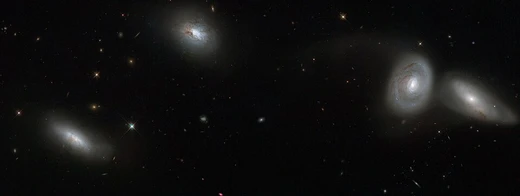
XMMXCS 2215−1738
One of the most distant galaxy clusters known, discovered in 2006.

XMMXCS 2215−1738 is a galaxy cluster discovered in 2006 by the XMM Cluster Survey. It lies 10 billion light-years away with a redshift of z=1.45, making it one of the most distant galaxy clusters known.
- Distance
- 10 billion light-years
- Redshift
- z=1.45
- Discovery year
- 2006
- Temperature of intergalactic gas
- 10 million degrees
- Estimated mass
- 500 trillion solar masses
- Mass source
- mostly dark matter
- Telescopes used
- XMM-Newton, Keck Telescopes, Hubble Space Telescope
Lore & Background
XMMXCS 2215−1738 was discovered and studied using the XMM-Newton and Keck Telescopes, with further imaging by the Hubble Space Telescope. It is embedded in intergalactic gas with a temperature of 10 million degrees. The cluster's estimated mass is 500 trillion solar masses, most coming from dark matter. It contains hundreds of reddish galaxies surrounded by X-ray-emitting gas. The cluster is surprisingly large and evolved for a cluster that existed when the universe was only 3 billion years old. Led by University of Sussex researchers, part of the XMM Cluster Survey (XCS) used the X-ray Multi Mirror (XMM) Newton satellite to find it and the Keck Telescope to determine its distance. There is a naming contradiction: the galaxy is called XMMXCS 2215−1734 in many references, with some news sources listing both names. The source of the contradiction is not known, though XMMXCS 2215−1738 seems to be the more accurate.
Reader's Guide
XMMXCS 2215−1738 is significant as one of the most distant galaxy clusters known, providing a glimpse into the early universe when it was only 3 billion years old. Its discovery by the XMM Cluster Survey in 2006 using the XMM-Newton satellite, with distance determination by the Keck Telescope and further imaging by the Hubble Space Telescope, demonstrates the power of multi-telescope collaboration. The cluster's surprisingly large and evolved state challenges expectations for such an early epoch, as its mass of 500 trillion solar masses—mostly dark matter—and its hot intergalactic gas at 10 million degrees indicate substantial structure formation. The naming discrepancy between XMMXCS 2215−1734 and XMMXCS 2215−1738, with the latter considered more accurate, highlights the occasional uncertainties in astronomical cataloging. Its legacy lies in advancing understanding of galaxy cluster evolution and the role of dark matter in the early cosmos.
Did You Know?
- The cluster's intergalactic gas has a temperature of 10 million degrees.
- There is a naming contradiction: it is also called XMMXCS 2215−1734 in many references.
Frequently Asked Questions
What is XMMXCS 2215−1738?
It is a galaxy cluster identified in 2006 as part of the XMM Cluster Survey. Because of its extreme distance, it ranks among the most remote galaxy clusters ever catalogued.
How far away is XMMXCS 2215−1738?
The cluster sits roughly 10 billion light-years from us, corresponding to a redshift of z = 1.45. That means we are seeing it as it existed when the universe was only a few billion years old.
How massive is XMMXCS 2215−1738?
Its total mass is estimated at about 500 trillion solar masses. The vast majority of that mass is dark matter rather than ordinary stars or gas.
How hot is the intergalactic gas in XMMXCS 2215−1738?
The diffuse gas filling the cluster reaches temperatures around 10 million degrees. At that energy, the gas emits strongly in X-rays, which is how the XMM Cluster Survey detected it.
Why is XMMXCS 2215−1738 important to galaxy-cluster studies?
Because it is one of the most distant clusters known, it lets astronomers examine how massive structures were already assembled in the early universe. Its properties help test models of dark-matter growth and cluster formation at high redshift.
More in Galaxy Clusters and Groups, Part 3 1-24
Spotted an error? Know more?
Reader corrections go straight into our review queue. Suggest an edit · How this site is sourced