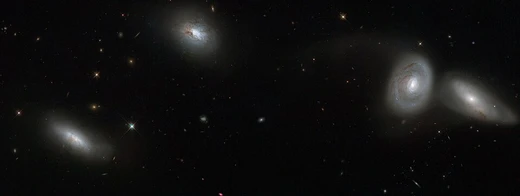
Supercluster
Superclusters are among the largest known structures in the universe.

A supercluster is a vast assembly of smaller galaxy clusters and groups, ranking among the largest known structures in the cosmos. Our own Milky Way belongs to the Local Group, which in turn lies within the Laniakea Supercluster, and this whole system is part of the even larger Pisces–Cetus Supercluster Complex. Because superclusters are so large and thinly spread, most of them—unlike individual clusters—are carried along by the overall expansion of the universe (the Hubble flow). Astronomers estimate that the observable universe contains about 10 million superclusters.
The existence of superclusters shows that galaxies are not spread evenly across space. Instead, they tend to clump together: groups contain up to a few dozen galaxies, clusters hold thousands, and these groups and clusters, along with isolated galaxies, merge into even larger formations called superclusters. The idea was first proposed by George Abell in his 1958 Abell catalogue of galaxy clusters, where he called them "second-order clusters" or clusters of clusters; they have also been described as extensions or concentrations. Superclusters themselves form colossal, web-like structures known as filaments, supercluster complexes, hyperclusters, chains, strands, superstructures, walls, or sheets. These can stretch from several hundred million light-years up to 10 billion light-years across, covering more than 5% of the observable universe—the largest structures ever identified. Studying superclusters offers clues about the universe's early conditions, when they were created. Researchers also examine the alignment of galaxy rotation axes within superclusters, which may reveal details about how galaxies first formed. Although superclusters are thought to be the largest structures consistent with the cosmological principle, even bigger formations—such as the Sloan Great Wall—have been spotted in surveys. At such enormous scales, it can be hard to tell whether these are genuine single structures or just multiple superclusters lined up by chance.
- Estimated number in observable universe
- 10 million
- Contains
- smaller galaxy clusters or galaxy groups
- Example nearby
- Laniakea Supercluster (contains Local Group and Milky Way)
- Larger containing structure
- Pisces–Cetus Supercluster Complex
- First postulated by
- George Abell
- Year of first postulation
- 1958
- Original name
- second-order clusters
Lore & Background
The existence of superclusters indicates that galaxies in the Universe are not uniformly distributed; most are clumped in groups and clusters, with groups containing up to some dozens of galaxies and clusters up to several thousand galaxies. Those groups and clusters and additional isolated galaxies form even larger structures called superclusters. Their existence was first postulated by George Abell in his 1958 Abell catalogue of galaxy clusters, where he called them 'second-order clusters', or clusters of clusters. They have also been called extensions or concentrations.
Superclusters form massive structures of galaxies called 'filaments', 'supercluster complexes', 'hyperclusters', 'chains', 'strands', 'superstructures', 'walls' or 'sheets', that may span between several hundred million light-years to 10 billion light-years, covering more than 5% of the observable universe. These are the largest structures known to date. Observations of superclusters can give information about the initial conditions of the universe, when these superclusters were created. The directions of the rotational axes of galaxies within superclusters are studied, potentially giving insight into the early formation process of galaxies.
Superclusters are supposed to be the largest structures in the Universe, following the cosmological principle, but even larger structures have been observed in surveys, including the Sloan Great Wall. At these large scales, it is difficult to distinguish these features from multiple superclusters in chance alignment, however.
Reader's Guide
Superclusters are significant because they represent a fundamental level of cosmic structure, demonstrating that galaxies are not uniformly distributed but instead clump into hierarchies of groups, clusters, and superclusters. Their existence was first formally recognized by George Abell in 1958, who catalogued them as 'second-order clusters'. The study of superclusters provides information about the initial conditions of the universe, as these structures were created early in cosmic history. By examining the rotational axes of galaxies within superclusters, researchers can gain insight into the early formation process of galaxies. Superclusters also form even larger structures—such as filaments, walls, and sheets—that can span up to 10 billion light-years and cover more than 5% of the observable universe, making them the largest known structures. However, at these immense scales, it can be difficult to distinguish true superclusters from chance alignments of multiple superclusters, as seen with the Sloan Great Wall. The estimated 10 million superclusters in the observable universe underscore their ubiquity and importance in understanding the large-scale structure and evolution of the cosmos.
Did You Know?
- The Milky Way is part of the Local Group, which is part of the Laniakea Supercluster, contained within the larger Pisces–Cetus Supercluster Complex.
- The number of superclusters in the observable universe is estimated to be 10 million.
From Excess to Entity: The Long Road to Recognition
The story of the Virgo Supercluster begins not with a telescope breakthrough but with a simple observation of unevenness. In 1863, William and John Herschel published the first large catalog of nebulae and noted a striking surplus of such objects clustered around the constellation Virgo, near the north galactic pole. For nearly a century, that surplus remained a curiosity rather than a confirmed structure. It was Gérard de Vaucouleurs who, in 1953, first argued the excess constituted a genuine large-scale galaxy arrangement, coining the phrase "Local Supergalaxy" before settling on "Local Supercluster" in 1958. Harlow Shapley offered an alternative label, "Metagalaxy," in his 1959 book Of Stars and Men. Yet the astronomical community remained divided through the 1960s and 1970s, with some researchers insisting the pattern was merely a chance alignment of unrelated galaxies. The debate finally settled when ambitious redshift surveys in the late 1970s and early 1980s revealed a clear flattened concentration of galaxies along the supergalactic plane, confirming the Virgo Supercluster as a real, coherent structure in the cosmic web.
A Flattened Disk, a Spherical Halo, and a Cosmic Thread
R. Brent Tully's 1982 analysis revealed the Virgo Supercluster's fundamental architecture: a two-part system comprising a distinctly flattened disk that holds roughly two-thirds of all luminous galaxies, and a more spherical halo containing the remaining third. The disk is remarkably thin—about one megaparsec in thickness—with an axis ratio stretching from at least 6:1 to possibly 9:1, giving it an elongated, pancake-like geometry. Data from the Two-degree-Field Galaxy Redshift Survey, released in 2003 after five years of observation, placed the Virgo Supercluster in context: it is a typical "poor" supercluster, lacking a dense central core, of rather modest size. At its heart sits one rich galaxy cluster, the Virgo Cluster, encircled by threads of galaxies and sparser groups. The Local Group, home to the Milky Way, sits on the outer rim, tucked into a small filament linking the Fornax and Virgo Clusters. The main body, called the Virgo Strand, splits into an upper branch running through the Virgo Southern Extension and Ursa Major Cluster, and a lower branch containing the Crater and Leo Clouds. Together these form part of the vast Centaurus–Virgo–Perseus–Pisces filament.
Galaxies in Clumps, Vast Voids Between
The distribution of galaxies within the Virgo Supercluster is far from uniform. The number density drops off in proportion to the square of the distance from the Virgo Cluster's center, indicating that this cluster occupies a privileged, non-random position. Ninety-eight percent of all luminous galaxies, defined as those brighter than absolute magnitude −13, are packed into just eleven named clouds, led by Canes Venatici, the Virgo Cluster itself, and the Virgo Southern Extension, followed by Leo II, Virgo III, Crater, Leo I, Leo Minor, Draco, Antlia, and NGC 5643. Within the disk, one-third of luminous galaxies reside in the Virgo Cluster while the other two-thirds scatter outside it. The halo is even more concentrated, with 94 percent of its luminous members confined to seven clouds. This clustering means that most of the supergalactic plane is, in the words of researchers, "a great void." A useful mental image is that of soap bubbles: flattened clusters sit at the intersections of enormous spherical voids, each 20 to 60 megaparsecs across, connected by long filamentary bridges. The nearest such neighbor is the Hydra–Centaurus Supercluster, beginning roughly 30 megaparsecs away and extending to 60.
A Thread in a Vast Tapestry: Laniakea and the Great Attractor
The Virgo Supercluster, while immense by local standards—spanning 45 megaparsecs and containing at least 100 galaxy groups and clusters—is just one of roughly ten million superclusters visible in the observable universe. It also forms part of the Pisces–Cetus Supercluster Complex, a massive galaxy filament that dwarfs it in scale. A pivotal 2014 study redefined our cosmic neighborhood by showing that the Virgo Supercluster is actually a component of a still larger structure called the Laniakea Supercluster, centered on the Great Attractor. Laniakea is defined not by high-density regions but by basins of gravitational attraction, a criterion that subsumes the Virgo and Hydra–Centaurus Superclusters, the Local Group, and several other structures into one entity. To avoid confusion with smaller, traditionally defined superclusters, researchers proposed calling such basin-based structures "supercluster cocoons." The gravitational pull associated with this larger structure manifests as a bulk flow of roughly 600 kilometers per second, first detected in the late 1980s and directed toward the Norma Cluster. Lynden-Bell and colleagues in 1988 named the responsible mass concentration the "Great Attractor," a designation that still anchors our understanding of the Virgo Supercluster's place in the grand gravitational architecture.
Frequently Asked Questions
What is a supercluster?
A supercluster is a colossal assembly of smaller galaxy clusters and groups, placing it among the largest recognized structures in the cosmos. It sits one level above individual clusters in the cosmic hierarchy of matter.
What does a supercluster actually contain?
Superclusters are built from smaller galaxy clusters and galaxy groups loosely gathered together. Our own Local Group, home to the Milky Way, lives inside the Laniakea Supercluster, which is itself nested within the far larger Pisces–Cetus Supercluster Complex.
How do superclusters behave on cosmic scales?
Because they are so vast and thinly distributed, most superclusters do not gravitationally hold their members in place the way a tight cluster does. Instead, they simply drift along with the overall expansion of the universe, a motion astronomers call the Hubble flow.
Who first proposed the idea of superclusters?
Astronomer George Abell first postulated the concept back in 1958. His pioneering work gave the field a framework for describing structure far larger than any single galaxy cluster.
How many superclusters are there in the observable universe?
Current estimates put the number at roughly ten million superclusters within the observable universe. That staggering count highlights just how richly structured the cosmos is on its largest scales.
More in Galaxy Clusters and Groups, Part 3 1-24
Spotted an error? Know more?
Reader corrections go straight into our review queue. Suggest an edit · How this site is sourced