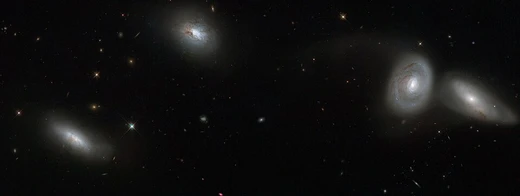
Horologium-Reticulum Supercluster
A massive supercluster comparable to Laniakea, spanning 550 million light-years.

The Horologium-Reticulum Supercluster is a massive supercluster spanning around 550 million light-years, with a mass of approximately 10^17 solar masses, similar to that of the Laniakea Supercluster which houses the Milky Way. It is centered on coordinates right ascension 03h 19m and declination −50° 02′, spanning an angular area of 12° × 12°, and is visible in the constellations Horologium and Eridanus. The nearest part of the supercluster is 700 million light-years away from Earth, while the far end is 1.2 billion light-years away.
Quick Facts
- Constellation
- Horologium and Eridanus
- Ra
- 03 · 19
- Dec
- -50 · 02
- Major Axis Mpc
- 169 Mpc
- Distance
- 291.4 Mpc
- Mass
- ~10 / 17
- Other Names
- Horologium-Reticulum Supercluster; MSCC 117
Facts from the source article.
Lore & Background
The first observation of the Horologium Supercluster was in 1899, and Harlow Shapley noticed it in 1935. The first attempt to study the supercluster after Shapley was in 1983. It includes the galaxy cluster Abell 3266. The Horologium-Reticulum Supercluster (SCL 48) contains approximately 35 galaxy clusters, making it one of the largest in the local universe and the second largest in the Main Supercluster Catalogue (MSCC). The galaxy clusters listed include Abell 3004, 3009, 3045, 3074, 3077, 3078, 3089, 3093, 3098, 3100, 3104, 3106, 3108, 3109, 3110, 3111, 3112, 3116, 3120, 3122, 3123, 3125, 3128, 3133, 3135, 3142, 3145, 3154, 3158, 3161, 3164, 3195, 3202, 3225, and 3266. However, another catalog suggests there are an additional 30 galaxy clusters, such as Abell 383.
Reader's Guide
The Horologium-Reticulum Supercluster is notable for its immense scale and mass, comparable to the Laniakea Supercluster that contains the Milky Way. Its discovery history spans from an initial observation in 1899 to Harlow Shapley's notice in 1935, with the first dedicated study after Shapley occurring in 1983. The supercluster contains about 5,000 galaxy groups, including 30,000 giant galaxies and 300,000 dwarf galaxies, and is listed as the second largest in the Main Supercluster Catalogue. Its membership includes approximately 35 galaxy clusters, though another catalog suggests up to 30 additional clusters, indicating some uncertainty in its exact composition. The supercluster's location in the constellations Horologium and Eridanus, and its inclusion of the well-known cluster Abell 3266, make it a significant structure for studying large-scale cosmic organization. Its angular extent of 12° × 12° and distance range from 700 million to 1.2 billion light-years provide a vast volume for cosmological research.
Did You Know?
- It spans an angular area of 12° × 12° in the sky.
- It was first observed in 1899 and later noticed by Harlow Shapley in 1935.
Scale and Physical Dimensions
The Horologium-Reticulum Supercluster stretches across roughly 550 million light-years, making it one of the most vast structures known in the nearby cosmos. Its total mass is estimated at approximately 10 to the 17th power solar masses, a figure that places it on par with the Laniakea Supercluster, the enormous structure that cradles our own Milky Way galaxy. Centered at right ascension 03h 19m and declination minus 50 degrees 02 minutes, the supercluster occupies an angular footprint of 12 degrees by 12 degrees on the celestial sphere. From Earth's vantage point, the nearest reaches of this structure sit about 700 million light-years away, while the farthest extents recede to roughly 1.2 billion light-years. This enormous depth means that light from the most distant portions has been traveling for over a billion years before reaching our telescopes. The supercluster is visible against the backdrop of the constellations Horologium and Eridanus, anchoring its identity firmly in the southern sky.
Galactic Composition and Cluster Membership
Within the Horologium-Reticulum Supercluster, astronomers have identified approximately 5,000 distinct galaxy groups. These groups collectively house an estimated 30,000 giant galaxies alongside roughly 300,000 dwarf galaxies, painting a picture of a structure dominated by smaller systems orbiting within larger gravitational frameworks. The supercluster contains around 35 recognized galaxy clusters, earning it a place among the largest structures in the local universe and the second-largest entry in the Main Supercluster Catalogue. Its membership roster includes well-known Abell clusters such as Abell 3004, 3074, 3100, 3128, 3195, and 3266, among many others spanning the Abell 3000 and 3100 series. Interestingly, an alternative catalog proposes the existence of approximately 30 additional galaxy clusters within the supercluster's boundaries, including Abell 383, suggesting that the true extent of its galactic membership may be even greater than currently confirmed in the primary listings.
Discovery and the Long Gap in Study
The story of the Horologium-Reticulum Supercluster's discovery spans nearly a century of astronomical progress. The first recorded observation of this structure dates back to 1899, though it remained largely uncharacterized for decades afterward. In 1935, the renowned astronomer Harlow Shapley drew attention to the supercluster, marking a significant milestone in recognizing it as a coherent large-scale structure. However, after Shapley's work, the supercluster fell into relative obscurity for nearly five decades. It was not until 1983 that the first serious attempt to study the supercluster in detail was undertaken, more than forty years after Shapley's observation. This long gap between Shapley's 1935 identification and the 1983 study highlights how challenging it was to map and characterize structures of this scale with the observational tools available in the mid-twentieth century. The supercluster's immense distance, ranging from 700 million to 1.2 billion light-years, compounded the difficulty of assembling a complete picture of its internal structure.
Standing Among the Largest Cosmic Structures
The Horologium-Reticulum Supercluster occupies a distinguished place in the hierarchy of known cosmic structures. With a mass of approximately 10 to the 17th power solar masses, it rivals the Laniakea Supercluster in sheer gravitational heft, yet it exists far beyond Laniakea's boundaries, centered in the southern constellations of Horologium and Eridanus. Its designation as SCL 48 in the supercluster catalog reflects its formal recognition among the largest structures in the local universe. As the second-largest entry in the Main Supercluster Catalogue, it stands just behind only one other structure in that particular ranking. The supercluster's membership of roughly 35 galaxy clusters, along with the possibility of an additional 30 clusters identified in alternative catalogs, underscores its status as a gravitational powerhouse. Its position in the broader large-scale structure of the universe makes it a critical reference point for cosmologists studying how matter clumps into filaments, walls, and voids across billions of light-years.
Frequently Asked Questions
What is the Horologium-Reticulum Supercluster?
It is one of the largest known cosmic structures, a supercluster of galaxies roughly as massive as Laniakea, the supercluster that contains the Milky Way. Its total mass is estimated at around 10 to the 17th power solar masses, and it stretches across roughly 550 million light-years.
How far is the Horologium-Reticulum Supercluster from Earth?
The closest edge of the supercluster sits about 700 million light-years away, while the most distant regions extend out to roughly 1.2 billion light-years. That means the light we observe from the far side left its source more than a billion years ago.
How many galaxy groups does the Horologium-Reticulum Supercluster contain?
Astronomers estimate that around 5,000 individual galaxy groups and clusters make up this supercluster. It spans an angular area of about 12 degrees by 12 degrees on the sky, centered near right ascension 03h 19m and declination −50° 02′.
Which constellations does the Horologium-Reticulum Supercluster appear in?
It is visible against the dark skies of the southern constellations Horologium and Eridanus. Because of its enormous depth—nearly 500 million light-years from near to far end—it occupies a large patch of the southern celestial sphere.
How does the Horologium-Reticulum Supercluster compare to Laniakea?
The two superclusters are remarkably similar in scale, both spanning roughly 550 million light-years and carrying a mass on the order of 10^17 solar masses. Laniakea is the supercluster that contains our Milky Way, while Horologium-Reticulum lies much farther out, beginning at 700 million light-years.
More in Galaxy Clusters and Groups, Part 3 1-24
Spotted an error? Know more?
Reader corrections go straight into our review queue. Suggest an edit · How this site is sourced