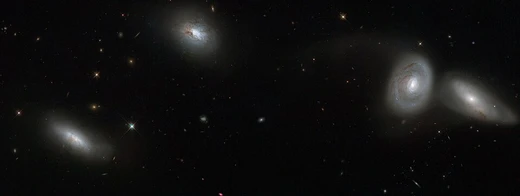
Abell catalogue
All-sky catalog of 4,073 rich galaxy clusters.

The Abell catalogue lists 4,073 rich galaxy clusters across the entire sky, all with a nominal redshift of z ≤ 0.2. It expands on George O. Abell’s original 1958 “Northern Survey” of 2,712 clusters by adding 1,361 clusters from the 1989 “Southern Survey,” published after Abell’s death by Harold G. Corwin and Ronald P. Olowin to cover the southern celestial hemisphere omitted earlier. Amateur astronomers with large telescopes in dark locations often view these clusters as challenging targets. The catalogue includes a morphological classification called “Abell Type,” based on visual inspection of photographic plates. Types are: - **I (Irregular):** No well-defined center or symmetry; uneven, clumpy galaxy distributions. - **R (Regular):** Relatively symmetric and centrally concentrated. - **IR / RI (Intermediate):** Features between irregular and regular. A colon (:) indicates a mean type from estimates differing by two steps, or an uncertain determination. A question mark (?) indicates a mean type from estimates differing by three steps, or a particularly questionable classification. **The Northern Survey** Abell compiled the original 2,712 clusters as part of his PhD thesis at the California Institute of Technology, published in 1958. He visually inspected red 103a-E plates from the Palomar Observatory Sky Survey (POSS), for which he was a principal observer. A. G. Wilson, another principal observer, helped by routinely inspecting plates as they were produced; Abell later re-examined them in detail with a 3.5× magnifying lens. To qualify, a cluster had to meet four criteria: - **Richness:** At least 50 members within a magnitude range from m3 (the 3rd-brightest member) to m3+2. This was not strictly enforced; many clusters with fewer than 50 members were included (though excluded from Abell’s statistical study). Clusters were divided into six richness groups based on the number of galaxies in that magnitude range (average per cluster: 64): - Group 0: 30–49 galaxies - Group 1: 50–79 - Group 2: 80–129 - Group 3: 130–199 - Group 4: 200–299 - Group 5: more than 299 - **Compactness:** The cluster’s 50 or more members must lie within one “counting radius” (the Abell radius) of the center. This radius is defined as 1.72/z arcminutes (where z is redshift) or 1.5h⁻¹ Mpc (with H₀ = 100 km s⁻¹ Mpc⁻¹ and h typically 0.5–1).
- Southern survey clusters
- 1361
Lore & Background
The original catalog of 2,712 rich clusters was published in 1958 by George O. Abell, then studying at the California Institute of Technology, as part of his PhD thesis. It was prepared by visual inspection of the red 103a-E plates of the Palomar Observatory Sky Survey (POSS), for which Abell was one of the principal observers. A. G. Wilson assisted in initial plate inspections. To qualify, a cluster had to meet criteria for richness (minimum 50 members within a magnitude range), compactness (members within the 'Abell radius'), distance (nominal redshift 0.02 to 0.2), and galactic latitude (excluding areas near the Milky Way). The catalog listed clusters in order of right ascension, with coordinates for equinox 1855 and galactic coordinates for 1900. The Southern Survey added 1,361 clusters from the south celestial hemisphere omitted from the original catalog. It used deep IIIa-J plates of the Southern Sky Survey (SSS) taken with the UK's 1.2-metre Schmidt Telescope at Siding Spring Observatory, Australia, in the 1970s. Abell began the survey in 1976 during a sabbatical in Edinburgh, enlisting Harold G. Corwin, who worked until 1981. After Abell's death in 1983, Ronald P. Olowin completed the catalog, published in 1989. The Southern Survey retained the original criteria and classification system, with numbers running from 2713 to 4076, and contains three duplicate entries.
Reader's Guide
The Abell catalogue's significance lies in its comprehensive all-sky coverage of rich galaxy clusters, achieved by supplementing the original Northern Survey with the Southern Survey. The morphological 'Abell Type' classification—Irregular, Regular, and Intermediate—provides a descriptive measure of cluster structure based on visual inspection of photographic plates, with additional notation for uncertainty. The catalog's richness and distance groups offer quantitative parameters for studying cluster populations and distances. For amateur astronomers, Abell clusters are considered challenge objects viewable in dark locations with large aperture telescopes. The catalog's legacy includes its continued use as a reference, with the preferred format among professional astronomers being 'ACO' followed by the number. The inclusion of a supplementary catalog of 1,174 clusters from the Southern Survey that were not rich enough or too distant further extends its utility.
Did You Know?
- The Abell catalog contains three duplicate entries: A3208 = A3207, A3833 = A3832, and A3897 = A2462.
- The Abell radius is defined as 1.72/z arcminutes, where z is the cluster's redshift, or as 1.5h−1 Mpc.
- The Southern Survey used deep IIIa-J plates from the UK's 1.2-metre Schmidt Telescope at Siding Spring Observatory, Australia.
Origins and Method of the Northern Survey
George O. Abell compiled his landmark catalog of rich galaxy clusters as part of his doctoral work at the California Institute of Technology, publishing the result in 1958. The entire survey was built on a painstaking visual examination of the red 103a-E photographic plates from the Palomar Observatory Sky Survey, for which Abell served as one of the principal observers. During the initial phase, fellow observer A. G. Wilson helped by routinely checking the plates as they were freshly produced. Once that pass was complete, Abell returned to the full set of plates for a more thorough second inspection. In both rounds he worked with nothing more sophisticated than a 3.5× magnifying lens, relying on his trained eye to identify and count galaxy members across vast stretches of the northern sky. The resulting catalog listed 2,712 clusters ordered by increasing right ascension, with coordinates referenced to the equinox of 1855 and galactic coordinates for 1900. Each entry also recorded the cluster's precession rate, the magnitude of its tenth-brightest member, and its assigned richness and distance groups.
Selection Criteria and the Abell Radius
Abell established four criteria that a candidate grouping of galaxies had to satisfy before earning a place in his catalog. First, richness demanded at least fifty member galaxies within a magnitude window of m3 to m3+2, though Abell applied this threshold flexibly and many entries in the final list fell short of that number. He organized clusters into six richness groups ranging from 30–49 members up to more than 299, with a catalog-wide average of 64 galaxies per cluster. Second, compactness required that those members fit within a single counting radius centered on the cluster, a distance now called the Abell radius, defined as 1.72/z arcminutes or 1.5h⁻¹ Mpc. Third, distance was constrained by a nominal redshift between 0.02 and 0.2, which Abell translated into seven distance groups based on the apparent magnitude of the tenth-brightest member, spanning from 13.3 to above 18.0. Fourth, regions near the Milky Way's dense star fields were generally excluded because interstellar obscuration made reliable identification difficult, though a few clusters near the Galactic Plane were retained where Abell was confident of their genuineness.
Abell Type Morphological Classification
Beyond numerical parameters, Abell introduced a qualitative morphological system—now known as the Abell Type—to describe the visual character of each cluster. Based on careful inspection of photographic plates, he assigned one of three primary designations. Type I, or Irregular, covered clusters that lacked a clear central concentration or overall symmetry, often displaying clumpy, uneven distributions of member galaxies. Type R, or Regular, described clusters with a comparatively symmetric, centrally concentrated appearance. Type IR or RI, the Intermediate category, captured those clusters that showed a blend of both irregular and regular traits, sitting between the two extremes. To flag uncertainty or disagreement among observers, Abell appended special symbols: a colon indicated a mean type derived from estimates that differed by two classification steps, while a question mark signalled a particularly questionable determination where estimates diverged by three steps. This morphological label complemented the catalog's quantitative richness and distance parameters, giving astronomers a quick descriptive snapshot of each cluster's structural character.
Southern Survey and Enduring Legacy
The original 1958 catalog was confined to declinations north of –27°, the southern boundary of the Palomar plates Abell had used. To close that gap, co-authors Harold G. Corwin and Ronald P. Olowin compiled a Southern Survey covering the previously omitted portions of the south celestial hemisphere. Published in 1989—six years after Abell's death in 1983—this supplement added 1,361 additional rich clusters, bringing the combined all-sky catalog to a total of 4,073 entries with nominal redshifts up to 0.2. The Southern Survey thus completed what had been a northern-hemisphere-only effort into a truly comprehensive sky-wide resource. Beyond professional astronomy, the Abell catalog has found a devoted following among amateur observers. Many of its clusters serve as challenging deep-sky targets, rewarding patient observers who use large-aperture telescopes from dark-sky locations to resolve the individual galaxies that make up these vast groupings. The catalog's enduring utility, spanning from Abell's original plate work to modern observational programs, testifies to the lasting value of his meticulous visual survey.
Frequently Asked Questions
What is the Abell catalogue?
It is an all-sky reference listing 4,073 rich galaxy clusters, each with a nominal redshift of z ≤ 0.2. The catalogue serves as the standard catalogue for identifying and studying rich clusters across both celestial hemispheres.
Who put together the Abell catalogue?
George O. Abell started the project with his 1958 Northern Survey of 2,712 clusters. After Abell passed away, Harold G. Corwin and Ronald P. Olowin published the 1989 Southern Survey, adding 1,361 clusters from the southern sky to complete the all-sky version.
Why do amateur astronomers care about Abell clusters?
These rich clusters are regarded as demanding deep-sky targets that usually need a large aperture and truly dark skies to resolve individual member galaxies. Many backyard observers with 14-inch or larger scopes treat them as a rite-of-passage challenge.
What does an 'Abell Type' classification mean?
It is a morphological label assigned to each cluster based on a visual inspection of its overall appearance and internal structure. The type helps observers and researchers quickly gauge how rich, compact, or diffuse a given cluster looks.
How did the catalogue go from northern-only to all-sky?
Abell's original 1958 work could only survey the northern hemisphere visible from his observatory. The 1989 Southern Survey filled that gap by cataloguing 1,361 additional clusters in the southern sky, bringing the combined total to 4,073 and making the catalogue truly all-sky.
More in Galaxy Clusters and Groups, Part 3 1-24
Spotted an error? Know more?
Reader corrections go straight into our review queue. Suggest an edit · How this site is sourced