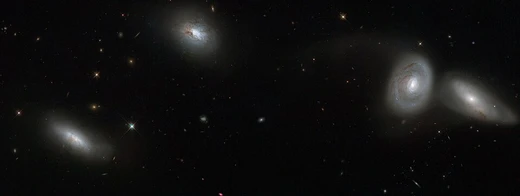
Coma Supercluster
A nearby supercluster containing the Coma and Leo Clusters.

The Coma Supercluster (SCl 117) is a large, nearby grouping of galaxies, home to both the Coma Cluster (Abell 1656) and the Leo Cluster (Abell 1367), both of which shine brightly in X-rays. Situated about 300 million light-years away in the constellation Coma Berenices, it sits at the heart of the Great Wall and forms part of the Coma Filament. Roughly spherical in shape, it spans around 98 million light-years across and contains over 3,000 galaxies. While astronomers had recognized the Coma Cluster itself since around 1900, the supercluster’s existence wasn’t confirmed until later, largely because the Coma and Leo Clusters are separated by about 21 megaparsecs and 20 degrees on the sky. In 1977, detailed analysis of redshifts from hundreds of galaxies proved they belonged to a single, larger structure. This made it one of the first superclusters ever identified, helping scientists grasp the universe’s large-scale layout.
The supercluster’s galaxies fall into three groups: those packed into the dense cores of the two main clusters, those in smaller, low-mass groups, and a few scattered, isolated galaxies. Its dominant feature is four distinct chains of clusters, each roughly 80 megaparsecs long, with relatively empty voids between them.
In the cluster cores, galaxies are densely packed and move at high speeds—around 1,000 km/s in Abell 1656 and slightly slower in Abell 1367. These are mostly elliptical or lenticular galaxies, likely shaped by mergers or tidal stripping. In contrast, galaxies in low-mass groups are usually spirals with lower velocity dispersions, about 300 km/s. These groups are less dense and loosely bound, making them candidates for future absorption into one of the main clusters. Isolated galaxies, the least dense and most spread out, are also mostly spirals, indicating ongoing star formation.
The supercluster’s kinematics show multiple redshift peaks, suggesting it hasn’t yet settled into a gravitationally relaxed state. Instead, many galaxy groups retain their own speeds, implying they haven’t fully merged into the supercluster—though they are expected to do so eventually. This is backed by the overall inward motion of galaxies toward the cluster core.
Quick Facts
- Constellation
- Coma Berenices
- Ra
- 12h 24m 06.8s
- Dec
- +23d 55m 23s
- Redshift
- 0.023
- Distance
- 92 Mpc
- Epoch
- J2000
Facts from the source article.
Lore & Background
Although the extent of the Coma Cluster has been understood since around 1900, it took several decades for the existence of the supercluster to be discovered. This was due to the very large physical separation (around 21 Mpc) and angular separation (around 20°) between the Coma and Leo Clusters. In 1977, further analysis of the redshifts of hundreds of galaxies within the supercluster confirmed that these were all part of a larger group of clusters.
The Coma Supercluster contains three distinct populations of galaxies: galaxies in the cores of the two main clusters (Coma and Leo), galaxies in low mass groups, and a few isolated galaxies. The dominant structure of the supercluster is four distinct chains of clusters, each one roughly 80 Mpc long. Between each cluster chain is a relatively empty region of space. Galaxies found at the cores of clusters are high in density and have a high velocity dispersion: around 1000 km/s in Abell 1656, and slightly lower than this in Abell 1367. These galaxies tend to be either elliptical or lenticular galaxies, suggesting that they have undergone mergers or tidal stripping.
Galaxies in low mass groups are usually spiral galaxies with lower velocity dispersions, around 300 km/s. These are less dense and more loosely bound, which opens the door for possible future accretion into one of the main clusters. Isolated galaxies have the lowest density and are widely spread out; they are mostly spiral galaxies, suggesting ongoing star formation.
Reader's Guide
The Coma Supercluster is significant as one of the first superclusters to be discovered, helping astronomers understand the large-scale structure of the universe. Its discovery in 1977, through redshift analysis of hundreds of galaxies, confirmed that the Coma and Leo Clusters, despite their large physical and angular separation, belong to a larger group. The supercluster's kinematics show multiple peaks in the redshift distribution, indicating the system is not gravitationally relaxed; many galaxy groups maintain their own individual velocities, implying they have not yet fully merged into the supercluster but are expected to eventually. This is supported by the general motion of the galaxies moving inwards towards the core of the cluster. The supercluster's composition—with core populations of elliptical and lenticular galaxies, low-mass groups of spirals, and isolated spirals—provides insight into galaxy evolution and cluster dynamics. Its location in the center of the Great Wall and part of the Coma Filament further underscores its role in mapping cosmic structure.
Did You Know?
- The Coma Supercluster is roughly spherical and about 98 mega light-years in diameter.
- It contains more than 3,000 galaxies.
- The Coma and Leo Clusters are separated by about 21 Mpc and an angular separation of about 20°.
- The supercluster's existence was confirmed in 1977 through redshift analysis of hundreds of galaxies.
The Long Road to Recognition
The Coma Supercluster, catalogued as SCl 117, sits roughly 300 million light-years away in the direction of Coma Berenices. While astronomers had grasped the basic extent of the Coma Cluster by around 1900, piecing together the full supercluster proved far more elusive. The two principal members—the Coma Cluster (Abell 1656) and the Leo Cluster (Abell 1367)—are separated by a staggering physical distance of about 21 megaparsecs and an angular gap of roughly 20 degrees on the sky. That vast apparent separation made it extraordinarily difficult to recognize them as components of a single larger structure. It was not until 1977 that a deeper statistical analysis of redshifts across hundreds of galaxies within the region confirmed that these clusters, along with many others, belonged to one coherent supercluster. Despite the late formal identification, the Coma Supercluster ranks among the earliest superclusters ever recognized, and its discovery played a pivotal role in helping astronomers build a coherent picture of the universe's large-scale architecture.
Three Populations, Four Chains
The internal architecture of the Coma Supercluster is far from uniform. Its more than 3,000 galaxies fall into three clearly distinct populations. At the densest cores of the Coma and Leo Clusters, galaxies are packed tightly together and exhibit velocity dispersions near 1,000 km/s in Abell 1656, with slightly lower values in Abell 1367. These core residents are predominantly elliptical or lenticular types, signatures of past mergers and tidal stripping that removed their outer disk material. A second population lives in lower-mass groups, where spiral galaxies drift with velocity dispersions closer to 300 km/s. These groups are sparser and more loosely bound, leaving them vulnerable to eventual gravitational capture by one of the two dominant clusters. The third and most diffuse population consists of isolated spiral galaxies scattered widely through space, still actively forming stars. The overall skeleton of the supercluster is organized into four elongated chains of clusters, each stretching roughly 80 megaparsecs, with comparatively empty voids separating them.
A System Still in Motion
The Coma Supercluster is not a settled, static structure. Redshift surveys of its member galaxies reveal multiple distinct peaks in the velocity distribution, a hallmark of a system that has not yet reached gravitational equilibrium. In a fully relaxed cluster, one would expect a single smooth distribution of velocities centered on the mean. Instead, the multiple peaks indicate that many galaxy groups still carry their own inherited velocities from earlier epochs, meaning they have not yet fully merged into the supercluster's gravitational potential. The broader kinematic picture reinforces this interpretation: the general trend of motion across the system is an inward drift toward the central core, consistent with ongoing gravitational collapse and accretion. The low-mass groups and isolated spirals, in particular, are expected to be gradually drawn into the denser cores over cosmic time. In essence, the Coma Supercluster is a structure caught mid-assembly, still knitting its constituent pieces together under the slow pull of gravity.
A Spherical Anchor in the Great Wall
Positioned at the heart of the Great Wall and embedded within the Coma Filament, the Coma Supercluster occupies a central role in the local large-scale structure of the universe. Its overall shape is approximately spherical, spanning a diameter of about 98 megaparsecs, and it harbors more than 3,000 galaxies in total. The two anchor clusters, Abell 1656 (Coma) and Abell 1367 (Leo), are both classified as X-ray luminous, indicating intense hot intracluster gas and vigorous gravitational interaction among their members. From Earth, the supercluster lies approximately 300 million light-years distant, projected against the constellation Coma Berenices. Because of its relative proximity compared to many other superclusters, its roughly symmetric geometry, and the wealth of observable member galaxies, it has served as a particularly valuable laboratory for studying how clusters, groups, and filaments interconnect. Its identification in the late 1970s provided one of the earliest concrete examples of supercluster-scale organization, helping to cement the concept that the universe's matter is distributed in a cosmic web of filaments, walls, and voids rather than in isolated clumps.
Frequently Asked Questions
What is the Coma Supercluster?
It is a massive, roughly spherical assembly of galaxies cataloged as SCl 117, sitting at the core of the Great Wall structure. As one of the closest major superclusters to the Milky Way, it is a key reference point for studying large-scale cosmic architecture.
How large is the Coma Supercluster?
It spans roughly 98 million light-years in diameter and holds more than 3,000 galaxies within a single coherent grouping. That makes it one of the most voluminous structures in our immediate cosmic neighborhood.
Which famous galaxy clusters are inside the Coma Supercluster?
The Coma Cluster (Abell 1656) and the Leo Cluster (Abell 1367) serve as its two brightest anchors, both emitting strongly in X-ray wavelengths. These two clusters dominate the supercluster's luminosity and are among the most studied rich groups in the sky.
Where can I find the Coma Supercluster in the sky?
It lies in the direction of the constellation Coma Berenices, about 300 million light-years from the Solar System. Because of that distance, it is far beyond naked-eye visibility and is studied primarily through deep imaging and X-ray observations.
When was the Coma Supercluster first confirmed as a real structure?
The Coma Cluster itself had been recognized since around 1900, but the broader supercluster was not formally established as a distinct entity until 1977. That confirmation came as astronomers began mapping the three-dimensional distribution of galaxies beyond individual clusters.
More in Galaxy Clusters and Groups, Part 3 1-24
Spotted an error? Know more?
Reader corrections go straight into our review queue. Suggest an edit · How this site is sourced