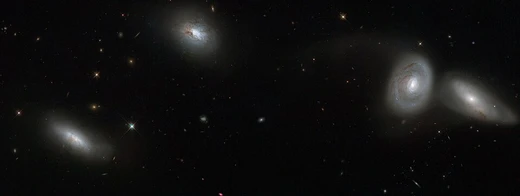
Laniakea Supercluster
Home supercluster of the Milky Way and 100,000 nearby galaxies.

The Laniakea Supercluster, whose name comes from Hawaiian and means "immense heaven" or "open skies," is a vast cosmic structure centered on the Great Attractor. It contains the Milky Way and roughly 100,000 other galaxies. Astronomers first defined it in September 2014, using a new method that groups galaxies into superclusters based on their relative velocities, treating them as basins of attraction. This redefinition absorbed the previously known Virgo and Hydra-Centaurus Superclusters as parts of Laniakea, with the Virgo Supercluster being the historical local supercluster.
Later studies indicate that Laniakea is not gravitationally bound and will eventually disperse rather than persist as a dense region. Some researchers prefer the traditional definition of superclusters as high-density areas of the cosmic web, suggesting that basins of attraction like Laniakea should be called "supercluster cocoons" (or simply "cocoons"). These cocoons contain smaller, traditional superclusters that evolve inside them.
Laniakea is the inner part of a larger structure known as the Pisces–Cetus Supercluster Complex, both among the largest known cosmic structures. Recent observations of basins of attraction suggest that a basin around the Ophiuchus Cluster may be linked to Laniakea, and that both are moving toward the Shapley Concentration, possibly forming part of an even greater structure.
The name *laniākea* was suggested by Nawaʻa Napoleon, an associate professor of Hawaiian language at Kapiʻolani Community College. It honors Polynesian navigators, who used their knowledge of the sky to cross the Pacific Ocean.
Laniakea spans about 120 megaparsecs (400 million light-years) and contains roughly 100,000 galaxies. Its mass is around 10¹⁷ solar masses, or 100,000 times that of the Milky Way, similar to the Horologium Supercluster.
Quick Facts
- Epoch
- J2000
- Constellation
- Triangulum Australe and Norma / (Great Attractor)
- Ra
- 10 · 32 / (Great Attractor)
- Dec
- -46 · 00 / (Great Attractor)
- Parent
- Pisces–Cetus Supercluster Complex (Shapley Concentration?)
- Redshift
- 0.0708 (center)
- Distance
- 250 e6ly 67.80 ± 0.077 / (Great Attractor) / (H / 0 / from Planck 2013)
Facts from the source article.
Lore & Background
The Laniakea Supercluster encompasses approximately 100,000 galaxies stretched out roughly 120 Mpc (400 million ly) and has an approximate mass of 10^17 solar masses, almost the same as that of the Horologium Supercluster. It consists of several previously defined subparts, including the Virgo Supercluster (where the Local Group and Milky Way reside), the Hydra–Centaurus Supercluster, the Antlia Wall, the Southern Supercluster Strand, the Ophiuchus Supercluster, the Norma Wall, and the Pavo–Indus Supercluster. The most massive galaxy clusters within Laniakea include Virgo, Hydra, Centaurus, Fornax, Eridanus, Ophiuchus, and Norma. The entire supercluster cocoon consists of approximately 300 to 500 known galaxy clusters and groups, though the real number may be much larger due to the Zone of Avoidance.
Follow-up studies suggest that Laniakea is not gravitationally bound and will disperse rather than continue to maintain itself as an overdensity relative to surrounding areas. Some papers favored the traditional definition of superclusters as high-density regions, proposing that basins of attraction including Laniakea be called 'supercluster cocoons' (or 'cocoons'), containing smaller traditional superclusters that evolve inside their parent cocoon. Because there is no community consensus on an agreed definition of the term supercluster, other studies avoid calling any structure a supercluster, including Laniakea and Shapley, referring to them simply as basins of attraction.
Although confirmation of Laniakea's existence emerged in 2014, early studies in the 1980s already suggested that several then-known superclusters might be connected. South African astronomer Tony Fairall stated in 1988 that redshifts suggested the Virgo and Hydra–Centaurus superclusters may be connected, with some studies considering them a single structural entity called the Virgo–Hydra–Centaurus Supercluster. More recent observations using the Cosmicflows-4 catalog have shown that a basin of attraction centered on the Ophiuchus Cluster might be associated with Laniakea, forming a 'probabilistic Basin of Attraction' (p-BoA).
Reader's Guide
The Laniakea Supercluster is significant as the large-scale structure that contains the Milky Way and roughly 100,000 other galaxies, centered on the Great Attractor. Its definition in September 2014 introduced a new method for defining superclusters based on the relative velocities of galaxies as basins of attraction, rather than solely on high-density regions. This redefinition subsumed the previously defined Virgo and Hydra–Centaurus Superclusters as appendages. However, follow-up studies have disputed whether Laniakea qualifies as a supercluster in the traditional sense, since it is not gravitationally bound and is projected to be torn apart by dark energy. Some researchers have proposed calling such basins of attraction 'supercluster cocoons' to distinguish them from traditional, bound superclusters. The lack of community consensus on the definition of 'supercluster' means that some studies avoid the term entirely for Laniakea and similar structures. Laniakea is also a constituent part of the larger Pisces–Cetus Supercluster Complex, and latest observations suggest it and the Apus and Coma superclusters are moving toward the Shapley Concentration, possibly being part of that greater structure. The name, suggested by Nawaʻa Napoleon, honors Polynesian navigators who used knowledge of the sky to navigate the Pacific Ocean.
Did You Know?
- The supercluster cocoon contains approximately 300 to 500 known galaxy clusters and groups, though many may be hidden by the Zone of Avoidance.
- The Great Attractor is the central gravitational point of Laniakea, influencing the motions of the Local Group and all other galaxies throughout the supercluster.
The 2014 Redefinition
In September 2014, a collaborative team of astronomers fundamentally reshaped how we understand the cosmic neighborhood of the Milky Way. R. Brent Tully from the University of Hawaiʻi at Mānoa, Hélène Courtois at the University of Lyon, Yehuda Hoffman at the Hebrew University of Jerusalem, and Daniel Pomarède at CEA Université Paris-Saclay published a framework that redefined superclusters not as dense clumps of galaxies but as gravitational basins of attraction—regions where the relative velocities of galaxies flow inward toward a common center. This approach absorbed the previously separate Virgo and Hydra-Centaurus superclusters into a single, larger entity. The idea was not entirely new; as early as 1988, South African astronomer Tony Fairall had noted that redshift data hinted the Virgo and Hydra-Centaurus structures might be linked. More recent work using the Cosmicflows-4 catalog has even suggested a probabilistic basin of attraction around the Ophiuchus Cluster could belong to this same gravitational domain, further expanding its reach.
Architecture of a Cosmic Neighborhood
Laniakea stretches roughly 120 megaparsecs—about 400 million light-years—and cradles approximately 100,000 galaxies within its gravitational reach. Its total mass sits near 10 to the 17th power solar masses, making it roughly 100,000 times heavier than the Milky Way and comparable to the Horologium Supercluster. The structure is not monolithic; it is assembled from numerous previously catalogued subcomponents. These include the Virgo Supercluster (home to the Virgo Cluster and our Local Group), the Hydra-Centaurus Supercluster, the Centaurus Wall, the Antlia Wall, the Southern Supercluster Strand or Fornax Wall, the Ophiuchus Supercluster, the Norma Wall, and the Pavo-Indus Supercluster. The Great Attractor, a gravitational focal point near Norma, pulls the motions of the Local Group and surrounding galaxies inward. Bounding voids such as the Local Void and Sculptor Void mark its outer edges. In total, the structure contains an estimated 300 to 500 known galaxy clusters and groups, though the true count is likely higher because the Zone of Avoidance—a band of sky obscured by Milky Way dust—hides many from detection.
A Structure Without a Future
Despite its vast scale, Laniakea is not a gravitationally bound system. Unlike the smaller, denser superclusters nested within it—which are expected to eventually collapse under their own gravity—the larger basin of attraction is projected to disperse over time, its cohesion undone by the accelerating expansion driven by dark energy. This distinction has fueled an ongoing terminological debate within the astronomical community. Some researchers prefer the traditional view of superclusters as high-density knots in the cosmic web and have proposed calling structures like Laniakea "supercluster cocoons" or "watershed superclusters," with the smaller dense superclusters evolving inside their parent cocoon. Others, finding no consensus on what the word "supercluster" should mean, simply refer to these regions as basins of attraction. Laniakea's broader context adds further complexity: it sits inside the Pisces-Cetus Supercluster Complex, and both it and neighboring structures such as Apus and Coma appear to be drifting toward the Shapley Concentration, hinting that Laniakea may itself be a sub-basin of an even larger gravitational domain.
A Name from the Open Sky
The name Laniākea carries a linguistic and cultural weight that reaches far beyond astrophysics. In Hawaiian, the word is a compound of lani, meaning "heaven," and ākea, meaning "spacious" or "immeasurable," together evoking the idea of an immense, boundless sky. The pronunciation follows Hawaiian phonology, rendered approximately as "LAH-nee-ah-KEH-ah." The name was proposed by Nawaʻa Napoleon, an associate professor of Hawaiian language at Kapiʻolani Community College, and it was chosen deliberately to honor the legacy of Polynesian navigators. Those ancient wayfinders crossed the vast Pacific Ocean not with instruments but with an intimate, generational knowledge of the stars, ocean swells, and celestial patterns. By giving the structure that contains our own galaxy this name, the astronomical community linked a modern cosmological discovery to a tradition of reading the sky as a map—a tradition that, in its own way, spanned the same immense distances that Laniakea spans in the present universe.
Frequently Asked Questions
What is the Laniakea Supercluster?
It is the massive gravitational structure that serves as the Milky Way's home supercluster, holding roughly 100,000 galaxies within its basin of attraction. Astronomers formally delineated it in September 2014 by mapping galaxies' relative velocities rather than relying on older positional boundaries.
What does the name Laniakea mean?
The name is drawn from Hawaiian and translates to 'immense heaven' or 'open skies.' It was selected to capture the sheer, boundless scale of the structure it describes.
How big is the Laniakea Supercluster?
It spans roughly 120 megaparsecs, or about 400 million light-years, and carries a total mass on the order of 10¹⁷ solar masses. That makes it one of the largest gravitationally coherent regions we have charted.
What sits at the gravitational center of Laniakea?
The Great Attractor acts as the supercluster's central gravitational anchor, drawing surrounding galaxies inward over cosmic time. It marks the deepest point in Laniakea's basin of attraction.
What happened to the Virgo Supercluster when Laniakea was defined?
The 2014 redefinition folded the old Virgo Supercluster and the Hydra-Centaurus Supercluster in as sub-regions of the larger Laniakea structure. The Virgo Supercluster is still cited historically as our former 'local' supercluster, but it no longer stands as a separate entity in the updated taxonomy.
More in Galaxy Clusters and Groups, Part 3 1-24
Spotted an error? Know more?
Reader corrections go straight into our review queue. Suggest an edit · How this site is sourced