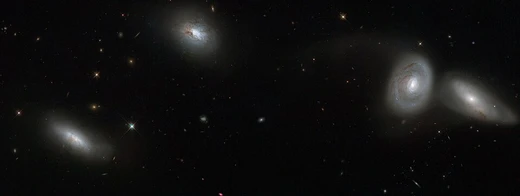
Hercules Superclusters
Two nearby superclusters, large and near the Coma Supercluster.

The Hercules Superclusters, also known as SCl 160, are actually two nearby superclusters of galaxies. Compared to other superclusters in our cosmic neighborhood, Hercules is notably large, spanning roughly 330 million light-years across. Directly in front of these superclusters lies the Northern Local Supervoid, a void region that matches the superclusters in size. The member galaxies have redshifts ranging from 0.0304 to 0.0414.
This system contains twelve galaxy clusters in total, including Abell 2147, Abell 2151 (the Hercules Cluster), Abell 2040, Abell 2052, Abell 2055, Abell 2063, Abell 2107, Abell 2148, Abell 2197, Abell 2199, and Abell 2152. A very long filament of galaxies connects this group to the pair of clusters Abell 2197 and Abell 2199. The cluster Abell 2162, located in the neighboring constellation Corona Borealis, is also part of the Hercules Superclusters.
These superclusters sit close to the Coma Supercluster, and together they form part of the CfA2 Great Wall. Harlow Shapley first investigated the distribution of galaxies in the constellation Hercules during the 1930s, and he likely discovered a supercluster there. However, this finding was not verified until the 1970s. In 1976, Massimo Tarenghi proposed that the A2151 cluster belonged to a single supercluster, and at a 1977 conference in Estonia, he and several other astronomers presented evidence confirming that a supercluster indeed exists in that region.
Quick Facts
- Constellation
- Hercules
- Major Axis Mpc
- 100 Mpc
- Redshift
- 0.0304-0.0414
Facts from the source article.
Lore & Background
In the 1930s, Harlow Shapley studied the structure of the distribution of galaxies in the constellation of Hercules, and was probably first to discover the existence of a supercluster in that region. However, this was not confirmed until the 1970s. In 1976, Massimo Tarenghi suggested that the A2151 cluster was part of a single supercluster, and at a conference in Estonia in 1977, he, together with several other astronomers, presented evidence that it was indeed a supercluster that appeared in that region.
The Hercules Superclusters have a total of 12 members, which includes Abell 2147, Abell 2151 (Hercules Cluster), Abell 2040, Abell 2052, Abell 2055, Abell 2063, Abell 2107, Abell 2148, Abell 2197, Abell 2199 and Abell 2152 galaxy clusters. An extremely long filament of galaxies has been found, that connects this group of clusters to the Abell 2197 and Abell 2199 pair. Abell 2162 in the nearby constellation Corona Borealis is also a member.
The Hercules Superclusters are near the Coma Supercluster, helping make up part of the CfA2 Great Wall.
Reader's Guide
The Hercules Superclusters are notable for their large size, with a diameter of approximately 330 Mly, and for being part of the CfA2 Great Wall alongside the nearby Coma Supercluster. Their discovery history spans from Harlow Shapley's initial work in the 1930s to confirmation in the 1970s, with Massimo Tarenghi and colleagues presenting evidence at a 1977 conference in Estonia. The superclusters contain 12 member clusters, including the well-known Hercules Cluster (Abell 2151). A particularly long filament of galaxies connects this group to the Abell 2197 and Abell 2199 pair. The Northern Local Supervoid lies in front of the superclusters and is as large as the superclusters themselves. The redshifts of member galaxies range from 0.0304 to 0.0414. The Hercules Superclusters are part of the large-scale structure of the universe and are listed in the Abell catalogue.
Did You Know?
- The Hercules Superclusters are approximately 330 Mly in diameter.
- Harlow Shapley was probably the first to discover the existence of a supercluster in the Hercules region in the 1930s.
- An extremely long filament of galaxies connects the group to the Abell 2197 and Abell 2199 pair.
Cosmic Architecture and Scale
Superclusters sit at the top of the known hierarchy of galactic organization, grouping together smaller clusters and galaxy groups into vast, loosely bound assemblies. They rank among the most enormous structures we have identified in the cosmos. Our own Milky Way, for instance, belongs to the Local Group—a collection of more than fifty-four galaxies—which in turn is embedded within the Laniakea Supercluster, itself nested inside the even broader Pisces–Cetus Supercluster Complex. Because superclusters are so expansive and so sparsely populated with matter, their internal gravity is generally too weak to halt the overall stretching of space. Unlike denser galaxy clusters that can resist cosmic expansion, most superclusters simply ride along with the Hubble flow, growing larger as the universe itself expands. Astronomers estimate that roughly ten million of these mega-structures populate the observable universe, making them an extraordinarily common yet individually immense feature of the cosmic landscape.
From Abell's Catalogue to a Vocabulary of Scale
The concept of superclusters entered astronomical discourse in 1958, when George Abell compiled his influential catalogue of galaxy clusters. In that work he identified groupings that were larger than individual clusters and proposed the term "second-order clusters," essentially clusters of clusters. Over the decades that followed, the community accumulated a rich and sometimes playful vocabulary for these formations. Depending on the particular configuration being described, a supercluster or its surrounding network might be labeled a filament, a supercluster complex, a hypercluster, a chain, a strand, a superstructure, a wall, or a sheet. The variety of terms reflects both the genuine diversity of shapes these structures take and the ongoing difficulty of drawing clean boundaries between one supercluster and the next. What unites all these labels is the recognition that galaxies do not float in isolation; they are woven into an interconnected web that stretches across hundreds of millions of light-years and far beyond.
Pushing the Boundaries of the Known
Superclusters are generally regarded as the largest structures in the universe, consistent with the cosmological principle that matter should appear statistically uniform when viewed at sufficiently large scales. Yet surveys have repeatedly turned up formations that seem to exceed even this expectation. The Sloan Great Wall, for example, is a structure so vast that it challenges the assumption that superclusters represent the upper limit of cosmic organization. At these extreme scales, however, a persistent interpretive problem arises: it becomes genuinely difficult to tell whether an observed feature is a single coherent supercluster or merely several superclusters that happen to be aligned along our line of sight by chance. This ambiguity means that the true maximum size of a gravitationally connected structure may remain uncertain. What is clear is that these mega-formations span distances ranging from several hundred million light-years up to roughly ten billion light-years, and collectively they occupy more than five percent of the observable universe, making them the dominant architectural feature of the cosmic web.
Reading the Universe's First Moments
The very existence of superclusters carries profound implications for cosmology. If galaxies were distributed perfectly evenly throughout space, we would not see the nested hierarchy of groups, clusters, and superclusters that observations reveal. In reality, most galaxies are concentrated in groups of a few dozen or in clusters containing several thousand, and these smaller units aggregate into the vast supercluster networks. Because the large-scale pattern of matter was seeded in the earliest moments after the Big Bang, studying the geometry and distribution of superclusters offers a direct window into those initial conditions. Researchers also examine the orientations of galactic rotational axes within a supercluster, hoping that any statistical alignment will shed light on how galaxies formed and evolved during the universe's youth. In this way, superclusters serve not merely as catalogued objects but as fossil records preserving information about the physics that shaped the cosmos from its very beginning.
Frequently Asked Questions
What exactly is the Hercules Superclusters (SCl 160)?
Despite the singular name, SCl 160 is actually a pair of nearby superclusters of galaxies rather than one unified structure. Together they form one of the larger supercluster groupings in our local cosmic neighborhood.
How big is the Hercules Superclusters system?
The two superclusters combined stretch roughly 330 million light-years across, making them notably larger than many other superclusters we can observe nearby. This scale dwarfs typical galaxy clusters by an enormous margin.
What is the Northern Local Supervoid and how does it connect to Hercules?
The Northern Local Supervoid is a vast underdense region of space that lies directly in front of the Hercules Superclusters along our line of sight. Strikingly, the void is roughly the same size as the superclusters themselves, creating a dramatic contrast between extreme galactic density and near-total emptiness.
Where does Hercules Superclusters sit relative to other nearby structures?
The system is located near the Coma Supercluster, placing it among the most massive structures in our local cosmic environment. Member galaxies carry redshifts ranging from 0.0304 to 0.0414, confirming they are comparatively close in cosmological distance.
More in Galaxy Clusters and Groups, Part 3 1-24
Spotted an error? Know more?
Reader corrections go straight into our review queue. Suggest an edit · How this site is sourced