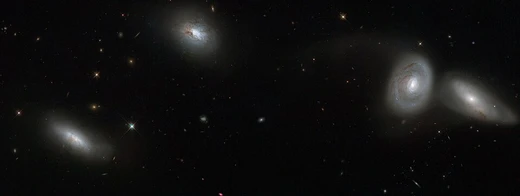
Hyperion proto-supercluster
Largest and earliest known proto-supercluster, discovered in 2018.

The Hyperion proto-supercluster is the largest and earliest known proto-supercluster, discovered in 2018. It is estimated to weigh about 5,000 times the mass of the Milky Way and is seen at 20% of the current age of the universe.
Quick Facts
- Epoch
- J2000
- Constellation
- Sextans
- Ra
- 10 · 6
- Dec
- 2.3
- Major Axis Mpc
- 150 Mpc
- Minor Axis Mpc
- 60 Mpc
- Redshift
- 2.45
Facts from the source article.
Lore & Background
The discovery was announced in late 2018 by a team led by Olga Cucciati. They used computational astrophysics methods and astroinformatics, applying statistical techniques to large datasets of galaxy redshifts. A two-dimensional Voronoi tessellation was used to correlate gravitational interaction (virialization) of visible structures, and the existence of non-visible (dark matter) structures was inferred. The correlation was based on redshift data from the VIMOS-VLT Deep Survey, using the Visible Multi Object Spectrograph (VIMOS) instrument of the Very Large Telescope in Chile, and other surveys to a lesser extent. Spectroscopic redshift data for 3,822 objects (galaxies) was selected. The discovery was published in Astronomy & Astrophysics in September 2018.
The structure lies within the two square degree Cosmic Evolution Survey (COSMOS) field of the constellation Sextans. Hyperion's redshift is z=2.45, putting it 11 billion light years from Earth; it existed at less than 20% of the present age of the Universe. Eventually it is 'expected to evolve into something similar to the immense structures in the local universe such as the superclusters making up the Sloan Great Wall or the Virgo Supercluster'.
The supercluster contains dark matter, evidenced by a mismatch between the visible objects in it and their computed gravitational binding. As a relic from the early Universe, the dark matter data could be used to test cosmological theories.
Reader's Guide
The Hyperion proto-supercluster is significant as the largest and earliest known proto-supercluster, providing a unique window into the early universe. Its discovery in 2018, using the Very Large Telescope in Chile, relied on analyzing redshifts of 10,000 objects, with spectroscopic data for 3,822 galaxies. The structure's mass of about 5,000 times that of the Milky Way and its size—60 Mpc × 60 Mpc × 150 Mpc—make it a titanic formation. Its legacy lies in its use for cosmology: the presence of dark matter, inferred from a mismatch between visible objects and gravitational binding, allows tests of cosmological theories. As the 2018 paper authors note, 'the identification of massive/complex proto-clusters at high redshift could be useful to give constraints on dark matter simulations' of the Lambda-CDM model. Hyperion is expected to evolve into a structure similar to the Sloan Great Wall or the Virgo Supercluster, linking early-universe formation to present-day large-scale structures.
Did You Know?
- Hyperion was discovered in 2018 by a team led by Olga Cucciati.
- It is estimated to weigh 4.8 × 10^15 solar masses, about 5,000 times the mass of the Milky Way.
- The structure lies within the COSMOS field in the constellation Sextans.
Architecture of the Cosmic Web
Superclusters represent one of the grandest organizational tiers in the cosmos. Rather than scattering uniformly across space, galaxies tend to clump into groups of a few dozen members and clusters of several thousand. These smaller assemblies then aggregate into superclusters, which themselves can merge into even more vast formations. Astronomers have coined a colorful vocabulary for these mega-structures: filaments, chains, strands, walls, sheets, superstructures, hyperclusters, and supercluster complexes. Their spans range from a few hundred million light-years up to roughly ten billion light-years, and collectively they blanket more than five percent of the observable universe. The Milky Way sits deep within this hierarchy, nested in the Local Group of over fifty-four galaxies, which belongs to the Laniakea Supercluster, which in turn is embedded in the broader Pisces–Cetus Supercluster Complex.
From Abell's Catalogue to the Cosmological Principle
The very idea of superclusters traces back to 1958, when George Abell compiled his landmark catalogue of galaxy clusters. In that work he identified groupings of clusters and dubbed them second-order clusters, or clusters of clusters. Other researchers later referred to the same phenomenon as extensions or concentrations. For decades these structures occupied the top rung of known cosmic architecture, consistent with the cosmological principle that the universe should look statistically similar at every scale. Yet surveys have since revealed formations that appear even larger, most famously the Sloan Great Wall, raising a thorny question: are these genuinely new structural tiers, or merely multiple superclusters aligned by chance along our line of sight? At such immense distances, separating a true mega-structure from a coincidental projection becomes extraordinarily difficult, leaving the upper boundary of cosmic organization still debated.
Windows into the Universe's First Moments
Because superclusters are the largest coherent structures we can observe, they serve as natural laboratories for probing the universe's earliest conditions. The very fact that galaxies are not spread evenly but instead gathered into hierarchical clumps carries information about the initial density fluctuations that seeded all later structure. Researchers also examine the orientations of galactic rotational axes within a supercluster, hoping that any preferred alignment will reveal how galaxies first assembled in the young cosmos. In this way, mapping the geometry and internal kinematics of a supercluster is not merely an exercise in cataloguing distant light; it is an attempt to read the fossil record of cosmic evolution, tracing how the first seeds of structure grew into the vast filaments and walls we see today.
Drifting with the Hubble Flow
A defining dynamical property of superclusters is their behavior on the largest scales. Because they are both enormous in extent and very diffuse in mass density, most superclusters do not gravitationally bind their constituent clusters the way a compact galaxy cluster does. Instead, they participate in the overall Hubble expansion of space, stretching apart over cosmic time. This distinguishes them sharply from smaller, denser clusters, which can resist the expansion and remain gravitationally coherent. Current estimates place the total number of superclusters within the observable universe at roughly ten million, a staggering population spread across the full volume of the visible cosmos. Their low-density, expansion-following nature means that the supercluster is less a fixed object and more a transient pattern in the expanding fabric of space, a reminder that even the grandest structures are subject to the universe's relentless stretching.
Frequently Asked Questions
What is the Hyperion proto-supercluster?
It is the largest and earliest-identified proto-supercluster known to astronomers, sitting roughly 11 billion light-years away at a redshift of 2.45. The structure was catalogued in 2018 and immediately stood out as a record-holder in both size and antiquity.
How massive and large is the Hyperion proto-supercluster?
Its total mass is estimated at about 4.8 × 10¹⁵ solar masses, roughly 5,000 times the mass of the Milky Way. Its physical footprint spans approximately 196 × 196 × 489 million light-years, giving it a distinctly elongated, slab-like geometry.
When was the Hyperion proto-supercluster discovered?
It was identified in 2018. At the time of detection, observers recognized it right away as both the most massive and the most ancient proto-supercluster on record.
How early in the universe's history did the Hyperion proto-supercluster already exist?
We see it when the cosmos was less than 20 percent of its present age, meaning the structure was already assembled during a very young universe. Its redshift of 2.45 places the light-travel distance at about 11 billion light-years.
Why is the Hyperion proto-supercluster significant for cosmology?
Because no larger or earlier proto-supercluster had been catalogued before 2018, it provides a crucial data point for testing models of how the first massive cosmic webs formed. Its sheer scale at such a young epoch pushes the boundaries of what current structure-formation simulations can explain.
More in Galaxy Clusters and Groups, Part 3 1-24
Spotted an error? Know more?
Reader corrections go straight into our review queue. Suggest an edit · How this site is sourced