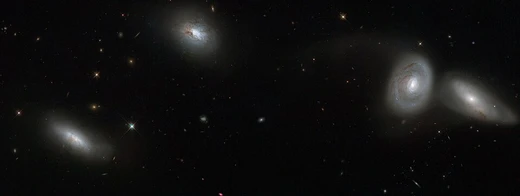
Ophiuchus Supercluster
A nearby supercluster centered on the Ophiuchus Cluster.

The Ophiuchus Supercluster is a relatively close grouping of galaxies found in the constellation Ophiuchus. It sits at the far side of the Ophiuchus Void, and a filament may link it to the Pavo-Indus-Telescopium and Hercules Superclusters. Its core is the Ophiuchus Cluster, a cD cluster of Abell class type I, and it contains at least two additional galaxy clusters, four more galaxy groups, and several field galaxies.
In 2014, the Ophiuchus Cluster and its surroundings were recognized as part of the larger Laniakea Supercluster, a basin of attraction centered on the Great Attractor that also includes the Virgo Supercluster as a lobe. Later work on basins of attraction suggested that the region around the Ophiuchus Cluster may belong to Laniakea, and that both are moving toward the Shapley Concentration, possibly making them part of an even larger structure.
A cavity 1.5 million light-years wide in the Ophiuchus Supercluster was traced back to the central galaxy of the Ophiuchus Cluster. That galaxy, NeVe 1, hosts the supermassive black hole WISEA J171227.81-232210.7, which ejected roughly 270 million solar masses, triggering the Ophiuchus Supercluster eruption. This event may be the largest known explosion in the observable universe since the Big Bang.
The Ophiuchus Cluster was discovered in 1981 by Ken-ichi Wakamatsu and Matthew Malkan on Palomar Schmidt IV-N plates during a search for hidden globular clusters. Understanding the supercluster's properties may help explain the excess velocity component of the local group of galaxies.
Quick Facts
- Credit
- Ken-ichi Wakamatsu and Matthew Malkan
- Epoch
- J2000
- Constellation
- Ophiuchus
- Ra
- 13 · 25 · 00
- Dec
- -30 · 00 · 00
- Parent
- Laniakea Supercluster
- Distance
- 139.6 +/- 67.80 ± 0.077 (Ophiuchus Cluster)
Facts from the source article.
Lore & Background
The Ophiuchus Supercluster was identified as part of a greater supercluster, Laniakea, in 2014. Laniakea is a basin of attraction centered on the Great Attractor, in which the Virgo Supercluster is now considered a lobe. A subsequent study based on observations of basins of attraction suggested that a basin of attraction around the Ophiuchus Cluster may be associated with Laniakea, and both are moving toward the Shapley Concentration, suggesting they are likely part of this even larger structure.
In February 2020, astronomers reported that a 1.5 million light-year wide cavity in the Ophiuchus Supercluster originated from the central galaxy of the Ophiuchus Cluster. The cD galaxy, NeVe 1, is the site of the Ophiuchus Supercluster eruption, triggered by the ejection of approximately 270 million solar masses from its supermassive black hole, called WISEA J171227.81-232210.7. This may be the largest known explosion in the observable universe since the Big Bang.
The Ophiuchus Cluster was discovered in 1981 by Ken-ichi Wakamatsu of Gifu University and Matthew Malkan on Palomar Schmidt IV-N Plates during a hidden globular cluster survey. Determining characteristics of a supercluster may help to more correctly explain the excess velocity component of the local group of galaxies.
Reader's Guide
The Ophiuchus Supercluster is significant as a nearby structure that helps map the large-scale distribution of galaxies in the local universe. Its identification in 2014 as part of the Laniakea Supercluster, a basin of attraction centered on the Great Attractor, recontextualized the Virgo Supercluster as a lobe within a larger system. Subsequent studies suggest that the Ophiuchus Cluster's basin of attraction may be associated with Laniakea, and both are moving toward the Shapley Concentration, indicating they may be part of an even larger structure. The supercluster gained further prominence in February 2020 with the report of a 1.5 million light-year wide cavity originating from its central galaxy, NeVe 1. The eruption, caused by the ejection of about 270 million solar masses from the supermassive black hole WISEA J171227.81-232210.7, may represent the largest known explosion in the observable universe since the Big Bang. This discovery underscores the role of supermassive black holes in shaping their environments. The supercluster's discovery history, beginning with the Ophiuchus Cluster in 1981, also highlights the ongoing effort to understand the excess velocity component of the local group of galaxies.
Did You Know?
- The Ophiuchus Supercluster forms the far wall of the Ophiuchus Void.
- It may be connected in a filament with the Pavo-Indus-Telescopium and Hercules Superclusters.
Frequently Asked Questions
What is the Ophiuchus Supercluster?
It is a relatively nearby collection of galaxies located in the direction of the constellation Ophiuchus. The structure sits on the far edge of the Ophiuchus Void and is anchored by the Ophiuchus Cluster at its core.
What is the central cluster of the Ophiuchus Supercluster?
The Ophiuchus Cluster serves as the gravitational heart of the supercluster, classified as a cD-type Abell class I cluster. It is the dominant mass around which the remaining member groups and field galaxies are organized.
How is the Ophiuchus Supercluster linked to other large-scale structures?
A cosmic filament may bridge it to the Pavo-Indus-Telescopium and Hercules Superclusters. In 2014 it was also formally incorporated into the broader Laniakea Supercluster, the gravitational basin that includes the Great Attractor.
What does the Ophiuchus Supercluster contain besides its core cluster?
Beyond the Ophiuchus Cluster itself, the supercluster includes at least two additional galaxy clusters and four or more galaxy groups. Several unbound field galaxies also populate the surrounding region.
Why do astronomers find the Ophiuchus Supercluster noteworthy?
Its relatively close distance makes it one of the more accessible superclusters for studying large-scale structure in detail. It also acts as a useful reference point for mapping the void-and-filament network that ties neighboring superclusters together.
More in Galaxy Clusters and Groups, Part 3 1-24
Spotted an error? Know more?
Reader corrections go straight into our review queue. Suggest an edit · How this site is sourced