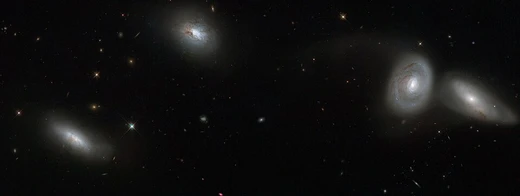
Corona Borealis Supercluster
Dense supercluster in Corona Borealis, collapsing into a massive cluster.

The Corona Borealis Supercluster lies in the constellation of the same name and is the most notable supercluster in the Northern Celestial Hemisphere. It is unusually dense and compact for such a structure, with its total mass estimated between 0.6 and 12 × 10¹⁶ solar masses. The supercluster includes the galaxy clusters Abell 2056, Abell 2061, Abell 2065 (the most massive cluster within it), Abell 2067, Abell 2079, Abell 2089, and Abell 2092. Among these, Abell 2056, 2061, 2065, 2067, and 2089 are gravitationally bound and currently collapsing into a single, massive cluster with an estimated mass of about 1 × 10¹⁶ solar masses. If inter-cluster mass exists, Abell 2092 may also be part of this merging process. The supercluster spans roughly 100 megaparsecs (330 million light-years) across and 40 megaparsecs (130 million light-years) deep. Its redshift of 0.07 corresponds to a distance of about 265.5 megaparsecs (964 million light-years). Astronomers C. Donald Shane and Carl A. Wirtanen first noticed a concentration—or "cloud"—of "extragalactic nebulae" in this region during a large-scale sky survey. In 1958, George Abell became the first to identify what he called "second-order clusters" (clusters of clusters) in the initial publication of his Abell catalogue. A detailed study by Postman and colleagues in 1988 calculated the supercluster’s mass at 8.2 × 10¹⁵ solar masses and listed the Abell clusters 2019, 2061, 2065, 2067, 2079, 2089, and 2092 as its members. Abell 2124, located 33 megaparsecs (110 million light-years) from the supercluster’s center, has been considered part of the group by some researchers. Abell 2069 lies nearby but is more distant, showing only a line-of-sight association.
Quick Facts
- Credit
- Pablo Carlos Budassi
- Constellation
- Corona Borealis
- Redshift
- 0.07
- Other Names
- MSCC 463; SCL 158
Facts from the source article.
Lore & Background
Astronomers C. Donald Shane and Carl A. Wirtanen were the first to note a concentration or 'cloud' of 'extragalactic nebulae' in the region during a large-scale survey of extragalactic structures in the sky. George Abell was the first to note the presence of what he called 'second-order clusters', namely clusters of clusters in the first publication of his Abell catalogue in 1958. Postman and colleagues were the first to study the supercluster in detail in 1988, calculating it to have a mass of 8.2×10^15 M☉, and contain the Abell clusters Abell 2019, Abell 2061, Abell 2065, Abell 2067, Abell 2079, Abell 2089, and Abell 2092. Abell 2124 lies 33 megaparsecs (110 million light-years) from the center of the supercluster and has been considered part of the group by some authors. Abell 2069 lies close by but is more distant, with a line-of-sight association only. Of the clusters within the supercluster, Abell 2056, 2061, 2065, 2067, and A2089 are gravitationally bound and in the process of collapsing to form a massive cluster. This entity has an estimated mass of around 1×10^16 M☉. If there is inter-cluster mass present, then Abell 2092 may also be involved.
Reader's Guide
The Corona Borealis Supercluster is notable as the most prominent supercluster in the Northern Celestial Hemisphere, and for its dense, compact nature compared with other superclusters. Its mass has been calculated to lie between 0.6 and 12×10^16 solar masses, reflecting significant uncertainty. The supercluster contains seven Abell clusters, with Abell 2065 being the most massive. A key feature is that five of these clusters—Abell 2056, 2061, 2065, 2067, and 2089—are gravitationally bound and currently collapsing to form a single massive cluster, with an estimated mass of about 1×10^16 M☉. Abell 2092 may also be involved if inter-cluster mass is present. The supercluster was first noted as a cloud of extragalactic nebulae by Shane and Wirtanen, and later recognized as a second-order cluster by Abell. Postman and colleagues provided the first detailed study in 1988, calculating a mass of 8.2×10^15 M☉ and including Abell 2019 in their list. Abell 2124 lies 33 megaparsecs from the center and is considered part of the group by some authors, while Abell 2069 has only a line-of-sight association. The supercluster spans 100 megaparsecs in width and 40 megaparsecs in depth, with a redshift of 0.07 corresponding to a distance of about 265.5 megaparsecs.
Did You Know?
- The Corona Borealis Supercluster is the most prominent supercluster in the Northern Celestial Hemisphere.
- Five of its galaxy clusters are gravitationally bound and collapsing to form a massive cluster with an estimated mass of around 1×10^16 M☉.
- Astronomers C. Donald Shane and Carl A. Wirtanen first noted a concentration of extragalactic nebulae in this region.
Mythological Roots and Cultural Echoes
The constellation Corona Borealis carries a name that speaks directly to its visual shape. In Latin, the title translates to "northern crown," a reference to the semicircular arc traced by its brightest stars against the dark sky. In classical mythology, this celestial crown was said to be a gift from the god Dionysus to Ariadne, the Cretan princess, who was then set among the stars. Yet the pattern inspired far more than one narrative. Various other cultures saw in the same arrangement of points a gathering of elders, the nest of an eagle, the den of a bear, or even the smokehole of a dwelling. The Roman astronomer Ptolemy catalogued the figure in the second century as one of his forty-eight constellations, and he also noted a southern twin, Corona Australis, sharing a similar arc-like form. Two millennia later, the pattern endures as one of the eighty-eight constellations officially recognized by the International Astronomical Union, a testament to how deeply this simple crown has been woven into humanity's storytelling about the sky.
A Treasury of Unusual Stars
Within the modest 179-square-degree footprint of Corona Borealis, astronomers have identified a remarkable collection of stellar oddities. The constellation's brightest member, Alpha Coronae Borealis—officially named Alphecca by the IAU—presents as a blue-white star of magnitude 2.2, but it is actually an Algol-type eclipsing binary whose brightness wavers by a tenth of a magnitude over a 17.4-day cycle. Its primary is a white A0V star nearly three times the Sun's mass, encircled by a debris disk extending to roughly 60 astronomical units. Far more exotic is R Coronae Borealis, a yellow supergiant that serves as the prototype for an entire class of hydrogen-deficient variable stars, believed to be the product of two white dwarfs merging. Then there is T Coronae Borealis, nicknamed the Blaze Star, a recurrent nova that normally glimmers at magnitude 10 but erupted to naked-eye brightness of magnitude 2 in 1946, with another flare predicted for 2025. Together, these objects make a small crown-shaped patch of sky a laboratory for some of the most puzzling stellar physics known.
Deep Sky and the Supercluster
Beyond the relatively nearby stars that form the crown's familiar outline, Corona Borealis harbors some of the most distant structures visible to the unaided imagination. Abell 2065, a densely packed galaxy cluster situated approximately one billion light-years from the Solar System, contains more than four hundred member galaxies and is itself a component of the far larger Corona Borealis Supercluster. This supercluster represents a vast assembly of galaxies, making the constellation a window into the large-scale architecture of the universe. Closer to home, the constellation also hosts five stars known to be orbited by Jupiter-sized exoplanets, linking the ancient crown to the modern search for worlds beyond our own. Additionally, the multiple star systems ADS 9731 and Sigma Coronae Borealis, with six and five components respectively, remind observers that even within a single small patch of sky, stellar architecture can be extraordinarily complex. The constellation thus spans a staggering range of distance and scale, from a binary pair seventy-five light-years away to a galaxy cluster a billion light-years distant.
Mapping the Crown Across Centuries
The formal boundaries of Corona Borealis, like many constellation limits, are a relatively modern imposition on an ancient pattern. The second-century astronomer Ptolemy first recorded the figure among his forty-eight constellations, and for centuries afterward its exact edges were loosely understood. In 1603, the German cartographer Johann Bayer assigned Bayer designations from Alpha through Upsilon to twenty stars within the region in his atlas Uranometria. The English astronomer John Flamsteed later refined observations, identifying what Bayer had catalogued as single stars—such as Zeta and Nu Coronae Borealis—as close double pairs. Chinese astronomers, working within their own tradition, recognized nine stars in the asterism, adding Pi and Rho to the set known in the West. The modern era brought precision: in 1922 the International Astronomical Union adopted the three-letter abbreviation CrB, and in 1930 the Belgian astronomer Eugène Delporte drew the official polygon of eight segments that still defines the constellation's borders today. These boundaries enclose a right-ascension span from 15 hours 16 minutes to 16 hours 25 minutes and a declination range between 39.71 and 25.54 degrees, encompassing thirty-seven stars at or brighter than magnitude 6.5.
Frequently Asked Questions
What is the Corona Borealis Supercluster?
It is a large-scale structure of galaxy clusters situated within the constellation Corona Borealis and stands as the most prominent supercluster visible in the Northern Celestial Hemisphere. It is notably compact and dense compared to other superclusters of its kind.
How large is the Corona Borealis Supercluster?
The structure spans roughly 100 megaparsecs (about 330 million light-years) across its widest dimension and extends about 40 megaparsecs (130 million light-years) in depth. Its total mass is estimated to fall somewhere between 0.6 and 12 × 10¹⁶ solar masses.
Which galaxy clusters make up the Corona Borealis Supercluster?
It encompasses seven Abell clusters: Abell 2056, 2061, 2065, 2067, 2079, 2089, and 2092. Among them, Abell 2065 is the single most massive cluster in the group.
Is the Corona Borealis Supercluster collapsing into one giant cluster?
Yes—five of its member clusters (Abell 2056, 2061, 2065, 2067, and 2089) are gravitationally bound to one another and are actively merging into a single, far more massive cluster. This ongoing collapse is what makes the structure so dynamically interesting to astronomers.
How far away is the Corona Borealis Supercluster?
It sits at a distance of approximately 265.5 megaparsecs, or roughly 964 million light-years, from Earth. Its redshift of 0.07 places it in the relatively nearby universe by cosmological standards.
More in Galaxy Clusters and Groups, Part 3 1-24
Spotted an error? Know more?
Reader corrections go straight into our review queue. Suggest an edit · How this site is sourced