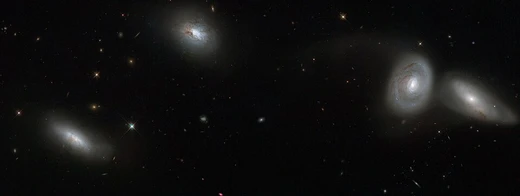
Shapley-Ames Catalog
First catalog of bright galaxies in both hemispheres.

The Shapley-Ames Catalog of Bright Galaxies, published in 1932, lists 1,249 objects with a brightness of 13.2 magnitude or brighter. Harlow Shapley and Adelaide Ames compiled it, drawing 1,189 objects from the New General Catalogue and 48 from the Index Catalogue. Using new photographic recordings that included comparison stars of known brightness, they measured and recorded galaxy brightnesses only up to magnitude 13.2. This was the first catalog to cover bright galaxies in both the northern and southern hemispheres. It provides each galaxy’s position, brightness, size, and Hubble classification. For the next six decades, astronomers relied on it as a key reference for information on redshifts and galaxy types.
Shapley and Ames began their survey of nearby galaxies in 1926. A key discovery was that galaxies were not evenly distributed—the northern hemisphere had more galaxies than the southern, violating the assumption of isotropy. They also found that the Virgo cloud extended further than previously thought. Based on this data, they created a new hierarchy of clusters, calling a cluster of galaxy clusters a supercluster, and named the Virgo cloud in the northern hemisphere the "Local Supercluster."
In 1981, Allan Sandage and Gustav Tammann published an updated version, the Revised Shapley-Ames Catalog (RSA). They kept the original list of galaxies except for three objects no longer considered galaxies, and updated and substantially extended the information on the remaining 1,246 individual galaxies.
- Publication year
- 1932
- Compilers
- Harlow Shapley and Adelaide Ames
- Total objects
- 1249
- Magnitude limit
- 13.2
- Objects from ngc
- 1189
- Objects from ic
- 48
- Revised edition year
- 1981
Lore & Background
Shapley and Ames began their study of all nearby galaxies in 1926. An important finding from this research was that the galaxies were not evenly distributed (they violated the isotropy assumption) in that the northern hemisphere contained more galaxies than the southern hemisphere. It also found that the Virgo cloud extended further than previously believed. From this data, Shapley and Ames therefore created a new hierarchy of clusters called a supercluster, which is a cluster of galaxy clusters, and called this Virgo cloud in the northern hemisphere a 'Local Supercluster'.
With the help of new photographic recordings, which also contained comparison stars of known brightness, the brightness of many galaxies were measured and recorded only up to a magnitude of 13.2. They identified 1189 objects based on the New General Catalogue and 48 based on the Index Catalogue.
In 1981, Allan Sandage and Gustav Tammann published an updated version known as the Revised Shapley-Ames Catalog (RSA). The original list of galaxies was maintained, with the exception of three objects which were no longer considered galaxies. The information on the 1246 individual galaxies have been updated and substantially extended.
Reader's Guide
For the next 60 years after its publication, astronomers referred to this catalog as a primary source for information about redshifts and galaxy types. The catalog's identification of the uneven distribution of galaxies in the northern and southern hemispheres, and its discovery that the Virgo cloud extended further than previously believed, led to the creation of the concept of a supercluster—a cluster of galaxy clusters—which Shapley and Ames called the 'Local Supercluster'. This work fundamentally changed the understanding of large-scale structure in the universe. The 1981 Revised Shapley-Ames Catalog (RSA) by Allan Sandage and Gustav Tammann updated and substantially extended the information on the 1246 individual galaxies, maintaining the original list except for three objects no longer considered galaxies. The catalog remained a primary reference for astronomers for decades, providing foundational data on galaxy positions, brightness, sizes, and Hubble classifications.
Did You Know?
- The catalog includes 1249 objects brighter than 13.2 magnitude.
- It was the first compilation of bright galaxies covering both the northern and southern sky.
- Shapley and Ames identified a 'Local Supercluster' from the uneven distribution of galaxies.
- The 1981 Revised Shapley-Ames Catalog removed three objects no longer considered galaxies.
Defining the Catalogue Tradition
An astronomical catalogue, at its core, is a structured listing or tabulation of celestial objects. Rather than being a random collection, these entries are deliberately grouped together because the objects share a unifying characteristic—whether that be a common type, a particular morphology, a shared origin, a specific means of detection, or a common method of discovery. This organizing principle is what transforms a mere list into a scientific instrument. The catalogue becomes a reference framework, allowing astronomers to locate, compare, and study objects that belong to the same family. In the broader landscape of astronomical literature, catalogues occupy a foundational role: they are the index cards of the universe, the way we impose order on the overwhelming diversity of what the sky contains. Every entry carries with it the implication that the object fits within a defined category, making the catalogue not just a record but a classification system in its own right.
Survey as the Foundation
The creation of an astronomical catalogue is rarely an isolated act of observation. In most cases, these tabulations are the direct product of a broader astronomical survey—a systematic, often large-scale effort to scan portions of the sky and record what is found. The survey provides the raw material; the catalogue is the distilled, organized output. This relationship between survey and catalogue means that the scope, sensitivity, and methodology of the original observation are baked into the final list. A catalogue of radio sources, for instance, reflects the capabilities and pointing strategy of the radio telescope used, while a catalogue of X-ray sources depends on the orbital path and detector sensitivity of the satellite that captured them. The catalogue thus inherits the strengths and limitations of its parent survey. Understanding a catalogue's provenance—what survey produced it, under what conditions, with what instruments—remains essential for interpreting its contents and recognizing what it may have missed.
A Spectrum of Celestial Objects
The objects recorded across astronomical catalogues span an extraordinary range of celestial phenomena. Some catalogues focus on double stars, compiling pairs that share a common gravitational bond. Others target open star clusters or globular clusters, grouping stars that formed together. Still others catalogue planetary nebulae, dark nebulae, peculiar galaxies, or emission-line objects. The detection methods vary just as widely: radio telescopes identify sources at specific frequencies, satellites capture X-ray and gamma-ray emissions, and ground-based optical or infrared surveys map visible-light and thermal objects across the sky. Even within a single type of object, catalogues can differ in scope—one might list all stars within eight parsecs, while another catalogs ultracool dwarfs identified through a broader infrared survey. This diversity ensures that no single catalogue captures the full picture of the sky.
The Architecture of Designations
The identification system for astronomical catalogues is a layered architecture of letters, numbers, and personal names. Some entries are purely numerical, such as the sequential Cambridge Catalogues of Radio Sources running from 1C through 10C. Others combine a number with a letter to denote a specific survey version or instrument, as seen in designations like 1RXH for ROSAT pointed observations or 2MASS for the Two Micron All Sky Survey. A large portion of catalogues bear the name of their creator or principal contributor—Abell, Abt, Alden, Alessi, Arp, Barnard, Baade, and many others—linking the list directly to the individual who compiled it. Cross-referencing is common: a single open star cluster might appear under multiple names in different catalogues, connected by equivalences. This web of aliases and designations reflects the collaborative, cumulative nature of astronomical cataloguing, where each new survey adds another thread to an ever-expanding tapestry of celestial identification.
Frequently Asked Questions
Who compiled the Shapley-Ames Catalog and when was it published?
Harlow Shapley and Adelaide Ames put together this catalog, which was published in 1932. They assembled 1,189 entries from the New General Catalogue and another 48 from the Index Catalogue, arriving at a final total of 1,249 objects.
What makes the Shapley-Ames Catalog unique among galaxy catalogs of its era?
It was the first catalog to include bright galaxies from both the northern and southern celestial hemispheres in a single reference. That dual-hemisphere coverage gave observers a unified list where they had previously relied on separate northern and southern compilations.
What brightness limit does the Shapley-Ames Catalog apply, and how were those measurements made?
The catalog only includes galaxies at or brighter than 13.2 magnitude. Shapley and Ames derived those photometric values using new photographic plates that featured comparison stars of known brightness, allowing them to calibrate each galaxy's luminosity reliably.
What data does the Shapley-Ames Catalog record for each of its 1,249 galaxies?
Every entry lists the galaxy's sky position, measured brightness, apparent size, and Hubble classification. This made it a practical quick-reference tool for astronomers who needed a compact snapshot of each bright galaxy's basic properties.
Why do astronomy fans still point to the Shapley-Ames Catalog as a milestone?
As the first all-hemisphere catalog of bright galaxies, it established a standardized, photo-calibrated framework that later surveys built upon. Its 1932 publication gave the community a single, consistent baseline that remained useful for decades of follow-up observational work.
More in Galaxy Clusters and Groups, Part 3 1-24
Spotted an error? Know more?
Reader corrections go straight into our review queue. Suggest an edit · How this site is sourced