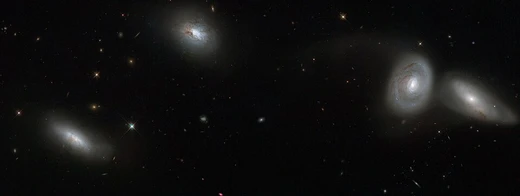
Hydra–Centaurus Supercluster
Closest supercluster neighbor to Virgo, spanning two parts.

The Hydra–Centaurus Supercluster (SCl 128), also known as the Hydra and Centaurus Superclusters or the Hydra–Centaurus concentration, is a supercluster in two parts that is the closest neighbor of the Virgo Supercluster. Its center is located about 39 Mpc (127 Mly) away, extending to a maximum distance of around 69 Mpc (225 Mly). Both Virgo and Hydra–Centaurus superclusters are connected and are sometimes considered a single structure, referred to as the Virgo–Hydra–Centaurus Supercluster, and may reside in a larger Centaurus Wall.
Quick Facts
- Epoch
- J2000
- Ra
- 13 · 14 · 00.0
- Dec
- -33 · 18 · 00
- Parent
- Virgo–Hydra–Centaurus Supercluster, Centaurus Wall, Laniakea Supercluster
- Redshift
- 0.016000 (4,797 km/s)
- Distance
- ~39-69.4 Mpc
- Other Names
- Cen-Hya Supercluster, Hydra-Cen Supercluster, Hydra-Centaurus Supercluster, SCl 128
Facts from the source article.
Lore & Background
The supercluster includes four large galaxy clusters in the Centaurus part, known as the '4 clusters' filament: Abell 3526 (Centaurus Cluster), Abell 3565, Abell 3574, and Abell 3581. This filament also includes the major cluster Abell S753 and extends up to around 260 Mly (80 Mpc) to reach Abell 3581. The Antlia Wall, also called the Hydra Wall or Hydra-Antlia filament, emerges from the Centaurus Cluster, passes under the Zone of Avoidance as the 'Puppis filament', links the Lepus Cloud, and passes through the NGC 1600 Group before connecting to the Perseus–Pisces supercluster at about 420 Mly (130 Mpc). In 2014, it was revealed that the Antlia Wall and the rest of the Hydra–Centaurus Supercluster are connected to the Perseus–Pisces Supercluster. In 2017, Pomarède et al. identified that the Antlia Wall and the Lepus Cloud are part of the Centaurus–Puppis–PP Filament, extending 420 Mly from the Centaurus Cluster to the Perseus–Pisces supercluster. Before 2017, this was unknown because the filament goes under the Zone of Avoidance, obscuring parts of it behind the Milky Way's disk.
Reader's Guide
The Hydra–Centaurus Supercluster is notable as the closest neighbor to the Virgo Supercluster, with both connected and sometimes considered a single structure. It contains major clusters such as the Centaurus Cluster and the Hydra Cluster, and its Antlia Wall filament links to the Perseus–Pisces Supercluster, revealing a large-scale cosmic web. The supercluster lies near the Great Attractor, dominated by the Norma Cluster (Abell 3627), which exerts a gravitational force causing all matter within 50 Mpc to flow at 600 km/s toward it. In 2014, a different definition of superclusters proposed that the Centaurus Supercluster is a lobe of the larger Laniakea Supercluster, a basin of attraction centered on the Great Attractor, which would also include the Virgo Supercluster and the Milky Way. However, follow-up studies favored traditional definitions of superclusters as high-density regions, and no community consensus on the term 'supercluster' has been reached. This ongoing debate underscores the supercluster's significance in mapping large-scale structure and gravitational dynamics.
Did You Know?
- The Hydra–Centaurus Supercluster is the closest neighbor of the Virgo Supercluster.
- Its Antlia Wall filament connects to the Perseus–Pisces Supercluster at a distance of about 420 Mly (130 Mpc).
- The supercluster includes the Norma Cluster (Abell 3627), which dominates the Great Attractor and causes a bulk flow of 600 km/s within 50 Mpc.
Identity, Scale, and Cosmic Neighborhood
The Hydra–Centaurus Supercluster, catalogued as SCl 128, stands as the nearest major supercluster neighbor to the Virgo Supercluster. Structured in two distinct parts, it stretches from a central point roughly 39 megaparsecs (about 127 million light-years) from us out to a maximum reach of approximately 69 megaparsecs, or 225 million light-years. Because of its proximity and gravitational interconnection with Virgo, the two structures are occasionally treated as a single entity, earning names like the Virgo–Hydra–Centaurus Supercluster or simply the Centaurus Supercluster. Some researchers have even proposed that both sit within a broader formation called the Centaurus Wall, which would incorporate elements of the Southern Supercluster and the Fornax Wall, including the Fornax Cluster. Under yet another framework—Laniakea—these structures shrink to smaller lobes within a far larger basin of attraction. The result is a supercluster whose exact boundaries and identity shift depending on which cosmological lens you apply.
The Four-Cluster Filament and the Antlia Wall
The Centaurus portion of this supercluster is anchored by what astronomers call the 4-clusters filament, a chain of four massive galaxy clusters: Abell 3526 (the Centaurus Cluster), Abell 3565, Abell 3574, and Abell 3581. The filament also incorporates the major cluster Abell S753 and stretches roughly 260 million light-years (80 megaparsecs) to reach Abell 3581. Extending from the Centaurus Cluster is the Antlia Wall, a long filament that dips beneath the Milky Way's Zone of Avoidance—where it is sometimes called the Puppis filament—before connecting to the Lepus Cloud. It threads through the region of the NGC 1600 Group and crosses the gravitational divide between Laniakea and the Perseus–Pisces superclusters, ultimately linking to Perseus–Pisces at about 420 million light-years (130 megaparsecs). Two prominent clusters, the Hydra Cluster (A1060) and the Antlia Cluster (AS0636), sit along this structure. In 2017, Pomarède and colleagues recognized that the Antlia Wall and Lepus Cloud form a single continuous filament, the Centaurus–Puppis–PP Filament, which together with the Southern Supercluster Strand forms the front boundary of the Sculptor Void.
The Great Attractor and Gravitational Dominion
Within the broader neighborhood of the Hydra–Centaurus Supercluster lies the Great Attractor, a region dominated by the Norma Cluster (Abell 3627). This extraordinarily massive concentration of galaxies exerts such a powerful gravitational pull that every piece of matter within a 50-megaparsec radius is drawn into a bulk flow of roughly 600 kilometers per second toward the Norma Cluster. The Great Attractor's influence is so dominant that it effectively defines the gravitational center of the entire Laniakea structure—a vast basin of attraction that encompasses not only Hydra–Centaurus but also the Virgo Supercluster and, by extension, the Milky Way and Earth itself. The supercluster's smaller satellite clusters, positioned 150 to 200 million light-years from the central regions, also orbit within this gravitational sphere. The Great Attractor thus serves as the invisible anchor around which the cosmic architecture of this region is organized, pulling galaxies, filaments, and voids into a coherent gravitational pattern spanning hundreds of millions of light-years.
The Laniakea Revelation and the Supercluster Definition Debate
In 2014, a landmark announcement reframed the Hydra–Centaurus Supercluster as merely one lobe within a far larger structure called Laniakea, defined not by density concentrations but as a basin of gravitational attraction centered on the Great Attractor. Under this broader definition, Laniakea swallows the Virgo Supercluster as well, meaning the Milky Way—and Earth—reside inside it. However, follow-up studies largely reverted to the traditional view, treating superclusters as high-density regions like Virgo and Hydra–Centaurus, and suggested that terms like basin of attraction better describe structures such as Laniakea. To this day, the astronomical community has not reached consensus on a single agreed-upon definition of supercluster. A related observational challenge emerged in 2017, when Pomarède and colleagues demonstrated that the Antlia Wall and the Lepus Cloud, previously thought to be separate features, are actually one continuous filament. Their apparent separation on the sky was an illusion caused by the Milky Way's Zone of Avoidance obscuring the middle portion of the structure.
Frequently Asked Questions
What is the Hydra–Centaurus Supercluster?
It is a two-part supercluster, catalogued as SCl 128, that acts as the nearest supercluster neighbor to the Virgo Supercluster. Fans and astronomers also refer to it as the Hydra and Centaurus Superclusters or simply the Hydra–Centaurus concentration.
How far away is the Hydra–Centaurus Supercluster?
Its central region lies approximately 39 megaparsecs (around 127 million light-years) from the Milky Way, while its outermost boundary stretches to roughly 69 megaparsecs (225 million light-years).
Which major galaxy clusters are members of the Hydra–Centaurus Supercluster?
The Centaurus portion hosts Abell 3526, Abell 3565, Abell 3574, and Abell 3581, while the Antlia Wall section includes the Hydra Cluster (A1060) and the Antlia Cluster (AS0636).
Is the Hydra–Centaurus Supercluster actually part of the Virgo Supercluster?
The two structures are gravitationally linked and are sometimes treated as a single combined entity called the Virgo–Hydra–Centaurus Supercluster. Some larger-scale models even embed both within a broader feature known as the Centaurus Wall.
What bulk flow is associated with the Hydra–Centaurus Supercluster?
Within roughly 50 megaparsecs of the structure, galaxies show a collective drift of about 600 km/s directed toward the Norma Cluster.
More in Galaxy Clusters and Groups, Part 3 1-24
Spotted an error? Know more?
Reader corrections go straight into our review queue. Suggest an edit · How this site is sourced