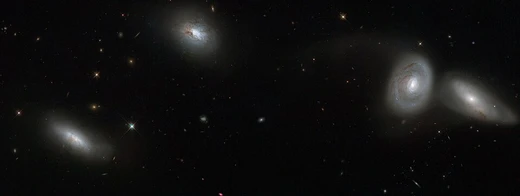
Vela Supercluster
A massive supercluster hidden behind the Milky Way's Zone of Avoidance.

The Vela Supercluster is a vast grouping of galaxies, one of the largest known structures in the universe. It lies roughly 870 million light-years away, centered on the constellation Vela, and spans an area of about 25 by 20 degrees across the sky. The supercluster is made up of two main components: a broad primary wall and a secondary wall that is merging with it. Together, these walls stretch roughly 385 million light-years along their longer axis and about 300 million light-years along the shorter one. Its total mass is around 1,000 times that of the Milky Way, or about 1 × 10¹⁵ solar masses. Astronomers have spectroscopically identified roughly 20 galaxy clusters within it.
The supercluster sits in a region known as the Zone of Avoidance, where the disk of the Milky Way blocks our view. Because of this, it can only be studied at longer wavelengths—infrared, microwave, and radio—that can penetrate the gas and dust of the galactic disk. Its discovery was announced in December 2016 by a team led by Kraan-Korteweg, based on redshift measurements of 4,500 galaxies. The data came from the 2dF Galaxy Redshift Survey, using the AAOmega fiber-optic instrument at the Anglo-Australian Observatory, along with observations from the South African Large Telescope.
The discovery paper described the supercluster as *Terra incognita*—"an unknown great continent in the nearby Universe whose outline we are only beginning to discern." Future surveys, such as the Taipan Galaxy Surveys, are expected to reveal more details about this structure.
Quick Facts
- Epoch
- J2000.0
- Constellation
- Vela, Antlia, Pyxis
- Ra
- 09 · 22 · 43
- Dec
- -50 · 07 · 08
- Major Axis Mpc
- 115 Mpc ~0.676 (Hubble constant based on 2016 Planck data)
- Redshift
- 18 000 km/s
- Distance
- 265.5 Mpc ~0.676 (Hubble constant based on 2016 Planck data)
- Mass
- 1 × 10 / 15
Facts from the source article.
Lore & Background
The Vela Supercluster was discovered in December 2016 by Kraan-Korteweg et al. through an analysis of the redshifts of 4500 galaxies from combined data of the 2dF Galaxy Redshift Survey, using the AAOmega fiber optics from the Anglo-Australian Observatory, and the South African Large Telescope. The supercluster consists of two walls: a broad main wall and a secondary merging wall. The combined dimensions of the walls are 115 km/s Mpc on the major dimensions and 90 km/s Mpc on the minor ones, corresponding to about 385 million and 300 million light-years, respectively. It is located in a region obstructed by the view of the Milky Way's disc, known as the Zone of Avoidance, so it can only be studied at longer wavelengths such as infrared, microwave, and radio, which can pass through the gases and dust of the disc.
Reader's Guide
The discovery of the Vela Supercluster is significant because it reveals a major large-scale structure in a previously hidden region of the sky, the Zone of Avoidance. The paper reporting the discovery describes the supercluster as 'Terra incognita' (Latin for 'unknown land'), 'an unknown great continent in the nearby Universe whose outline we are only beginning to discern.' This highlights how much of the universe remains unexplored due to obscuration by the Milky Way. The supercluster's mass, about 1,000 times that of the Milky Way, and its size as one of the largest structures found, underscore its importance for understanding cosmic large-scale structure. More comprehensive surveys in the future, such as the Taipan Galaxy Surveys, are expected to provide additional data about the supercluster, helping to map this 'unknown continent' and refine models of galaxy formation and evolution.
Did You Know?
- The Vela Supercluster is about 265.5 megaparsecs (870 million light-years) away.
- About 20 initial galaxy clusters have been identified spectroscopically within it.
- The supercluster can only be studied at longer wavelengths due to the Zone of Avoidance.
More in Galaxy Clusters and Groups, Part 3 1-24
Spotted an error? Know more?
Reader corrections go straight into our review queue. Suggest an edit · How this site is sourced