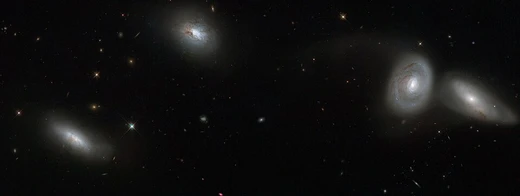
Southern Supercluster
A long chain of galaxies forming part of the Laniakea supercluster.

The Southern Supercluster is a large, nearby structure of galaxies, lying about 63.6 million light-years away across the constellations Cetus, Fornax, Eridanus, Horologium, and Dorado. Astronomer Gérard de Vaucouleurs first recognized it as a supercluster in 1953. It is built around three major clusters—the Dorado, Fornax, and Eridanus clusters—plus numerous smaller galaxy groups.
Physically, the Southern Supercluster forms a long chain stretching 134 million light-years, made up of at least 15 to 33 galaxy groups and clusters. It has two distinct segments. Region A, the richest part, is about 9.8 million light-years wide, 65.2 million light-years thick, and lies roughly 62 million light-years away, moving at a redshift of 1161 km/s. This segment runs almost parallel to the supergalactic plane. Region B is wider (42.4 million light-years) and thicker (84.8 million light-years), sits about 71.8 million light-years away with a redshift of 1403 km/s, and is oriented perpendicular to the supergalactic plane.
This supercluster connects to the Telescopium−Grus Cloud through a minor filament called the Cetus-Aries Cloud, identified in 1987 by astronomers Brent Tully and Richard Fisher. The Southern Supercluster itself is a branch of a larger filament known as the Southern Supercluster Strand, which also includes the Telescopium−Grus Cloud. This strand extends from the Centaurus Cluster all the way to the Perseus–Pisces Supercluster. Together with the Centaurus–Puppis–PP filament (which contains the Antlia Wall), the Southern Supercluster Strand forms a wall that bounds the Sculptor Void.
In 2014, it was announced that the Southern Supercluster Strand is a lobe of the even larger Laniakea supercluster, which is centered on the Great Attractor. This means the Southern Supercluster and the Telescopium−Grus Cloud are part of Laniakea, along with the Virgo Supercluster—making Laniakea our local supercluster.
The observational history of the Southern Supercluster goes back to 1847, when John Herschel noted a stream of nebulae (as galaxies were then called) across the same constellations. De Vaucouleurs later named it the "southern supergalaxy" in 1953, and most of its groups and clusters were identified by around 1975. In 1987, Tully and Fisher described the Cetus-Aries Cloud as a connecting filament between the Southern Supercluster and the Telescopium−Grus Cloud.
- Distance
- 19.5 Mpc (63.6 Mly)
- Constellations
- Cetus, Fornax, Eridanus, Horologium, Dorado
- First identified
- 1953 by Gérard de Vaucouleurs
- Length
- 41 Mpc (134 Mly)
- Main clusters
- Dorado, Fornax, Eridanus
- Region a distance
- 19 Mpc (62.0 Mly)
- Region b distance
- 22 Mpc (71.8 Mly)
Lore & Background
The Southern Supercluster is a long, 41 Mpc (134 Mly) chain of at least 15 to 33 groups and clusters of galaxies that runs through the Dorado, Fornax, and Eridanus clusters. It consists of two segments: Region A, the richest part, has a width of 3 Mpc (9.8 Mly), a thickness of 20 Mpc (65.2 Mly), lies at a distance of 19 Mpc (62.0 Mly) with a redshift of 1161 km/s, and is almost parallel to the supergalactic plane. Region B has a width of 13 Mpc (42.4 Mly), a thickness of 26 Mpc (84.8 Mly), lies at a distance of 22 Mpc (71.8 Mly) with a redshift of 1403 km/s, and is perpendicular to the supergalactic plane.
The Southern Supercluster connects to the Telescopium−Grus Cloud through the Cetus-Aries Cloud, a minor filament identified and described in 1987 by astronomer Brent Tully with colleague Richard Fisher in the book The Nearby Galaxies Atlas. The Southern Supercluster is a branch of a larger filament extending from the Centaurus Cluster known as the Southern Supercluster Strand, which also encompasses the Telescopium−Grus Cloud. This strand extends all the way to the Perseus–Pisces Supercluster. The Southern Supercluster, along with the Centaurus–Puppis–PP filament (which contains the Antlia Wall), form a wall bounding the Sculptor Void.
Observational history: In 1847, John Herschel pointed out a stream of galaxies in the same constellations. In 1953, Gérard de Vaucouleurs recognized this band as a supercluster, dubbing it the "southern supergalaxy." In 1987, Tully and Fisher identified the Cetus-Aries Cloud as a connection between the Southern Supercluster and the Telescopium−Grus Cloud. In 1989, Mitra et al. first described the physical structure based on galaxy redshifts and suspected a filament connecting to the Perseus–Pisces Supercluster, confirmed in 2017 by Pomarède et al. In 1992, Fouque et al. grouped the Cetus-Aries Cloud and the Antlia Cloud with the Southern Supercluster's three major clusters, though Brent Tully considers the Antlia Cloud part of the Virgo Supercluster. In 2013, Courtois et al. identified the Southern Supercluster Strand, designating the Southern Supercluster as branch SSCa and the Telescopium−Grus Cloud as branch SSCb.
Reader's Guide
The Southern Supercluster is significant as a nearby example of large-scale cosmic structure, first recognized by Gérard de Vaucouleurs in 1953. Its identification as a long chain of galaxies spanning 41 Mpc and containing at least 15 groups and clusters illustrates the filamentary nature of the universe. The supercluster's two distinct regions—Region A, rich and parallel to the supergalactic plane, and Region B, perpendicular—highlight structural complexity. Its connection to the Telescopium−Grus Cloud via the Cetus-Aries Cloud, and its inclusion in the Southern Supercluster Strand, which extends to the Perseus–Pisces Supercluster, places it within a vast network of galaxies. The 2014 announcement that the Southern Supercluster Strand is a lobe of the Laniakea supercluster, centered on the Great Attractor, recontextualized the Southern Supercluster as part of the local supercluster alongside the Virgo Supercluster. This discovery, along with the 2017 confirmation of the strand's extension to the Perseus–Pisces Supercluster, underscores the Southern Supercluster's role in mapping the large-scale structure of the nearby universe and its place within the hierarchy of superclusters.
Did You Know?
- The Southern Supercluster was first identified in 1953 by Gérard de Vaucouleurs, who called it the 'southern supergalaxy'.
- It is a long chain of at least 15 to 33 groups and clusters, stretching 41 Mpc (134 Mly).
More in Galaxy Clusters and Groups, Part 3 1-24
Spotted an error? Know more?
Reader corrections go straight into our review queue. Suggest an edit · How this site is sourced