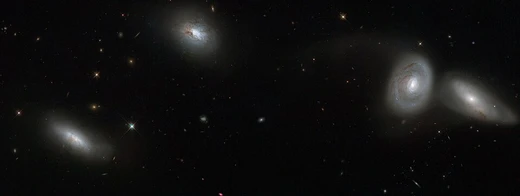
Shapley Supercluster
A bound supercluster pulling itself together, not expanding with the universe.

The Shapley Supercluster (also cataloged as SCl 124 or the Shapley Concentration) is a massive, gravitationally bound system of galaxies that is collapsing inward rather than expanding with the rest of the universe. It appears as a prominent overdensity of galaxies in the constellation Centaurus, with its core about 650 million light-years away (redshift z=0.046). Recent studies indicate that the Laniakea Supercluster—which contains the Local Group and the Milky Way—may be part of this structure, along with several other nearby superclusters that are all moving toward it.
Harlow Shapley first spotted this concentration in the early 1930s. Using photographic plates from the 24-inch Bruce telescope in South Africa, he and his Harvard colleagues surveyed the southern sky and cataloged 76,000 galaxies brighter than 18th magnitude by 1932. In that catalog, Shapley noted a particularly striking "cloud" in Centaurus, remarkable for its "great linear dimension, the numerous population and distinctly elongated form"—now recognized as the core of the supercluster. He estimated its distance as 14 times that of the Virgo Cluster, placing it at about 231 Mpc based on modern Virgo distances. The supercluster was later named by Somak Raychaudhury, who identified it using UK Schmidt Telescope plates and the Automated Plate Measuring Facility at Cambridge; he named it after Shapley in honor of his pioneering galaxy survey. Around the same time, Roberto Scaramella and colleagues independently noticed it in the Abell catalog, calling it the Alpha concentration.
The structure spans roughly 260 megaparsecs, covering redshifts from 0.033 to 0.06 (mean z=0.048). Its core region, between right ascension 198–204 degrees and declination −34 to −29 degrees, contains 11 clusters and groups—including A3552, A3554, A3556, A3558, A3559, A3560, A3562, AS0724, AS0726, SC1327-312, and SC1329-313—with masses ranging from about 1 to 6×10¹⁴ solar masses. Among these, A3558 and A3528 are merging X-ray clusters forming two complex structures at the center and outskirts. The high-density core, likely the largest collapsing core of any local supercluster, has a mass of about 1.3×10¹⁶ solar masses and a radius of 12.4 Mpc.
Quick Facts
- Epoch
- J2000
- Constellation
- Centaurus
- Ra
- 13 · 25
- Dec
- -30 · 0 · 0
- Major Axis Mpc
- 191.5 Mpc / (300.0 Mpc?)
- Distance
- 200 Mpc
Facts from the source article.
Lore & Background
In 1930, Harlow Shapley and his colleagues at the Harvard College Observatory started a survey of galaxies in the southern sky, using photographic plates obtained at the 24-inch Bruce telescope at Bloemfontein, South Africa. By 1932, Shapley reported the discovery of 76,000 galaxies brighter than 18th apparent magnitude in a third of the southern sky, based on galaxy counts from his plates. In this catalog, Shapley could see most of the 'Coma-Virgo cloud' (now known to be a superposition of the Coma Supercluster and the Virgo Supercluster), but found a 'cloud' in the constellation of Centaurus to be the most striking concentration of galaxies. He found it particularly interesting because of its 'great linear dimension, the numerous population and distinctly elongated form'. This can be identified with what we now know as the core of the Shapley Supercluster. Shapley estimated the distance to this cloud to be 14 times that to the Virgo Cluster, from the average diameters of the galaxies. In recent times, the Shapley Supercluster was named by Somak Raychaudhury, from a survey of galaxies from UK Schmidt Telescope Sky survey plates, using the Automated Plate Measuring Facility (APM) at the University of Cambridge in England. Around the same time, Roberto Scaramella and co-workers had also noticed the Shapley Supercluster in the Abell catalogue of clusters of galaxies: they had named it the Alpha concentration.
The Shapley Supercluster (SCC) is described as a miniature universe that extends over ≈260 megaparsecs (Mpc) and covers a redshift range from 0.033 to 0.06 (with a mean redshift z = 0.048). Its core region, with the right ascension ranging between 198 and 204 degrees and declination ranging between −34 and −29 degrees, includes 11 clusters and groups with masses in the range M500 ≈ (1–6)×10^14 M☉. Among these, A3558 and A3528 are merging X-ray clusters that form two complex structures in the centre and in the outskirts of SSC. The high-density core of the Shapley supercluster is probably the largest among the collapsing cores of superclusters in the local Universe with a mass around 1.3×10^16 M☉ and a radius of 12.4 Mpc. In another research paper, it states that Shapley Supercluster consist of 28 galaxy clusters. In another research paper, Shapley Supercluster is detected to have three concentration areas: the central concentration (Abell 3556, Abell 3558, Abell 3560, Abell 3564, Abell 3566), a second concentration (Abell 3528, Abell 3530, Abell 3532), and a third concentration known as 'Front Eastern Wall' (Abell 3571, Abell 3572, Abell 357).
Reader's Guide
The Shapley Supercluster lies very close to the direction in which the Local Group of galaxies (including our galaxy) is moving with respect to the cosmic microwave background (CMB) frame of reference. This has led many to speculate that the Shapley Supercluster may be one of the major causes of our galaxy's peculiar motion—the Great Attractor may be another—and has led to a surge of interest in this supercluster. It has been found that the Great Attractor and all the galaxies in our region of the universe (including our galaxy, the Milky Way) are moving toward the Shapley Supercluster. In 2017 it was proposed that the movement towards attractors like the Shapley Attractor in the supercluster creates a relative movement away from underdense areas, that may be visualized as a virtual repeller. This approach enables new ways of understanding and modelling variations in galactic movements. The nearest large underdense area has been labelled the dipole repeller. The supercluster's role as a major gravitational attractor influencing the motion of our Local Group and the Great Attractor underscores its significance in understanding large-scale flows and the structure of the local universe.
Did You Know?
- The Shapley Supercluster was first seen as a 'cloud' in Centaurus by Harlow Shapley in the 1930s.
- It is one of the largest bound concentrations of galaxies, pulling itself together rather than expanding with the universe.
- The Shapley Supercluster may contain the Laniakea Supercluster, which includes the Milky Way.
More in Galaxy Clusters and Groups, Part 3 1-24
Spotted an error? Know more?
Reader corrections go straight into our review queue. Suggest an edit · How this site is sourced