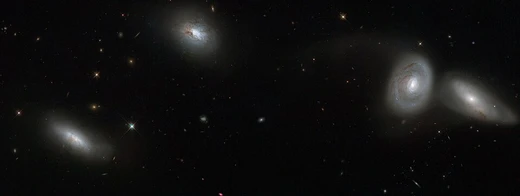
Saraswati Supercluster
One of the largest known superclusters, located 4 billion light years away.

The Saraswati Supercluster is a vast galaxy supercluster located roughly 1.2 gigaparsecs (4 billion light-years) from Earth, found in the Stripe 82 region of the Sloan Digital Sky Survey and oriented toward the constellation Pisces. With a major axis spanning about 200 megaparsecs (652 million light-years), it ranks among the largest known structures in the universe. This supercluster contains at least 43 galaxy clusters and has a total mass of 2 × 10^16 solar masses, forming a galaxy filament.
The name comes from the Hindu goddess of knowledge, Saraswati, and the legendary Saraswati River (often linked to the present-day Ghaggar-Hakra River). In Sanskrit, the name also means “ever flowing stream with many pools,” reflecting how the supercluster’s many clusters and groups move and merge together.
A team of astrophysicists from the Inter-University Centre for Astronomy and Astrophysics and the Indian Institute of Science Education and Research, led by Joydeep Bagchi in Pune, India, discovered the supercluster in 2017. They analyzed data from the Stripe 82 region of the Sloan Digital Sky Survey, specifically the LOWZ data sets from the Baryon Oscillation Spectroscopic Survey and the LEGACY-BOSS-SOUTHERN survey (both part of the SDSS DR12 catalogue). This analysis revealed an overdensity among 625 galaxies from LOWZ and 3,016 from the LEGACY-BOSS-SOUTHERN sample.
The Saraswati Supercluster is among the largest and most massive superclusters known, comparable to the nearby Shapley Concentration. It comprises 43 massive galaxy clusters, the most massive being Abell 2631 and ZwCL 2341.1+0000, and is surrounded by a network of galaxy filaments, clusters, and voids. This structure and its surroundings show that some extreme, large-scale matter density enhancements had already formed in the past, when dark energy was just beginning to dominate structure formation. The concentration helps clarify the role of dark energy and cosmological initial conditions in the formation of superclusters.
Quick Facts
- Epoch
- J2000.0
- Constellation
- Pisces
- Member No
- 43 clusters
- Major Axis Mpc
- 200 Mpc
- Redshift
- 0.28
- Distance
- 1.2 Gpc
Facts from the source article.
Lore & Background
The Saraswati Supercluster was discovered in 2017 by a team of astrophysicists from the Inter-University Centre for Astronomy and Astrophysics and Indian Institute of Science Education and Research led by Joydeep Bagchi and colleagues in Pune, India. Analyzing data from Stripe 82 of the Sloan Digital Sky Survey, particularly the LOWZ data from the Baryon Oscillation Spectroscopic Survey (part of the DR12 catalogue), the team detected an overdensity of 625 galaxies from LOWZ and 3,016 from the LEGACY-BOSS-SOUTHERN survey.
The supercluster is named after the Hindu goddess of knowledge Saraswati and the legendary Saraswati River, as the Sanskrit name also means “ever flowing stream with many pools,” reflecting the supercluster's many clusters and groups moving and merging together. It consists of 43 massive galaxy clusters, the most massive being Abell 2631 and ZwCL 2341.1+0000, and is surrounded by a network of galaxy filaments, clusters, and voids.
Reader's Guide
The Saraswati Supercluster is one of the largest and most massive superclusters known, comparable to the massive Shapley Concentration in the nearby universe. Its discovery and study reveal that some extreme large-scale, prominent matter density enhancements had formed in the past when dark energy had just started to dominate structure formation. This galactic concentration sheds light on the role of dark energy and cosmological initial conditions in supercluster formation. The supercluster's existence within the Stripe 82 region of the SDSS, as identified through the LOWZ and LEGACY-BOSS-SOUTHERN datasets, provides a valuable laboratory for understanding how large-scale structures evolve under the influence of dark energy. Its mass of 2 × 10^16 M☉ and diameter of about 200 Mpc make it a key object for testing cosmological models of structure formation.
Did You Know?
- The Saraswati Supercluster is about 1.2 gigaparsecs (4 billion light years) away.
- It has a major axis diameter of about 200 Mpc (652 million light years).
- The supercluster consists of at least 43 galaxy clusters.
- It was discovered in 2017 by a team led by Joydeep Bagchi.
More in Galaxy Clusters and Groups, Part 3 1-24
Spotted an error? Know more?
Reader corrections go straight into our review queue. Suggest an edit · How this site is sourced