Pavo–Indus Supercluster
A neighboring supercluster forming a lobe of Laniakea.

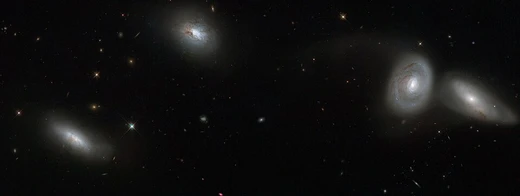
The Pavo–Indus Supercluster is a neighboring supercluster located about 60–70 Mpc (196–228 Mly) away in the constellations of Pavo, Indus, and Telescopium. It contains three main clusters, Abell 3656, Abell 3698, and Abell 3742, along with other groups such as the NGC 6769 Group and Abell S805. Notably, in 2014 it was announced that the Pavo–Indus Supercluster is a lobe in the greater Laniakea Supercluster, which is centered on the Great Attractor, and also includes the Virgo Supercluster.
Quick Facts
- Parent
- Laniakea Supercluster
- Epoch
- J2000
- Constellation
- Pavo, Indus, Telescopium
- Ra
- 20 · 48 · 26
- Dec
- -39 · 06 · 09
- Major Axis Mpc
- 66 Mpc
- Redshift
- 0.015 (4,500 km/s)
- Distance
- 60-70 Mpc
- Other Names
- SCL 175
Facts from the source article.
Lore & Background
The Pavo–Indus Supercluster exhibits a wall or filamentary structure extending to a total length of 66 Mpc. Along with the Telescopium−Grus Cloud, it forms parts of a wall bounding the Local Void and the Sculptor Void. In 1983, Winkler et al. suggested based on redshift maps that the Pavo–Indus Supercluster may be connected to the Centaurus Supercluster. Later, in 1984 and in a 1988 paper by Fairall titled 'A redshift map of the Triangulum Australe–Ara region: further indication that Centaurus and Pavo are one and the same supercluster,' it was concluded that Pavo–Indus was indeed connected to the Centaurus and Hydra supercluster, and that the Virgo Supercluster was an appendage of a larger structure. Subsequent studies concluded that Pavo–Indus formed part of a wall of galaxies similar in size to the CfA2 Great Wall, dubbed the Norma Wall, with the Norma Cluster at its center. This wall encompasses the Pavo–Indus supercluster through the Norma Cluster, passing the Zone of Avoidance in the Great Attractor region, to meet up with the Centaurus–Crux Cluster and the CIZA J1324.7−5736 cluster, while also splitting off to form the Centaurus Wall.
Reader's Guide
The Pavo–Indus Supercluster is significant as a key component of the Laniakea Supercluster, the vast structure that also contains the Virgo Supercluster and is centered on the Great Attractor. Its connection to the Centaurus and Hydra superclusters, as established by Fairall and others, helped reveal the large-scale filamentary architecture of the nearby universe. The supercluster's role in the Norma Wall—a structure comparable to the CfA2 Great Wall—highlights its importance in mapping the distribution of galaxies and voids. The disputed relationship with the Perseus–Pisces Supercluster, where Di Nella et al. found no evidence of a connection but Tully et al. revealed a filamentary extension called the Arch that caps the Local Void and provides a connection, underscores ongoing research into cosmic web connectivity. Additionally, its physical proximity to the Ophiuchus Supercluster suggests a possible unknown filament linking the two, further emphasizing the complexity of supercluster interactions.
Did You Know?
- The Pavo–Indus Supercluster is located about 60–70 Mpc away in the constellations Pavo, Indus, and Telescopium.
- It contains three main Abell clusters: Abell 3656, Abell 3698, and Abell 3742.
- In 2014, it was announced as a lobe of the greater Laniakea Supercluster.
- The supercluster forms part of the Norma Wall, a structure similar in size to the CfA2 Great Wall.
Frequently Asked Questions
What is the Pavo–Indus Supercluster?
It is a neighboring supercluster in the southern sky that stretches roughly 66 megaparsecs (about 215 million light-years) end to end. It is composed of several galaxy clusters and groups held together by gravity, forming a distinct lobe within the larger cosmic web.
How far away is the Pavo–Indus Supercluster from Earth?
It lies approximately 60 to 70 megaparsecs, or 196–228 million light-years, from our vantage point. That distance places it noticeably beyond the Virgo Supercluster while still sitting inside the broader Laniakea structure.
Which galaxy clusters and groups make up the Pavo–Indus Supercluster?
Three Abell clusters—Abell 3656, Abell 3698, and Abell 3742—form its core, supplemented by smaller structures such as the NGC 6769 Group and Abell S805 (the IC 4765 Group). Additional members include the Pavo II and DRCG 1842-63 groups as well as the Norma Cluster.
Is the Pavo–Indus Supercluster independent or part of a larger structure?
A 2014 reclassification confirmed that it is actually a lobe of the Laniakea Supercluster, the enormous structure centered on the Great Attractor. Laniakea also contains the Virgo Supercluster, so Pavo–Indus is one of its constituent arms rather than a standalone entity.
In which constellations can I locate the Pavo–Indus Supercluster?
It spans the southern-sky constellations of Pavo, Indus, and Telescopium. Because of that placement, it is best observed from mid- to high-southern latitudes during the appropriate season.
More in Galaxy Clusters and Groups, Part 3 1-24
Spotted an error? Know more?
Reader corrections go straight into our review queue. Suggest an edit · How this site is sourced