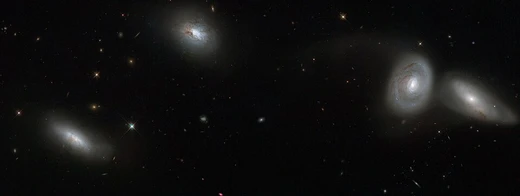
NGC 759
Elliptical galaxy with a face-on dust disk and star formation.

NGC 759, an elliptical galaxy in the constellation Andromeda, lies about 230 million light-years from Earth. It belongs to the galaxy cluster Abell 262. Although cataloged as a radio galaxy, its radio emissions might stem from star formation rather than an active galactic nucleus.
At its core, NGC 759 contains a face-on dust disk, roughly 11,000 light-years across, with tightly wound spiral arms. Within this disk lies a smaller circumnuclear molecular gas ring, about 4,200 light-years in diameter, where star formation occurs in H II regions. These structures may have formed from a merger of gas-rich disk galaxies or from gas accretion. One scenario, proposed by Vlasyuk et al., suggests a tidal encounter with a large spiral galaxy, accompanied by substantial gas accretion, created both the disk and the inner ring.
The galaxy holds about 2.4 billion solar masses of molecular gas, most concentrated in that circumnuclear ring. This gas likely originated from the same merger event that produced the ring and main disk.
One supernova, SN 2002fb, has been observed in NGC 759. Discovered on September 6, 2002, by the Lick Observatory and Tenagra Observatory Supernova Searches, it was a Type Ia event with a magnitude of 17.1.
Quick Facts
- Constellation Name
- Andromeda
- Epoch
- J2000
- Ra
- 01 · 57 · 50.3
- Dec
- 36 · 20 · 35
- Dist Ly
- 70.4 Mpc
- Z
- 0.015567
- H Radial V
- 4667 km/s
- Group Cluster
- Abell 262
- Appmag V
- 13.3
- Names
- MCG 6-5-67, PGC 7397, UGC 1440
Facts from the source article.
Lore & Background
NGC 759 was discovered by astronomer Heinrich d'Arrest on September 17, 1865. It is a member of Abell 262. The central region of NGC 759 harbors a face-on dust disk with tightly wound spiral structure, measuring 11,000 light-years (3.4 kpc) in diameter. Within this disk lies a smaller circumnuclear molecular gas ring, 4,200 light-years (1.3 kpc) across, that hosts star formation in H II regions. These features may be the result of a merger of gas-rich disk galaxies or by the accretion of gas-rich material, where gas lost momentum and fell to the center. However, Vlasyuk et al. suggests the disk and ring formed from a tidal encounter between NGC 759 and a large spiral galaxy accompanied by substantial gas accretion.
NGC 759 contains 2.4 billion solar masses of molecular gas, most concentrated in the circumnuclear ring. The gas may originate from the same merger event that produced the ring and main disk. One supernova has been observed in NGC 759: SN 2002fb, a Type Ia supernova of magnitude 17.1, discovered by LOTOSS on September 6, 2002. Despite being classified as a radio galaxy, the radio emission could be due to star formation rather than an active galactic nucleus.
Reader's Guide
NGC 759 is significant as an elliptical galaxy that challenges simple classifications. Although categorized as a radio galaxy, its radio emission may originate from star formation rather than an active galactic nucleus, highlighting the complexity of interpreting radio sources. Its face-on dust disk and circumnuclear molecular gas ring with ongoing star formation provide evidence of a past merger or tidal encounter with a gas-rich spiral galaxy. The presence of 2.4 billion solar masses of molecular gas, mostly in the ring, and a Type Ia supernova (SN 2002fb) add to its astrophysical interest. As a member of Abell 262, NGC 759 contributes to understanding galaxy evolution in cluster environments. The uncertainty over the origin of its disk and ring—whether from a merger or tidal encounter—underscores the ongoing debate about how elliptical galaxies acquire gas and trigger star formation. Its legacy lies in illustrating that elliptical galaxies can host complex, star-forming structures typically associated with spirals.
Did You Know?
- NGC 759 was discovered by Heinrich d'Arrest on September 17, 1865.
- It contains a face-on dust disk with a diameter of 11,000 light-years.
- One supernova, SN 2002fb (Type Ia), was observed in NGC 759 on September 6, 2002.
More in Galaxy Clusters and Groups, Part 3 1-24
Spotted an error? Know more?
Reader corrections go straight into our review queue. Suggest an edit · How this site is sourced