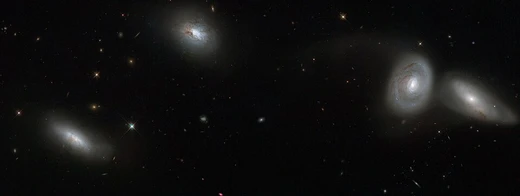
NGC 7016
Elliptical radio galaxy in Abell 3744 with bent jets.

NGC 7016 is an elliptical galaxy roughly 480 million light-years away in the constellation Capricornus. It moves at a calculated velocity of 11,046 km/s and spans an estimated 160,000 light-years in diameter. American astronomer Francis Preserved Leavenworth discovered it on July 8, 1885. The galaxy hosts a supermassive black hole with an estimated mass of 1.4 billion solar masses.
In the galaxy cluster Abell 3744, NGC 7016 is one of two notable radio galaxies, the other being the double galaxy system NGC 7018. These two sit together in the cluster’s central region. NGC 7016 is a Fanaroff-Riley type I radio galaxy, featuring bent, asymmetric jets. Lower-resolution data from the VLA reveal a long, bent jet extension on the galaxy’s left side, forming a tendril-like structure. On the opposite side, the counterjet shows extreme looping, creating a feature called the “swirl.” This swirl is thought to result from the jet colliding with radio plasma from NGC 7018, as well as from an interaction with a wake of gas left by the motion of NGC 7018 and its companion galaxy through the cluster.
Quick Facts
- Epoch
- J2000
- Ra
- 21 · 07 · 16.3
- Dec
- -25 · 28 · 08
- Dist Ly
- 147 Mpc
- Z
- 0.036845
- H Radial V
- 11,046 km/s
- Appmag V
- 14.85
- Absmag B
- -22.97 ± 0.14
- Constellation Name
- Capricornus
- Names
- ESO 529-25, AM 2104-254, MCG -4-49-13, PRC C-58 PGC 66136
Facts from the source article.
Lore & Background
NGC 7016 is a Fanaroff-Riley type I radio galaxy, characterized by bent asymmetric jets. Lower-resolution radio data from the VLA reveal a very long, bent extension of the jet on the left side of the galaxy, forming a tendril structure. On the counterjet side, extreme looping creates a feature referred to as the 'swirl.' This swirl is thought to result from the jet colliding with radio plasma from NGC 7018, as well as an interaction with a wake of gas left by the motion of NGC 7018 and its companion galaxy through the cluster. The galaxy was discovered by American astronomer Francis Preserved Leavenworth on July 8, 1885.
Reader's Guide
NGC 7016's significance lies in its role as a prominent radio galaxy within Abell 3744, where its interaction with NGC 7018 provides a laboratory for studying jet dynamics and cluster physics. The bent asymmetric jets and the 'swirl' feature, likely shaped by collisions with NGC 7018's radio plasma and gas wakes, illustrate complex feedback processes between supermassive black holes and their environment. The galaxy hosts a supermassive black hole with an estimated mass of 1.4 billion solar masses, linking its radio activity to a central engine. Its discovery by Francis Preserved Leavenworth in 1885 adds historical context, while its inclusion in the NGC catalog (7001–7840) ensures its place in astronomical reference. The VLA observations highlight the value of multi-wavelength data in revealing structures like the tendril and swirl, which inform models of jet propagation and cluster evolution.
Did You Know?
- NGC 7016 is an elliptical galaxy about 480 million light-years away in Capricornus.
- It is a Fanaroff-Riley type I radio galaxy with bent asymmetric jets.
- It was discovered by Francis Preserved Leavenworth on July 8, 1885.
More in Galaxy Clusters and Groups, Part 3 1-24
Spotted an error? Know more?
Reader corrections go straight into our review queue. Suggest an edit · How this site is sourced