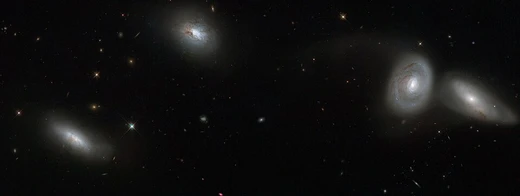
NGC 6166
Supergiant elliptical with the richest known globular cluster system.

NGC 6166 is a supergiant elliptical galaxy that sits at the heart of the Abell 2199 cluster, about 490 million light-years away in the constellation Hercules. As the cluster’s dominant member, it ranks among the most X-ray-luminous galaxies ever observed.
This galaxy is a massive cD type, with several smaller galaxies embedded within its outer envelope. Astronomers think it formed through multiple galaxy collisions, and it hosts an extraordinary number of globular clusters—estimates from 1996 ranged between 6,200 and 22,000, but a 2016 study pushed that figure to roughly 39,000, suggesting the galaxy’s halo merges seamlessly with the surrounding intra-cluster medium. This makes NGC 6166 home to the richest known globular cluster system.
At its core lies a supermassive black hole, with a mass of about 28.4 billion solar masses (give or take a few billion), as determined by dynamical modeling. The galaxy also contains an active nucleus classified as an FR I source, which drives two symmetric, parsec-scale radio jets and lobes. These features arise from gas falling into the center due to a cooling flow that deposits roughly 200 solar masses of gas there every year. Some evidence suggests O-type stars may exist near the galaxy’s center.
Two supernovae have been spotted in NGC 6166: SN 2009eu, a Type Ia event at magnitude 19.5, discovered by the Lick Observatory Supernova Search on May 21, 2009; and PSN J16283836+3932552, a Type Ia-91bg supernova also at magnitude 19.5, found by R. Gagliano, D. Post, Jack Newton, and Tim Puckett on May 15, 2015.
Quick Facts
- Epoch
- J2000
- Ra
- 16 · 28 · 38.276
- Dec
- +39 · 33 · 04.97
- Dist Ly
- 490 Mly / (142 Mpc)
- H Radial V
- −9100 km/s
- Appmag V
- 12.78
- Constellation Name
- Hercules
- Absmag V
- −24.1
- Names
- UGC 10409, PGC 58265, CGCG 2205.6+3107 0504, MCG +07-34-060, 3C 338
Facts from the source article.
Lore & Background
NGC 6166 is a supermassive, type cD galaxy, with several smaller galaxies within its envelope. It is suspected to have formed through a number of galaxy collisions, and it has a large number of globular clusters orbiting it: an estimated 6,200 to 22,000 in 1996, and a 2016 study gave an even higher number of around 39,000, suggesting that the halo of this galaxy blends smoothly with the intra-cluster medium. Because of that, the galaxy has the richest globular cluster system known.
The galaxy harbors a supermassive black hole at its center with a mass of 28.4 billion +2.7−1.8 M☉, nearly 30 billion M☉ based on dynamical modelling. NGC 6166 is known to host an active nucleus, classified as an FR I source, which powers two symmetric parsec-scale radio jets and radio lobes. These are caused by the infall of gas into its center due to a cooling flow that deposits 200 solar masses of gas every year there. It has been proposed that a number of O-type stars may be present in the center of NGC 6166.
Reader's Guide
NGC 6166 is significant as the primary galaxy of the Abell 2199 cluster and one of the most luminous galaxies known in X-ray emissions. Its status as a cD galaxy with several smaller galaxies within its envelope suggests it formed through multiple galaxy collisions, making it a key example of hierarchical galaxy assembly. The galaxy's globular cluster system is the richest known, with estimates ranging from 6,200 to 22,000 in 1996 to around 39,000 in 2016, indicating an exceptionally dense and extended halo that blends with the intra-cluster medium. The central supermassive black hole, with a mass of nearly 30 billion solar masses, drives an active FR I nucleus that produces radio jets and lobes, fueled by a cooling flow depositing 200 solar masses of gas annually. Two supernovae have been observed: SN 2009eu (Type Ia, mag. 19.5) discovered in 2009, and PSN J16283836+3932552 (Type Ia-91bg, mag. 19.5) discovered in 2015. These features make NGC 6166 a crucial laboratory for studying galaxy evolution, black hole growth, and cluster dynamics.
Did You Know?
- NGC 6166 is one of the most luminous galaxies known in terms of X-ray emissions.
- It has the richest globular cluster system known, with an estimated 39,000 globular clusters in 2016.
- The central black hole has a mass of nearly 30 billion solar masses.
- Two supernovae have been observed in NGC 6166: SN 2009eu and PSN J16283836+3932552.
More in Galaxy Clusters and Groups, Part 3 1-24
Spotted an error? Know more?
Reader corrections go straight into our review queue. Suggest an edit · How this site is sourced