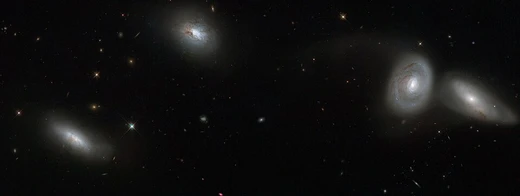
NGC 5102
Lenticular galaxy in Centaurus A/M83 Group, discovered by John Herschel.

NGC 5102, nicknamed Iota's Ghost due to its proximity to the star Iota Centauri, is a lenticular galaxy within the Centaurus A/M83 Group. It was first observed by the British astronomer John Herschel on April 21, 1835.
Astronomers have determined its distance using two separate methods. One approach, surface brightness fluctuations, which gauges the graininess of a galaxy's bulge, yields a distance of about 13.0 ± 0.8 million light-years. The other, the tip of the red giant branch technique, gives a slightly closer estimate of 11.1 ± 1.3 million light-years. When averaged, these measurements place NGC 5102 at roughly 12.1 ± 0.7 million light-years away.
Though no supernovae have been recorded in this galaxy, it is near enough for classical novae to be spotted. The first confirmed nova here, designated AT 2026ofr, was detected by the ATLAS survey on June 5, 2026, at a magnitude of 18.464.
Quick Facts
- Epoch
- J2000
- Ra
- 13 · 21 · 57.6070
- Dec
- -36 · 37 · 48.878
- Dist Ly
- 12.1 ± 0.7 Mly (3.70 ± 0.23 Mpc)
- Z
- 468 ± 2 km/s
- Appmag V
- 10.4
- Constellation Name
- Centaurus
Facts from the source article.
Lore & Background
NGC 5102 was discovered by British astronomer John Herschel on 21 April 1835. It is a lenticular galaxy located in the Centaurus A/M83 Group of galaxies, and is also known as Iota's Ghost because it appears near Iota Centauri in the sky. The galaxy's distance has been measured using two techniques: the surface brightness fluctuations method, which estimates distances to spiral galaxies based on the graininess of their bulges, and the tip of the red giant branch (TRGB) method, applicable because NGC 5102 is relatively close. The surface brightness fluctuations measurement gives a distance of 13.0 ± 0.8 Mly (4.0 ± 0.2 Mpc), while the TRGB method yields 11.1 ± 1.3 Mly (3.40 ± 0.39 Mpc). Averaged together, these give a distance estimate of 12.1 ± 0.7 Mly (3.70 ± 0.23 Mpc).
Reader's Guide
NGC 5102 is significant as a member of the Centaurus A/M83 Group, a nearby collection of galaxies, and for the multiple distance measurements that have been applied to it. The use of both surface brightness fluctuations and the tip of the red giant branch method provides a cross-check on its distance, with the averaged result of 12.1 ± 0.7 Mly (3.70 ± 0.23 Mpc) offering a refined estimate. Although no supernovae have been observed in NGC 5102, its proximity allows for the detection of classical novae. The first confirmed nova in this galaxy was discovered by ATLAS on 5 June 2026 at magnitude 18.464, designated AT 2026ofr. This detection highlights the galaxy's value as a site for studying stellar outbursts in a nearby lenticular galaxy. The galaxy's alternative name, Iota's Ghost, reflects its visual proximity to Iota Centauri in the night sky.
Did You Know?
- The first confirmed nova in NGC 5102 was discovered by ATLAS on 5 June 2026 and designated AT 2026ofr.
- Two distance measurement techniques have been used for NGC 5102: surface brightness fluctuations and the tip of the red giant branch method.
More in Galaxy Clusters and Groups, Part 3 1-24
Spotted an error? Know more?
Reader corrections go straight into our review queue. Suggest an edit · How this site is sourced