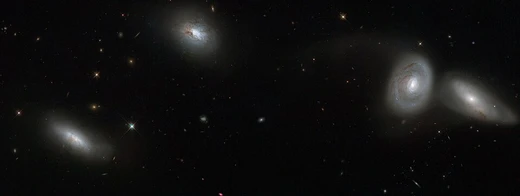
NGC 4945
A nearby barred spiral galaxy with a hidden active nucleus.

NGC 4945 is a barred spiral galaxy in the constellation Centaurus, visible near the optical double star Xi Centauri. It is also known as Caldwell 83 and was discovered by Scottish astronomer James Dunlop in 1826. Located approximately 11.0 million light-years (3.36 Mpc) from the Milky Way, it hosts one of the closest active galactic nuclei to Earth and is classified as a Seyfert 2 galaxy. It is one of the brightest galaxies of the Centaurus A/M83 Group and the second brightest in the subgroup centered on Centaurus A.
Quick Facts
- Epoch
- J2000
- Constellation Name
- Centaurus
- Ra
- 13 · 05 · 27.279
- Dec
- -49 · 28 · 04.44
- Z
- 0.0018680.00002
- Dist Ly
- 3.36 ±
- Group Cluster
- Centaurus A/M83 Group
- Mass
- 1.4e11 · 1.4 · 0.7
- Appmag V
- 9.3
- Notes
- Seyfert 2 galaxy
Facts from the source article.
Lore & Background
NGC 4945 is a barred spiral galaxy with a morphological classification of SB(s)cd?edge, indicating no inner ring structure and possibly loosely-wound spiral arms. It is viewed edge-on, inclined at 90° to the plane of the sky, and is thought to be similar to the Milky Way, though its maximum rotation rate of about 180 km/s is lower. The galaxy has a combined estimated mass of 1.4+1.4−0.7×10^11 M☉ and a stellar mass of 3.8×10^10 M☉. In 1964, it was classified as a radio source at the Parkes Observatory. Its nucleus is obscured in the optical band but is a prominent source of infrared emission, being the third brightest galaxy in the IRAS point source catalogue. Most of the galaxy shows a linear rotation curve, though the southwest region shows an infall suggestive of a bar. In 1979, strong H2O maser emission was detected from the central region. The nuclear region exhibits properties suggestive of both a Seyfert type galaxy and an intense starburst region with complex structure. The active nucleus is heavily obscured by dust, with dust lanes forming a tightly-wound structure in the inner 650 ly (200 pc). X-ray emission indicates a Type 2 Seyfert galaxy, and it is a strong emitter of hard X-rays, second only to NGC 4151, likely harboring a supermassive black hole. The starburst region is thought to be at least 5×10^6 years old and contributes at least half of the core's luminosity, concentrated in the central 330 ly (100 pc) and including a conical cavity likely produced by supernovae-driven winds. A hot wind from the nuclear region carries away 1.6 M☉ per year. NGC 4945 was the first galaxy outside the Local Group to have stars resolved within its galactic halo. The halo mass is about 3.5×10^9 M☉ and is metal-rich, typical for a Milky Way-like galaxy, and appears to be counter-rotating compared to the main disk, suggesting accretion. The mass of the dominant satellite accreted into the halo is about 1.5×10^9 M☉, roughly the same as the Large Magellanic Cloud. In October 2023, researchers using ALMA discovered an unknown object about 200 light-years from the center, named Punctum (Latin for 'point' or 'dot'), a highly-polarized millimeter continuum source of synchrotron radiation. It has high non-visible luminosity, with Chandra data reporting a 1×10^37 erg s−1 X-ray luminosity in the 3–6 keV range and ATCA data reporting a radio luminosity of 5×10^35 erg s−1 at 23 GHz. A July 2025 paper suggested it most resembles a magnetar due to its polarization of 50%±14%, though the millimeter luminosity of such objects is usually much lower.
Reader's Guide
NGC 4945 is significant as one of the closest active galactic nuclei to Earth, providing a valuable laboratory for studying Seyfert 2 galaxies and the interplay between an active nucleus and a starburst region. Its edge-on orientation allows detailed study of dust lanes and nuclear structure, while its status as the second brightest galaxy in the Centaurus A subgroup highlights its prominence in a nearby group. The discovery of Punctum in 2023, a highly-polarized millimeter source possibly a magnetar, adds to its legacy as a site of unusual astrophysical phenomena. The galaxy's halo, the first resolved outside the Local Group, offers insights into galaxy formation and accretion history. Two observed supernovae (SN 2005af and SN 2011ja) further contribute to its importance for stellar evolution studies. Its similarity to the Milky Way makes it a key object for comparative galactic research.
Did You Know?
- In October 2023, researchers discovered a highly-polarized millimeter source named Punctum near its center, possibly a magnetar.
- Two supernovae have been observed in NGC 4945: SN 2005af (2005) and SN 2011ja (2011).
More in Galaxy Clusters and Groups, Part 3 1-24
Spotted an error? Know more?
Reader corrections go straight into our review queue. Suggest an edit · How this site is sourced