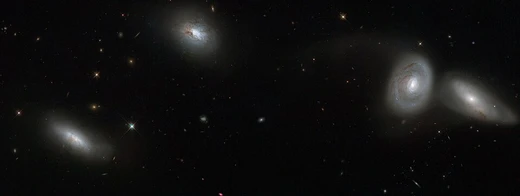
NGC 4921
Brightest spiral in Coma Cluster, anemic and hydrogen-deficient.

NGC 4921 is a large barred spiral galaxy situated in the Coma Cluster, within the constellation Coma Berenices. Discovered by German-British astronomer William Herschel on April 11, 1785, it lies about 320 million light-years from Earth. Its nucleus features a bar structure encircled by a distinct dust ring, which contains hot, blue stars that formed recently. The galaxy’s outer spiral arms are unusually smooth and poorly defined.
In 1976, Canadian astronomer Sidney Van den Bergh described NGC 4921 as “anemic” due to its low star-formation rate. He noted its “unusually low surface brightness” and “remarkably diffuse spiral arms.” Despite this, it remains the brightest spiral galaxy in the Coma Cluster.
Located near the cluster’s center, NGC 4921 has a high relative velocity of 7,560 km/s compared to the mean cluster velocity. Observations at the 21 cm hydrogen line reveal it is strongly deficient in neutral hydrogen (H I). The hydrogen distribution is heavily disturbed toward the southeast spiral arm and is less extended than the galaxy’s optical disk. This may result from interaction with the intergalactic medium, which strips gas via ram pressure. Some stripped gas filaments appear to fall back to the galaxy, possibly making NGC 4921 the first observational evidence of such fallback.
One supernova, SN 1959B, was observed in NGC 4921. Discovered on May 4, 1959, by Milton Humason using a Schmidt telescope at Palomar Observatory, it had an unknown type and a magnitude of 18.5. It appeared “quite far from the center” of the galaxy. Its light curve resembled that of SN 1987A in the Large Magellanic Cloud and showed “unusual photometric behavior.”
Quick Facts
- Epoch
- J2000
- Ra
- 13 · 01 · 26.1196
- Dec
- +27 · 53 · 09.602
- Dist Ly
- ca. 320 Mly
- Z
- 0.018286; 5,482 km/s
- Constellation Name
- Coma Berenices
- Group Cluster
- Coma Cluster
- Appmag V
- 13.04
Facts from the source article.
Lore & Background
NGC 4921 was discovered by German-British astronomer William Herschel on 11 April 1785. The galaxy has a nucleus with a bar structure surrounded by a distinct ring of dust that contains recently formed, hot blue stars. Its outer part consists of unusually smooth, poorly distinguished spiral arms. In 1976, Canadian astronomer Sidney Van den Bergh categorized this galaxy as 'anemic' because of the low rate at which stars are being formed, noting its unusually low surface brightness and remarkably diffuse spiral arms. The galaxy is located near the center of the Coma Cluster and has a high relative velocity of 7,560 km/s compared to the mean cluster velocity. When examined at the 21 cm wavelength Hydrogen line, NGC 4921 was found to be strongly H I deficient, indicating it is low in hydrogen. The distribution of hydrogen has been deeply perturbed toward the SE spiral arm and is less extended than the optical disk of the galaxy, possibly caused by interaction with the intergalactic medium stripping off gas via ram pressure. Some filaments of gas that have been stripped away are falling back to the galaxy, making NGC 4921 possibly the first observational evidence of this fallback.
Reader's Guide
NGC 4921 holds significance as the brightest spiral galaxy in the Coma Cluster, yet it is classified as 'anemic' due to its low star formation rate, unusually low surface brightness, and diffuse spiral arms. Its high relative velocity and strong hydrogen deficiency suggest ongoing environmental effects, likely ram-pressure stripping from the intergalactic medium. The perturbed hydrogen distribution and the observation of gas filaments falling back to the galaxy may represent the first observational evidence of such fallback. The only supernova observed in this galaxy, SN 1959B, was discovered by Milton Humason on May 4, 1959, using a Schmidt telescope at the Palomar Observatory. It appeared quite far from the center, and its light curve proved similar to supernova SN 1987A in the Large Magellanic Cloud, displaying unusual photometric behavior. NGC 4921 thus provides a key example of how cluster environment can shape galaxy evolution.
Did You Know?
- NGC 4921 was discovered by William Herschel on 11 April 1785.
- It is the brightest spiral galaxy in the Coma Cluster despite being classified as 'anemic'.
- The galaxy is strongly H I deficient and its hydrogen distribution is perturbed toward the SE spiral arm.
- SN 1959B, discovered by Milton Humason on May 4, 1959, had a light curve similar to SN 1987A.
More in Galaxy Clusters and Groups, Part 3 1-24
Spotted an error? Know more?
Reader corrections go straight into our review queue. Suggest an edit · How this site is sourced