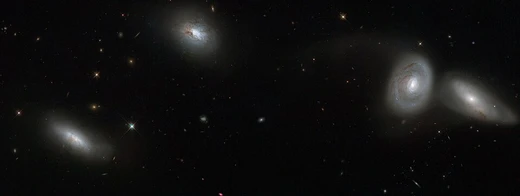
NGC 4889
Brightest galaxy in the Coma Cluster, home to a supermassive black hole.

NGC 4889 (also known as Caldwell 35) is an E4 supergiant elliptical galaxy and the brightest galaxy within the northern Coma Cluster. Located at a median distance of 94 million parsecs (308 million light years) from Earth, it is notable as the largest and most massive galaxy easily visible to Earth, and it hosts one of the most massive black holes on record.
Quick Facts
- Epoch
- J2000.0
- Constellation Name
- Coma Berenices
- Ra
- 13 · 00 · 08.1
- Dec
- +27 · 58 · 37
- Z
- 0.021502 · 0.000010
- Group Cluster
- Coma Cluster
- Appmag V
- 12.9
Facts from the source article.
Lore & Background
NGC 4889 was first observed in 1785 by Frederick William Herschel I, assisted by his sister Caroline Lucretia Herschel, and included in the Catalogue of Nebulae and Clusters of Stars a year later. In 1888, John Louis Emil Dreyer published the New General Catalogue, erroneously duplicating the galaxy as NGC 4884 and NGC 4889; later revision projects discovered the duplication and adopted NGC 4889. In December 1995, Patrick Caldwell Moore included it in the Caldwell catalogue as Caldwell 35.
The galaxy is classified as E4 in the Hubble sequence and as a cD galaxy, with a flattened, unequal distribution of stars and an immense diffuse halo extending 1.3 million light years in diameter. Its stellar population is dominated by old, population II stars, and it has 15,800 globular clusters. The supermassive black hole at its core, measured in December 2011, has a best-fit mass of 21 billion solar masses, with a possible range of 6 to 37 billion solar masses, and its event horizon diameter is 20 to 124 billion kilometers. The galaxy is a strong source of soft X-ray, ultraviolet, and radio frequency radiation.
Reader's Guide
NGC 4889 has played an important role in both amateur and professional astronomy, becoming a prototype in studying the dynamical evolution of other supergiant elliptical galaxies in the more distant universe. As the largest and most massive galaxy easily visible to Earth, it serves as a key object for understanding galaxy formation through mergers, the behavior of supermassive black holes, and the heating of the intracluster medium. Its central black hole, one of the most massive on record, is quiescent but may have been a quasar in the past. The galaxy lies at the center of component A of the Coma Cluster, a giant cluster of 2,000 galaxies, and is sometimes referred to as A1656-BCG. The Coma Cluster itself is at the center of the Coma Supercluster, within the CfA Homunculus and the CfA2 Great Wall, one of the largest structures in the known universe. For amateur observers, NGC 4889 can be seen with a 12-inch aperture telescope under dark skies, though light pollution from Beta Comae Berenices affects visibility.
Did You Know?
- NGC 4889 was erroneously duplicated in the New General Catalogue as both NGC 4884 and NGC 4889.
- The galaxy has 15,800 globular clusters, more than Messier 87's 12,000.
- NGC 4889 is classified as both an E4 and a cD galaxy.
More in Galaxy Clusters and Groups, Part 3 1-24
Spotted an error? Know more?
Reader corrections go straight into our review queue. Suggest an edit · How this site is sourced