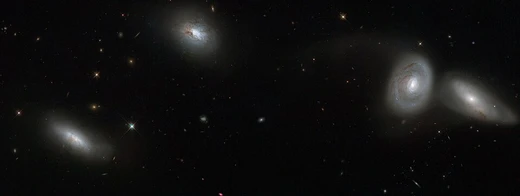
NGC 4874
Second-brightest galaxy in the Coma Cluster, with over 30,000 globular clusters.

NGC 4874 is a supergiant elliptical galaxy found in the constellation Coma Berenices. It ranks as the second-brightest member of the northern Coma Cluster, lying roughly 97 megaparsecs (316 million light-years) away. German-British astronomer William Herschel first spotted it on 11 April 1785, recording it as a bright, nebulous patch.
This galaxy is surrounded by a vast stellar halo roughly one million light-years across—about ten times the diameter of the Milky Way. It is also wrapped in a huge cloud of interstellar medium, which is being heated by material falling into its central supermassive black hole. A jet of highly energetic plasma extends 1,700 light-years from the galaxy’s core. NGC 4874 contains more than 30,000 globular clusters.
Three supernovae have been observed here. SN 1968B (unknown type, magnitude 17.4) was found by Fritz Zwicky on 3 February 1968. SN 1981G (Type Ia, magnitude 15) was discovered by Miklós Lovas on 2 June 1981. SN 2025ilo (Type Ib, magnitude 20.6) was detected by A. Horti-David, K. Sarneczky, and J. Vinko on 26 April 2025.
Quick Facts
- Epoch
- J2000
- Constellation Name
- Coma Berenices
- Ra
- 12 · 59 · 35.709
- Dec
- +27 · 57 · 33.80
- Z
- 0.023907 · 0.00000667
- Group Cluster
- Coma Cluster
- Dist Ly
- 96.804 ± 1.966 Mpcned
- Appmag V
- 11.4
- Appmag B
- 13.7
Facts from the source article.
Lore & Background
NGC 4874 was discovered on 11 April 1785 by German-British astronomer William Herschel, who catalogued it as a bright patch of nebulous feature. The galaxy is surrounded by an immense stellar halo that extends up to around ten times the size of the Milky Way Galaxy, roughly one million light-years in diameter. It is also enveloped by a huge cloud of interstellar medium that is currently being heated by the action of infalling material from its central supermassive black hole. A jet of highly energetic plasma extends out to 1,700 light-years from its center. The galaxy has more than 30,000 globular clusters.
Reader's Guide
NGC 4874 is notable as a supergiant elliptical galaxy and the second-brightest member of the northern Coma Cluster. Its immense stellar halo, roughly one million light-years in diameter, makes it one of the largest known galaxies in terms of halo size. The galaxy's central supermassive black hole heats a surrounding cloud of interstellar medium through infalling material, and a jet of highly energetic plasma extends 1,700 light-years from its center. With more than 30,000 globular clusters, it hosts an exceptionally rich system of these star clusters. Three supernovae have been observed in NGC 4874: SN 1968B (type unknown, mag. 17.4) discovered by Fritz Zwicky on 3 February 1968; SN 1981G (Type Ia, mag. 15) discovered by Miklós Lovas on 2 June 1981; and SN 2025ilo (Type Ib, mag. 20.6) discovered by A. Horti-David, K. Sarneczky, and J. Vinko on 26 April 2025. These observations contribute to understanding supernova rates and types in giant elliptical galaxies.
Did You Know?
- NGC 4874 was discovered by William Herschel on 11 April 1785.
- Its stellar halo extends roughly one million light-years in diameter, about ten times the size of the Milky Way.
- Three supernovae have been observed in NGC 4874, including SN 2025ilo discovered in April 2025.
More in Galaxy Clusters and Groups, Part 3 1-24
Spotted an error? Know more?
Reader corrections go straight into our review queue. Suggest an edit · How this site is sourced