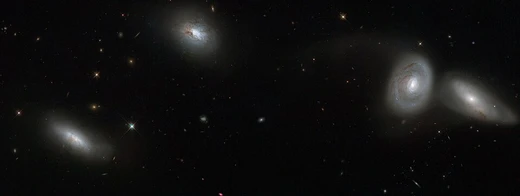
NGC 4869
Radio galaxy in Coma Cluster with bent radio jets and X-ray jet.

NGC 4869 is an elliptical galaxy located in the constellation of Coma Berenices, approximately 343 million light years from Earth. It is notable as a radio galaxy member of the Coma Cluster, featuring a narrow angle tailed radio source with a sharp bend and a lengthy low-surface brightness tail.
Quick Facts
- Constellation Name
- Coma Berenices
- Epoch
- J2000
- Ra
- 12 · 59 · 23.36
- Dec
- 27 · 54 · 41.78
- Z
- 0.022820
- H Radial V
- 6,841 km/s
- Dist Ly
- 343 Mly (105.16 Mpc)
- Appmag V
- 13.52
- Appmag B
- 14.9
- Notes
- Radio galaxy
- Names
- MCG +05-31-065, CGCG 160-225, PGC 44587, B2 1256+58, 5C 04.081, TXS 1257+281, 7C 1256+2810, KUG 1256+375, ABELL 1656:[D80] 105
- Group Cluster
- Coma Cluster
Facts from the source article.
Lore & Background
NGC 4869 was discovered by William Herschel in April 1785 and later observed by John Herschel in March 1827 and Heinrich d'Arrest in May 1863. It is a member of the Coma Cluster, with a small companion galaxy at a position angle of 325°. The galaxy is classified as a radio galaxy with a faint radio core, two oppositely directed radio jets, and a lengthy low-surface brightness tail. It contains a narrow angle tailed radio source lying toward the central region of the Coma Cluster by 111 kpc, showing a mean fractional polarization of 18% at 4.535 GHz and 21% at 8.465 GHz, with a large-scale structure almost 200 kpc. A characteristic feature is a sharp bend toward a north direction at 3.5 arcminutes from the host galaxy's position. A Chandra X-ray image reveals a straight collimated jet that flares when traversing a surface brightness edge. An elongated absorption feature in the galaxy may represent an edge-on disk. The supermassive black hole is estimated at 1.32 × 10^8 M☉ based on a 2002 study by Jong-Hak Woo and Urry.
Reader's Guide
NGC 4869 is significant as a radio galaxy within the Coma Cluster, one of the nearest rich galaxy clusters, providing insights into the interaction between radio jets and the intracluster medium. Its narrow angle tailed radio source, with a sharp northward bend and large-scale structure nearly 200 kpc, illustrates how cluster environment can distort radio emission. The Chandra X-ray detection of a flaring jet at a surface brightness edge highlights the dynamic processes at work. The estimated γ-ray luminosity (Lγ ≤ 4 × 10^39 erg s−1) similar to NGC 4874 places it in context with other cluster members. The elongated absorption feature suggests a possible edge-on disk, adding to its structural complexity. The supermassive black hole mass estimate from Woo and Urry (2002) contributes to understanding black hole scaling relations in cluster galaxies. Its legacy lies in serving as a case study for radio galaxy morphology and jet-environment interactions in a dense cluster setting.
Did You Know?
- It has a narrow angle tailed radio source with a sharp bend toward the north at 3.5 arcminutes from the host galaxy.
- A Chandra X-ray image shows a straight collimated jet that flares when crossing a surface brightness edge.
More in Galaxy Clusters and Groups, Part 3 1-24
Spotted an error? Know more?
Reader corrections go straight into our review queue. Suggest an edit · How this site is sourced