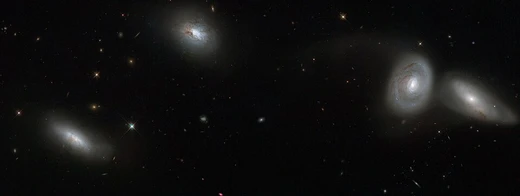
NGC 4848
A gas-stripped spiral galaxy in the Coma Cluster.

NGC 4848 is a barred spiral galaxy in the constellation Coma Berenices, located about 340 million light-years from Earth. It is notable for being part of the Coma Cluster and for having been stripped of its gas as it passed through the cluster, resulting in an asymmetrical hydrogen tail.
Quick Facts
- Epoch
- J2000
- Ra
- 12 · 58 · 05.6
- Dec
- +28 · 14 · 34
- Dist Ly
- 340 ± 15 Mly (104 ± 4.5 Mpc)
- Z
- 0.023513 ± 0.000033
- H Radial V
- 7,049 ± 10 km/s
- Appmag V
- 13.7
- Group Cluster
- Coma Cluster
- Constellation Name
- Coma Berenices
- Notes
- Hydrogen tail
- Names
- UGC 8082, MCG +05-31-039, CGCG 160-055, PGC 44405, 5C 04.058
Facts from the source article.
Lore & Background
NGC 4848 was discovered by Heinrich d'Arrest on April 21, 1865. It is a spiral galaxy viewed nearly edge-on and classified as SBab by de Vaucouleurs. Its nucleus is active and has been categorised as an HII region, with a ring of bright HII regions around the nucleus spanning 5–10 arcseconds. The galaxy's star formation rate is estimated at 9 M☉ per year based on multiple luminosity measurements.
The galaxy's hydrogen gas distribution is asymmetrical and forms a tail pointing away from the cluster center. The tail has projected dimensions of 62.5 by 18.5 kpc and an estimated hydrogen mass of 4×10^9 M☉. The tail was probably formed by ram pressure as the galaxy passed through the Coma Cluster's intergalactic medium at about 1,330 km/s. According to Fossati et al., this process started 200 million years ago, while a previous study indicated 400 million years. The lost hydrogen comprises about two thirds of the galaxy's original hydrogen content. A few star-forming regions, likely HII regions, are present in the tail.
A dwarf galaxy may cross the disk of NGC 4848, but its mass is too low to be the source of the hydrogen tail.
Reader's Guide
NGC 4848 is significant as a clear example of ram-pressure stripping in a dense cluster environment. Its hydrogen tail, pointing away from the Coma Cluster center, provides direct evidence of gas removal as the galaxy moves through the intergalactic medium at high speed. The estimated loss of two-thirds of its original hydrogen content illustrates the dramatic effect cluster membership can have on a galaxy's gas reservoir, which in turn affects its star formation. The uncertainty in the timeline—200 million years according to Fossati et al. versus 400 million years from an earlier study—highlights ongoing refinement in understanding such interactions. The presence of star-forming regions in the tail suggests that stripped gas can still form stars even after being removed from the galaxy. The possible crossing of a dwarf galaxy across NGC 4848's disk is noted but deemed insufficient to explain the tail, reinforcing ram pressure as the primary mechanism. This galaxy is often compared to others in the Coma Cluster, such as NGC 4921, which has also lost its hydrogen.
More in Galaxy Clusters and Groups, Part 3 1-24
Spotted an error? Know more?
Reader corrections go straight into our review queue. Suggest an edit · How this site is sourced