NGC 4622
A spiral galaxy with leading outer arms, defying conventional wisdom.

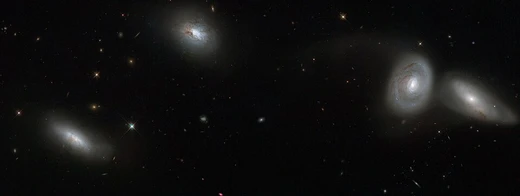
NGC 4622, nicknamed the Backward Galaxy, is a face-on, unbarred spiral galaxy with a striking ring structure, located in the constellation Centaurus and belonging to the Centaurus Cluster. It lies about 111 million light-years from Earth.
The galaxy is best known for having leading spiral arms. In most spiral galaxies, the outermost tips of the arms point away from the direction the disk rotates—these are called trailing arms. NGC 4622’s inner arm is trailing, but its outer arms are leading: their tips point toward the direction of rotation. This unusual orientation may have been caused by a gravitational interaction with another galaxy or by a merger with a smaller object.
Initially, astronomers suspected the inner arm was also leading, but later observations confirmed it is trailing. The findings faced skepticism, partly because they contradicted long-held assumptions—one researcher recalled being called “the backward astronomer who found the backward galaxy.” Critics noted that the method used to determine the arm direction relied on dust reddening and cloud silhouettes, which can be misleading in a galaxy tilted only 19 degrees from face-on. Clumpy dust clouds on one side of the disk could also produce false signals.
To address these concerns, a new study used a Fourier component method, independent of the earlier technique. This revealed two faint new arms in the inner disk that wind in the opposite direction from the strong outer clockwise pair. Analysis of color-age star formation sequences in the Fourier components confirmed that the strong outer pair is indeed the leading pair. An image of the Fourier components marks one arm of the newly discovered inner counterclockwise pair with black dots and one arm of the known clockwise outer pair with white dots.
Two supernovae have been observed in NGC 4622. SN 2001jx (magnitude 17.5, type unknown) was captured by the Hubble Space Telescope on May 25, 2001, and discovered by R. Buta, G. G. Byrd, and T. Freeman. SN 2019so (Type Ia-91bg-like, magnitude 18.535) was discovered by ATLAS on January 14, 2019.
According to AM Garcia, NGC 4622 is part of the NGC 4709 group, which includes at least 42 galaxies, such as NGC 4616, NGC 4622B (PGC 42852), NGC 4679, and NGC 4709. This group itself is a member of the Centaurus Cluster.
Quick Facts
- Epoch
- J2000
- Ra
- 12 · 42 · 37.7
- Dec
- -40 · 44 · 35
- Dist Ly
- 200 million ly
- Z
- 4,367 ± 39 km/s
- Appmag V
- 12.6
- Constellation Name
- Centaurus
- Names
- PGC 42701
Facts from the source article.
Lore & Background
NGC 4622 lies approximately 111 million light-years away in the constellation Centaurus. It is an example of a galaxy with leading spiral arms: each outer spiral arm winds away from the center and ends at a tip that points toward the direction of the disk's orbital rotation, rather than away from it. This contradicts the typical trailing spiral arms, where the tips point away from rotation. The inner spiral arm of NGC 4622 is trailing, as originally suspected but later confirmed by observations that also established the outer arms as leading.
The initial results were met with skepticism, partly because dust reddening and cloud silhouettes were used to determine the outer arms' leading nature. The galaxy disk is tilted only 19 degrees from face-on, making near-to-far-side effects of dust hard to discern, and clumpy dust clouds might be concentrated on one side, creating misleading results. In response, new research used the Fourier component method, which revealed two new weak arms in the inner disk winding opposite the outer strong clockwise pair, confirming that the galaxy has a pair of arms winding in the opposite direction from most galaxies. Analysis of a color-age star formation angle sequence established that the strong outer pair is the leading pair.
Two supernovae have been observed: SN 2001jx (type unknown, mag. 17.5) captured by the Hubble Space Telescope on 25 May 2001, discovered by R. Buta, G. G. Byrd, and T. Freeman; and SN 2019so (Type Ia-91bg-like, mag. 18.535) discovered by ATLAS on 14 January 2019. According to AM Garcia, NGC 4622 is a member of the NGC 4709 group, which consists of at least 42 galaxies and is part of the Centaurus Cluster.
Reader's Guide
NGC 4622's significance lies in its challenge to the conventional understanding of spiral arm dynamics. The discovery that its outer arms are leading—pointing toward the direction of disk rotation—contradicted the long-held belief that spiral arms always trail. This finding prompted skepticism and further investigation, leading to the use of the Fourier component method to independently confirm the arm sense. The galaxy thus serves as a key example in the study of galaxy interactions and mergers, as the leading arms may result from a gravitational interaction with another galaxy or a merger with a smaller object. Its legacy includes prompting astronomers to reconsider assumptions about spiral structure and to develop more robust methods for determining arm direction. The galaxy's membership in the Centaurus Cluster and the NGC 4709 group places it within a broader context of galaxy evolution and dynamics.
Did You Know?
- NGC 4622 is also called the Backward Galaxy because its outer spiral arms lead rather than trail.
- The galaxy's outer arms were determined to be leading using dust reddening and cloud silhouettes, though the method faced skepticism due to the disk's nearly face-on tilt.
More in Galaxy Clusters and Groups, Part 3 1-24
Spotted an error? Know more?
Reader corrections go straight into our review queue. Suggest an edit · How this site is sourced