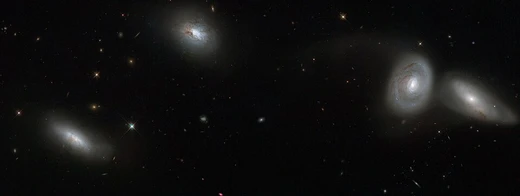
NGC 4490
Barred spiral galaxy interacting with NGC 4485, part of Arp 269.

NGC 4490, also known as the Cocoon Galaxy, is a barred spiral galaxy in the constellation Canes Venatici. It is notable as one of the closest interacting/merging galactic systems, interacting with its smaller companion NGC 4485, and is a starburst galaxy as a result. The pair is collectively known in the Atlas of Peculiar Galaxies as Arp 269.
Quick Facts
- Epoch
- J2000
- Ra
- 12 · 30 · 36.2390
- Dec
- 41 · 38 · 38.032
- Dist Ly
- 25.1 ± 5.0 Mly (7.7 ± 1.5 Mpc)
- Z
- 0.001885ned
- H Radial V
- 565 ± 3 km/s
- Appmag V
- 9.8
- Constellation Name
- Canes Venatici
Facts from the source article.
Lore & Background
NGC 4490 was discovered by German-British astronomer William Herschel on 14 January 1788. It lies at a distance of 25 million light years from Earth and is located 45 arcminutes northwest of beta Canum Venaticorum. With an apparent visual magnitude of 9.8, it can be observed with 15x100 binoculars. The galaxy has a double nucleus and belongs to the Canes II Group. It has a system of satellite galaxies oriented roughly in a plane. A stellar stream 25,000 light years long connects NGC 4490 and NGC 4485, made of bright knots and large gas rich pockets where young blue hot massive stars are formed. The two galaxies have already made their closest approach and are rushing away from each other.
Reader's Guide
NGC 4490 is significant as one of the closest interacting/merging galactic systems, providing a nearby laboratory for studying galaxy interactions and starburst activity. Its interaction with NGC 4485 has triggered intense star formation, making it a starburst galaxy. The double nucleus suggests a complex merger history. The stellar stream connecting the pair offers insight into tidal interactions and the formation of young massive stars in such environments. The galaxy has hosted two supernovae (SN 1982F and SN 2008ax) and one luminous red nova (AT 2011kp), contributing to the study of stellar explosions. Its inclusion in the Atlas of Peculiar Galaxies as Arp 269 and the Herschel 400 Catalogue underscores its importance as a notable celestial object. The system of satellite galaxies oriented roughly in a plane adds to its interest for studies of galaxy group dynamics.
Did You Know?
- NGC 4490 has a double nucleus.
- Two supernovae and one luminous red nova have been observed in NGC 4490.
- The galaxy is a member of the Canes II Group.
More in Galaxy Clusters and Groups, Part 3 1-24
Spotted an error? Know more?
Reader corrections go straight into our review queue. Suggest an edit · How this site is sourced