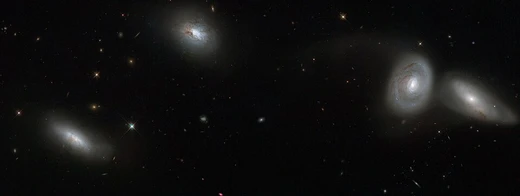
NGC 4314
Barred spiral galaxy with a nuclear starburst ring.

NGC 4314 is a barred spiral galaxy located about 53 million light-years away in the northern constellation Coma Berenices. It lies roughly 3° north-northwest of the star Gamma Comae Berenices and can be seen with a small telescope. German-born astronomer William Herschel discovered it on March 13, 1785. In 1961, Allan Sandage classified the galaxy as peculiar due to the unusual structure at the center of its bar. NGC 4314 belongs to the Coma I group of galaxies.
The galaxy’s morphological type is SBa, meaning it is a barred spiral with very tightly wound arms. It is tilted 21° relative to Earth’s line of sight, and its primary bar has a position angle of 158°. The bar spans a diameter of 76″ before connecting to the spiral arms, which trail in 130° arcs out to a radius of 125″ from the nucleus. Outside the nuclear region, the galaxy is generally gas-poor, with no H II regions in the outer arms.
Around the nucleus, a prominent ring of star formation extends to a radius of 9″. Within this ring, 76 open star clusters have been identified, likely linked at least partly to Lindblad resonance. Most of these clusters are 15 million years old or younger. The current burst of star formation is estimated to have lasted about 30 million years. Beyond the ring, the stars are generally older, suggesting an earlier episode of star formation.
Quick Facts
- Epoch
- J2000
- Constellation Name
- Coma Berenices
- Ra
- 12 · 22 · 31.978
- Dec
- +29 · 53 · 43.09
- Dist Ly
- 16.3 ±
- Group Cluster
- Coma I
- Appmag V
- 11.4
- Notes
- Circumnuclear ring
- Names
- IRAS 12200+3010, LEDA 40097, NGC 4314, UGC 7443, PGC 40097
Facts from the source article.
Lore & Background
NGC 4314 was discovered by German-born astronomer William Herschel on March 13, 1785. It is located about 3° north and slightly west of the star Gamma Comae Berenices and is visible in a small telescope. The galaxy was labelled as peculiar by Allan Sandage in 1961 because of the unusual structure in the center of the bar.
The morphological classification of this galaxy is SBa, indicating a barred spiral with very tightly wound spiral arms. It is inclined at an angle of 21° to the line of sight, and the primary bar has a position angle of 158°. The bar extends to a diameter of 76″ before joining the spiral arms, which trail in 130° arcs out to a radius of 125″ from the nucleus. Outside the nuclear region, the galaxy is generally gas-poor, with no H II regions in the outer spiral arms.
A prominent ring of star formation surrounds the galactic nucleus with a radius of 9″. 76 open clusters of stars have been found associated with this ring, likely due at least in part to Lindblad resonance. Most of these clusters are 15 million years old or less, and the current burst of star formation is estimated to have lasted 30 million years. External to the ring, the stars are generally older, suggesting a previous epoch of star formation.
Reader's Guide
NGC 4314 is a member of the Coma I group of galaxies. Its significance lies in its peculiar central structure and the well-defined nuclear starburst ring, which contains 76 open clusters of stars, most younger than 15 million years. The ring's formation is attributed at least partly to Lindblad resonance. The galaxy's outer regions are gas-poor and lack H II regions, contrasting with the active star formation in the ring. The age gradient—young stars in the ring and older stars outside—indicates a previous epoch of star formation. This makes NGC 4314 a valuable object for studying the dynamics of barred galaxies and the processes that trigger and sustain nuclear starbursts.
Did You Know?
- NGC 4314 is approximately 53 million light-years away in Coma Berenices.
- It was discovered by William Herschel on March 13, 1785.
- The galaxy has a prominent nuclear star formation ring with a radius of 9″.
- 76 open clusters of stars are associated with the ring, most 15 million years old or less.
More in Galaxy Clusters and Groups, Part 3 1-24
Spotted an error? Know more?
Reader corrections go straight into our review queue. Suggest an edit · How this site is sourced