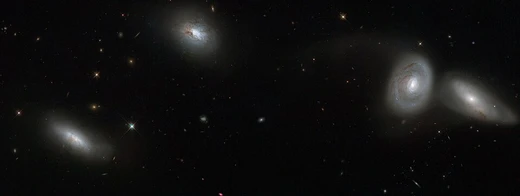
NGC 4278
Elliptical galaxy with an active LINER nucleus and a massive HI disk.

NGC 4278 is an elliptical galaxy located in the constellation Coma Berenices, approximately 55 million light years from Earth. It is notable for its active galactic nucleus (AGN) classified as a LINER, hosting a supermassive black hole with an estimated mass of (3.09±0.54)×10⁸ M☉. The galaxy exhibits unusual features for an elliptical, including a massive HI disk, dust filaments, and a larger-than-average number of globular clusters.
Quick Facts
- Epoch
- J2000
- Ra
- 12 · 20 · 06.8
- Dec
- +29 · 16 · 51
- Dist Ly
- 55.1 ± 19 Mly (16.9 ± 5.9 Mpc)
- Z
- 0.002068 ± 0.000017
- H Radial V
- 620 ± 5 km/s
- Appmag V
- 10.2
- Group Cluster
- Coma I
- Constellation Name
- Coma Berenices
- Notes
- LINER
- Names
- UGC 7386, CGCG 158-077, MCG +05-29-062, B2 1217+29, PGC 39764
Facts from the source article.
Lore & Background
NGC 4278 was discovered by William Herschel on March 13, 1785, and is part of the Herschel 400 Catalogue. Its nucleus is an active galactic nucleus (AGN) identified as a LINER based on its spectrum, powered by an accretion disk around a supermassive black hole. The nucleus emits radio waves with two small symmetric S-shaped jets spanning 20 mas each (1.4 parsec at the galaxy's distance), and hosts a compact ultraviolet source that exhibits strong variability, including a flare between June 1994 and January 1995 when it became 1.6 times brighter in six months. X-ray variability has also been observed, with the galaxy brightening five times within three years and flux increasing by 10% within an hour in one XMM-Newton observation. The X-ray spectrum is consistent with an absorbed power-law with column density of order 10²⁰ cm⁻², and the FeKα emission line has not been detected, typical for LINERs. The spectral energy distribution resembles a LINER at lower fluxes and a low luminosity Seyfert galaxy at higher fluxes. Dust features form knots and filaments that spiral down to the nucleus, and the galaxy possesses a massive HI disk (total mass 6.9×10⁸ M☉) rotating in the same sense as the stars but misaligned by 20° to 70°, likely formed after accretion of a dwarf satellite galaxy. Molecular clouds have been detected via CO emission. Spitzer IRS observations revealed multiphase gas and dust, emission by polycyclic aromatic hydrocarbons (PAHs), strong [Si II] 34.8-μm emission, and emission from molecular hydrogen and ionised gas. NGC 4278 hosts an estimated total of 1378+32−194 globular clusters, with a bimodal colour distribution; blue clusters are larger than red ones at the same galactocentric distance, and cluster size increases with galactocentric radius. The galaxy is a member of the NGC 4274 (or NGC 4062) group, which includes NGC 4020, NGC 4062, NGC 4136, NGC 4173, NGC 4203, NGC 4245, NGC 4251, NGC 4274, NGC 4283, NGC 4310, NGC 4314, NGC 4359, NGC 4414, NGC 4509, and NGC 4525. Another survey placed it in the same group with NGC 4631, NGC 4656, NGC 4559, NGC 4448, and NGC 4414. It is part of the Coma I Group within the Virgo Supercluster. Nearby galaxies include NGC 4283 (3.5 arcminutes northeast), NGC 4286 (9 arcminutes northeast), and NGC 4274 (about 20 arcminutes north).
Reader's Guide
NGC 4278 is significant as an elliptical galaxy that challenges typical expectations for its type, possessing a massive HI disk and dust features more common in spiral galaxies. Its active nucleus, classified as a LINER, exhibits variability across ultraviolet, X-ray, and radio wavelengths, including flares and jets, providing insights into low-luminosity AGN behavior. The detection of polycyclic aromatic hydrocarbons and strong [Si II] emission is uncommon for ellipticals, suggesting ongoing cold gas accretion. The galaxy's large globular cluster population and bimodal colour distribution offer clues to its formation history. As a member of the Coma I Group and the Virgo Supercluster, NGC 4278 contributes to understanding galaxy evolution in group environments. Its proximity and varied phenomena make it a valuable target for multiwavelength studies of AGN feedback, gas dynamics, and star cluster systems.
Did You Know?
- Its central supermassive black hole has an estimated mass of (3.09±0.54)×10⁸ M☉.
- The galaxy hosts a massive HI disk with a total mass of 6.9×10⁸ M☉, misaligned by 20° to 70° relative to the stars.
More in Galaxy Clusters and Groups, Part 3 1-24
Spotted an error? Know more?
Reader corrections go straight into our review queue. Suggest an edit · How this site is sourced