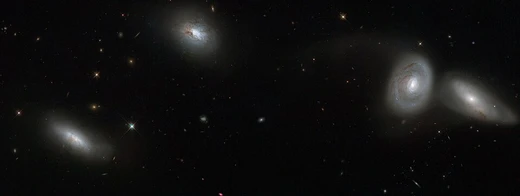
NGC 4274
Barred spiral galaxy with overlapping outer arms and multiple rings.

NGC 4274 is a barred spiral galaxy located in the constellation Coma Berenices, approximately 45 million light years from Earth. It is notable for its complex ring structure and as the foremost member of the NGC 4274 group, which is part of the Coma I Group within the Virgo Supercluster.
Quick Facts
- Epoch
- J2000
- Ra
- 12 · 19 · 50.5963
- Dec
- +29 · 36 · 52.912
- Dist Ly
- 13.911 ± 1.429 Mpcned
- Group Cluster
- NGC 4274 group (LGG 279)
- Z
- 0.003102 · 0.0000230ned
- Appmag V
- 10.4
- Constellation Name
- Coma Berenices
Facts from the source article.
Lore & Background
NGC 4274 was discovered by German-British astronomer William Herschel on 13 March 1785. It is a LINER galaxy, meaning its nucleus emits broad lines of weakly ionized atoms. The galaxy is characterized by overlapping outer arms that form a ring structure with an apparent diameter of 2.8′. The inner arms begin near the edge of the bulge and are bright and dusty, with dust lanes more prominent on the near side. Outside the near-ring, a set of fainter outer arms forms another ring with a diameter of 5.9′. A third ring exists near the nucleus, with a semimajor axis of 9″, corresponding to 680 parsecs at that distance. The bar of the galaxy is 5 kpc long, and it features a nuclear bar almost perpendicular to the outer bar.
Reader's Guide
NGC 4274 is significant as the foremost member of the NGC 4274 group, a galaxy group that includes NGC 4173, NGC 4245, NGC 4251, NGC 4283, IC 3215, NGC 4310, and NGC 4314. This group is part of the larger Coma I Group, which itself belongs to the Virgo Supercluster. The galaxy's multiple ring structures—inner, outer, and nuclear—make it a valuable object for studying the dynamics of barred spiral galaxies and the formation of ring features. One supernova, SN 1999ev (Type II, magnitude 14.4), was observed in NGC 4274, discovered by Scottish amateur astronomer Tom Boles on 7 November 1999. Its LINER classification adds to its interest for understanding nuclear activity in galaxies.
Did You Know?
- NGC 4274 has three distinct rings: an inner ring, an outer ring, and a nuclear ring.
- The galaxy's bar is 5 kpc long, and it has a nuclear bar almost perpendicular to the outer bar.
- One supernova, SN 1999ev (Type II), was observed in NGC 4274 on 7 November 1999.
- NGC 4274 is the foremost member of the NGC 4274 group, which contains eight galaxies.
More in Galaxy Clusters and Groups, Part 3 1-24
Spotted an error? Know more?
Reader corrections go straight into our review queue. Suggest an edit · How this site is sourced