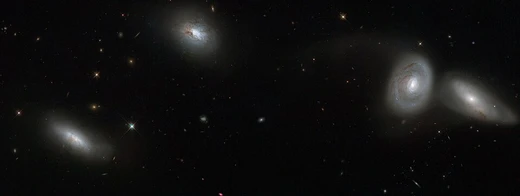
NGC 4203
Lenticular galaxy with ringed hydrogen and a low-ionization nucleus.

NGC 4203 is a lenticular galaxy in the northern constellation of Coma Berenices, discovered by English astronomer William Herschel on March 20, 1787. It is notable for its large reservoir of neutral hydrogen arranged in two ring-like structures, its low rate of new star formation, and a low-ionization nuclear emission-line region (type 1.9) powered by a supermassive black hole.
Quick Facts
- Epoch
- J2000
- Constellation Name
- Coma Berenices
- Ra
- 12 · 15 · 05.0
- Dec
- +33 · 11 · 50
- Z
- 0.003620
- H Radial V
- 1,083 km/s
- Gal V
- 1,093 km/s
- Dist Ly
- 15.28 +/-
- Group Cluster
- Coma I
- Appmag V
- 11.99
- Appmag B
- 12.98
- Names
- 2MASX J12150502+3311500, LEDA 39158, UGC 7256, UZC J121505.0+331152, Z 187-29 .
Facts from the source article.
Lore & Background
NGC 4203 was discovered on March 20, 1787 by English astronomer William Herschel. It lies 5.5° northwest of the 4th magnitude star Gamma Comae Berenices and can be viewed with a small telescope. Its morphological classification is SAB0−, indicating a lenticular form with tightly wound spiral arms and a weak bar structure at the nucleus.
The galaxy contains a large reservoir of neutral hydrogen—on the order of a billion solar masses—but undergoes only a low rate of new star formation; the inner star formation is roughly ten billion years old on average. The neutral hydrogen is arranged in two ring-like structures, with the outer ring having nine times the mass of the inner. In the central region there is about 2.5×10^7 M☉ of molecular hydrogen and dust structures within 980 ly (300 pc) of the nucleus. The gas in the outer disk may have been accreted from the inter-galactic medium or captured during a close encounter with a dwarf galaxy.
The nucleus contains a low-ionization nuclear emission-line region of type 1.9, generated by a supermassive black hole of an estimated (6±1)×10^7 M☉. An influx of gas of about 2×10^−2 M☉/yr is sufficient to explain the measured X-ray luminosity. Time-varying emissions from the region are perhaps best explained by an infalling red supergiant star losing mass to the black hole along a contrail. NGC 4203 is a member of the Coma I Group, which is part of the Virgo Supercluster.
Reader's Guide
NGC 4203 is significant as a lenticular galaxy with a well-characterized neutral hydrogen distribution in two rings, where the outer ring holds nine times the mass of the inner. Its low star formation rate and old stellar population (roughly ten billion years) contrast with its large gas reservoir, suggesting that the gas may have been accreted from the inter-galactic medium or captured from a dwarf galaxy. The galaxy's nucleus hosts a supermassive black hole of (6±1)×10^7 M☉, powering a low-ionization nuclear emission-line region of type 1.9. The measured X-ray luminosity is explained by a gas influx of 2×10^−2 M☉/yr, and time-varying emissions may be due to an infalling red supergiant star losing mass to the black hole. As a member of the Coma I Group within the Virgo Supercluster, NGC 4203 provides a local example of a galaxy with a quiescent nucleus and a complex gas accretion history.
Did You Know?
- NGC 4203 was discovered by William Herschel on March 20, 1787.
- The supermassive black hole at its center has an estimated mass of (6±1)×10^7 M☉.
- Time-varying emissions from the nucleus may be caused by an infalling red supergiant star losing mass to the black hole.
More in Galaxy Clusters and Groups, Part 3 1-24
Spotted an error? Know more?
Reader corrections go straight into our review queue. Suggest an edit · How this site is sourced