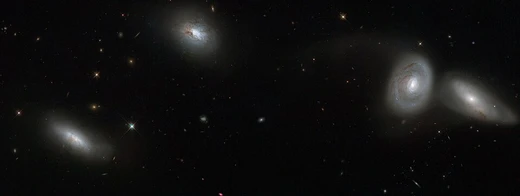
NGC 4096
Asymmetric spiral galaxy in Ursa Major with lopsided arms.

NGC 4096 is a spiral galaxy in the constellation Ursa Major, located about 35 million light years from Earth. It is notable for its asymmetric structure, with a lopsided spiral arm and stronger CO, HI, and H-alpha emissions in the northern half. The galaxy has been suggested to host a bar, though this remains unproven.
Quick Facts
- Epoch
- J2000
- Ra
- 12 · 06 · 01.1138
- Dec
- +47 · 28 · 42.834
- Dist Ly
- 37.5 ± 7.8 Mly (11.5 ± 2.4 Mpc)
- Z
- 0.001908 ± 0.000007
- H Radial V
- 572 ± 2 km/s
- Appmag V
- 10.8
- Constellation Name
- Ursa Major
Facts from the source article.
Lore & Background
NGC 4096 was discovered by William Herschel on March 9, 1788. It is a spiral galaxy visible with an inclination of 76°. Although the presence of a bar has been suggested, it has not been proven. The galaxy has multiple well-defined thin arms. NGC 4096 is asymmetric in the north–south axis, with the northern half having stronger CO emissions and asymmetric HI and H-alpha emissions following a lopsided spiral arm. The total stellar mass of the galaxy is estimated to be (6.13±0.1)×10⁹ M☉, and its star formation rate is estimated to be between 0.22 and 0.43 M☉ per year.
Two supernovae have been detected in NGC 4096. SN 1960H (Type Ia-pec, mag. 14) was discovered by Milton Humason on 17 June 1960, and independently by Paul Wild on 20 June 1960. SN 2014bi (Type II-P, mag. 18.2) was discovered by the Lick Observatory Supernova Search (LOSS) on 31 May 2014; it was low-luminosity, and the spectrum indicated it was about two weeks post maximum and significantly reddened.
Garcia in 1993 considered the galaxy to be a member of LGG 269 group, along with NGC 4111, NGC 3938, NGC 4051, and NGC 4138. On the other hand, Makarov et al. consider the galaxy to be a member of the Messier 106 Group, along with Messier 106, NGC 4242, NGC 4248, NGC 4288 and NGC 4460. The group is part of the Local Supercluster.
Reader's Guide
NGC 4096 is significant as an example of an asymmetric spiral galaxy, with a lopsided spiral arm and uneven gas emissions that suggest a disturbed or interacting history. Its membership in galaxy groups is disputed: Garcia in 1993 placed it in LGG 269, while Makarov et al. assign it to the Messier 106 Group, both part of the Local Supercluster. This uncertainty highlights the challenges in defining group boundaries. The galaxy's two supernovae—SN 1960H, a peculiar Type Ia discovered independently by Humason and Wild, and SN 2014bi, a low-luminosity, reddened Type II-P found by LOSS—provide data on stellar explosions at moderate distance. Its estimated stellar mass and star formation rate offer insights into its evolutionary state. The unproven bar suggestion and the galaxy's thin, well-defined arms add to its interest as a subject for studies of spiral structure and asymmetry.
Did You Know?
- The galaxy has an inclination of 76° and is asymmetric in the north–south axis.
- Two supernovae have been detected: SN 1960H (Type Ia-pec) and SN 2014bi (Type II-P).
- Its group membership is disputed: Garcia places it in LGG 269, while Makarov et al. place it in the Messier 106 Group.
More in Galaxy Clusters and Groups, Part 3 1-24
Spotted an error? Know more?
Reader corrections go straight into our review queue. Suggest an edit · How this site is sourced