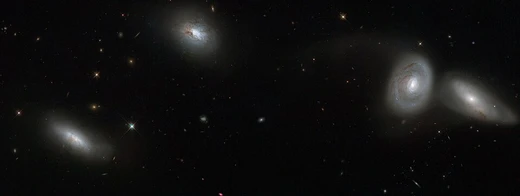
NGC 4062
Spiral galaxy with grand design arms and a supermassive black hole.

NGC 4062 is a spiral galaxy located in the constellation Ursa Major, approximately 50 million light years from Earth. It is notable for its grand design spiral arms, strong H-alpha emission, and membership in the NGC 4274 Group.
Quick Facts
- Epoch
- J2000
- Ra
- 12 · 04 · 03.7915
- Dec
- +31 · 53 · 44.765
- Dist Ly
- 49.1 ± 9.0 Mly (15.0 ± 2.8 Mpc)
- Z
- 0.002528 ± 0.000003
- H Radial V
- 758 ± 1 km/s
- Appmag V
- 11.2
- Constellation Name
- Ursa Major
- Group Cluster
- Coma I Group
Facts from the source article.
Lore & Background
NGC 4062 was discovered by William Herschel on March 20, 1787. The galaxy has a small elliptical bulge from which two high-contrast spiral arms emerge in a grand design pattern, best seen in near-infrared. The arms are initially smooth and narrow but become diffuse after half a revolution, traceable for a full revolution before fading. Dust lanes spiral across the disk, and HII regions are present but less than two arcseconds across, with patchy, flocculent star formation knots. The galaxy is a strong source of H-alpha emission, and kinematics in the central region indicate high velocity dispersion, possibly due to a bar. At its center lies a supermassive black hole with an estimated mass of 10^6.7 M☉ (5 million times more massive than the Sun), based on spheroid luminosity. NGC 4062 is a member of the NGC 4274 Group (LGG 279), which includes at least 19 galaxies such as NGC 4020, NGC 4136, and NGC 4274. However, Makarov considers it part of the NGC 4062 Group, which also includes NGC 4020, IC 2984, and UGC 7007.
Reader's Guide
NGC 4062 is significant as a nearby spiral galaxy that exhibits a classic grand design spiral structure, with well-defined arms that transition from smooth to diffuse. Its strong H-alpha emission and high central velocity dispersion suggest active star formation and possible bar-driven dynamics. The presence of a supermassive black hole with a mass of 5 million solar masses, estimated from spheroid luminosity, adds to its astrophysical interest. The galaxy's membership in the NGC 4274 Group, one of the larger nearby groups, provides context for studying galaxy interactions and evolution. The alternative grouping by Makarov into the NGC 4062 Group highlights ongoing uncertainties in group membership. Its discovery by William Herschel in 1787 places it within the historical catalog of deep-sky objects. The combination of visible dust lanes, HII regions, and flocculent star formation knots makes it a target for studies of spiral arm formation and star formation processes.
Did You Know?
- The galaxy lies about 50 million light years away and is approximately 50,000 light years across.
- It is a member of the NGC 4274 Group, which contains at least 19 galaxies.
More in Galaxy Clusters and Groups, Part 3 1-24
Spotted an error? Know more?
Reader corrections go straight into our review queue. Suggest an edit · How this site is sourced