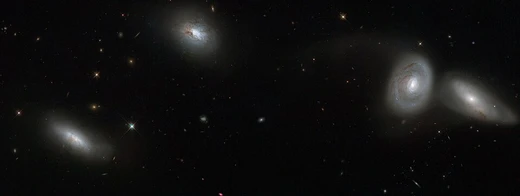
NGC 3258
Giant elliptical galaxy, brightest member of the Antlia Cluster.

NGC 3258 is a giant elliptical galaxy in the southern constellation of Antlia, discovered by British astronomer John Herschel on May 2, 1834. It is notable as one of the two brightest members of the Antlia Cluster, which lies about 40.7 megaparsecs (132.7 million light-years) from the Milky Way, and as the namesake of the sparse NGC 3258 group of galaxies.
Quick Facts
- Epoch
- J2000
- Constellation Name
- Antlia
- Ra
- 10 · 28 · 53.588
- Dec
- -35 · 36 · 19.98
- Z
- 0.009357
- Dist Ly
- 38.11 Mpc
- Group Cluster
- Antlia Cluster
- Appmag V
- 11.72
- Appmag B
- 12.50
Facts from the source article.
Lore & Background
NGC 3258 was discovered by John Herschel on May 2, 1834, in the southern constellation Antlia. It is classified as morphological type E1, indicating a mild ellipticity, and is a weak, extended radio source. Photometry reveals a disk of dust around the galaxy's center, aligned with its major axis, with a heated component of 48 M☉ within a radius of 5.5 kpc that may indicate star formation. No X-ray emission is detected, suggesting no activity at the center.
ALMA observations of the cold gas disk near the supermassive black hole at the core yield a mass estimate of 2.249×10^9 M☉ with an uncertainty of 0.18%, while spectroscopic observations of star motions near the core give an independent estimate of (2.2±0.2)×10^9 M☉, a good match. The galaxy hosts an extensive globular cluster population estimated at 6000±150, and 23 ultra-compact dwarfs have been identified in its vicinity, some possibly former dwarf galaxies captured and stripped during minor mergers. These objects provide a mass estimate of 2.7×10^12 M☉ within about 47 kpc of the center.
One supernova has been observed in NGC 3258: the type Ia SN 2010hx, discovered by Berto Monard on September 16, 2010 at magnitude 15.3.
Reader's Guide
NGC 3258 is significant as one of the two brightest members of the Antlia Cluster, a nearby galaxy cluster about 132.7 million light-years away, and as the namesake of the sparse NGC 3258 group. Its well-studied supermassive black hole, with mass estimates from both ALMA and spectroscopic observations that agree closely, provides a benchmark for black hole mass measurements. The galaxy's extensive globular cluster system (6000±150) and population of 23 ultra-compact dwarfs offer insights into galaxy formation and minor merger processes. The detection of a dust disk with a heated component possibly indicating star formation, alongside the lack of X-ray emission suggesting no active nucleus, presents a complex picture of a quiescent giant elliptical. The single observed supernova, SN 2010hx, adds to its observational record. Its legacy lies in contributing to understanding black hole masses, globular cluster systems, and the dynamics of galaxy groups.
Did You Know?
- It is one of the two brightest members of the Antlia Cluster, about 40.7 Mpc away.
- The supermassive black hole mass is estimated at about 2.2×10^9 M☉ from both ALMA and spectroscopic data.
- A population of 23 ultra-compact dwarfs has been identified in its vicinity.
More in Galaxy Clusters and Groups, Part 3 1-24
Spotted an error? Know more?
Reader corrections go straight into our review queue. Suggest an edit · How this site is sourced