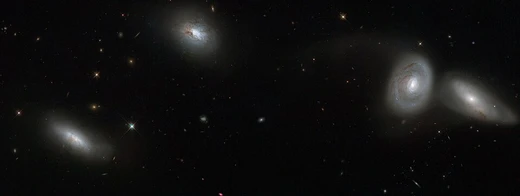
Messier 106
A nearby spiral galaxy with a water megamaser and supermassive black hole.

Messier 106 (also known as NGC 4258) is an intermediate spiral galaxy in the constellation Canes Venatici, discovered by Pierre Méchain in 1781. It is notable for containing an active nucleus classified as a Type 2 Seyfert and a central supermassive black hole whose mass has been measured from radio-wavelength observations of a rotating molecular gas disk. M106 is one of the largest and brightest nearby galaxies, similar in size and luminosity to the Andromeda Galaxy, and has played a key role in calibrating the cosmic distance ladder.
Quick Facts
- Epoch
- J2000
- Ra
- 12 · 18 · 57.5
- Dec
- +47 · 18 · 14
- Dist Ly
- 23.7 +/-
- Z
- 448 ± 3 km/s
- Appmag V
- 8.4
- Constellation Name
- Canes Venatici
- Notes
- Megamaser galaxy, Seyfert II galaxy.
- Names
- M 106, NGC 4258, UGC 7353, PGC 39600.
Facts from the source article.
Lore & Background
Messier 106 was discovered by Pierre Méchain in 1781. It lies at a distance of about 22 to 25 million light-years from Earth. The galaxy contains an active nucleus classified as a Type 2 Seyfert, and the presence of a central supermassive black hole has been demonstrated from radio-wavelength observations of the rotation of a disk of molecular gas orbiting within the inner light-year around the black hole. NGC 4217 is a possible companion galaxy. Besides its two visible arms, M106 has two 'anomalous arms' detectable using an X-ray telescope.
M106 has a water vapor megamaser seen by the 22-GHz line of ortho-H2O, which evidences dense and warm molecular gas. The water masers in M106 enabled the first case of a direct measurement of the distance to a galaxy, providing an independent anchor for the cosmic distance ladder. The galaxy has a slightly warped, thin, almost edge-on Keplerian disc on a subparsec scale, surrounding a central area with mass 4×10^7 M☉. The supermassive black hole at the core has a mass of (3.9±0.1)×10^7 M☉.
Two supernovae have been observed in M106: SN 1981K (Type II, mag. 17), reported by E. Hummel and verified by Paul Wild from archival photos dated 3 November 1981; and SN 2014bc (Type II, mag. 14.8), discovered by the PS1 Science Consortium 3Pi survey on 19 May 2014.
Reader's Guide
Messier 106 holds significant importance in astrophysics primarily through its water vapor megamaser, which enabled the first direct measurement of distance to a galaxy, thereby providing an independent anchor for the cosmic distance ladder. This achievement was crucial because before this, Cepheid variables from other galaxies could not be used to measure distances reliably due to differing metallicities. M106 contains Cepheid variables similar to both the metallicities of the Milky Way and other galaxies' Cepheids. By measuring the distance of Cepheids with metallicities similar to our galaxy, astronomers were able to recalibrate other Cepheids with different metallicities, a key fundamental step in improving quantification of distances to other galaxies in the universe. Additionally, the galaxy's active nucleus and supermassive black hole, with a mass of (3.9±0.1)×10^7 M☉, have been studied through radio observations of a rotating molecular gas disk. The presence of two anomalous arms detectable in X-rays and two recorded supernovae further contribute to its scientific value as a nearby, well-studied spiral galaxy.
More in Galaxy Clusters and Groups, Part 3 1-24
Spotted an error? Know more?
Reader corrections go straight into our review queue. Suggest an edit · How this site is sourced