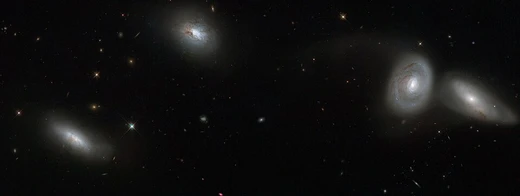
Dragonfly 44
Ultra diffuse galaxy with disputed dark matter content.

Dragonfly 44 is an ultra diffuse galaxy found in the Coma Cluster. It became famous after 2016 measurements of its star velocities suggested a mass close to one trillion solar masses, similar to the Milky Way. That mass estimate was supported by two separate studies that counted around 90 and 70 globular clusters surrounding the galaxy. However, later spatially resolved kinematic data reduced the mass to roughly 160 billion solar masses—six times lower than the earlier figure and an order of magnitude below the Milky Way's mass. The most recent survey found only 20 globular clusters around the galaxy, which matches this lower mass. The absence of X-ray emission from the galaxy and its vicinity further indicates that the earlier cluster counts were too high. Dragonfly 44 emits just 1% of the light that the Milky Way does. It was first identified using the Dragonfly Telephoto Array.
To probe its dark matter content, astronomers in 2016 used the DEIMOS instrument on the Keck II telescope, measuring star velocities over 33.5 hours across six nights. They then employed the Gemini Multi-Object Spectrograph on the 8-meter Gemini North telescope to detect a halo of spherical star clusters around the galaxy’s core. Based on these observations, in August 2016, researchers reported that Dragonfly 44 might consist almost entirely of dark matter.
Quick Facts
- Appmag V
- 21 mags; or 19.4 mags
- Ra
- 13 · 00 · 58.0
- Dec
- +26 · 58 · 35
- Epoch
- J2000
- Appmag B
- 22
- Absmag V
- -16.1 mag
- Group Cluster
- Coma Cluster
- Dist Ly
- ~100 Mpc (~330 Mly)
- H Radial V
- 6280 ± 120 km/s
- Z
- ~0.023
- Mass
- ~1.611
- Constellation Name
- Coma Berenices
Facts from the source article.
Lore & Background
Dragonfly 44 was discovered with the Dragonfly Telephoto Array. In 2016, astronomers used the DEIMOS instrument on Keck II to measure the velocities of stars for 33.5 hours over six nights to determine the galaxy's mass. They then used the Gemini Multi-Object Spectrograph on the 8-m Gemini North telescope to reveal a halo of spherical clusters of stars around the galaxy's core. Following this observation, in August 2016, astronomers reported that this galaxy might be made almost entirely of dark matter.
Early observations of the velocity dispersion suggested a mass of about one trillion solar masses, about the same as the Milky Way. This mass was consistent with counts of about 90 and 70 globular clusters observed around Dragonfly 44 in two different studies. Later, spatially resolved kinematics measured a mass of about 160 billion solar masses, six times less than early mass measurements and one order of magnitude less than the Milky Way's mass. The most recent work found 20 globular clusters around the galaxy, which is consistent with the current mass measurement. The lack of X-ray emission from the galaxy and its surroundings also shows that the number of globular clusters cannot be as many as was claimed before.
Reader's Guide
Dragonfly 44's significance lies in the dramatic revision of its mass and dark matter content over time. Initially, it was considered a candidate for a galaxy made almost entirely of dark matter, based on velocity dispersion measurements and globular cluster counts. However, later spatially resolved kinematics reduced its mass to about 160 billion solar masses, one order of magnitude less than the Milky Way, and the globular cluster count dropped to 20, consistent with the lower mass. The lack of X-ray emission further contradicted the earlier high cluster numbers. This case illustrates the importance of improved observational techniques in refining galaxy mass estimates and challenges early claims about extreme dark matter dominance. It remains an ultra diffuse galaxy in the Coma Cluster, emitting only 1% of the light of the Milky Way.
Did You Know?
- Dragonfly 44 emits only 1% of the light emitted by the Milky Way.
- Early mass estimates suggested it had about one trillion solar masses, similar to the Milky Way.
More in Galaxy Clusters and Groups, Part 3 1-24
Spotted an error? Know more?
Reader corrections go straight into our review queue. Suggest an edit · How this site is sourced