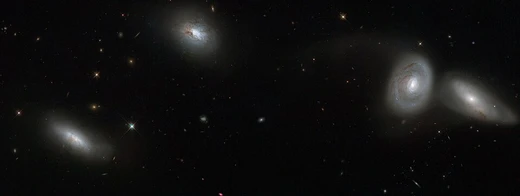
Centaurus A
Closest radio galaxy and BL Lac object to Earth.

Centaurus A, also cataloged as NGC 5128 and Caldwell 77, lies in the constellation Centaurus. Discovered in 1826 by Scottish astronomer James Dunlop from his home in Parramatta, Australia, its fundamental properties remain debated, including its Hubble type (lenticular or giant elliptical) and distance (11–13 million light-years). As the nearest radio galaxy and the closest BL Lac object to Earth, its active galactic nucleus has been heavily scrutinized by professionals. It is also the fifth-brightest galaxy in the sky, making it a popular target for amateur astronomers, though it is only visible from the southern hemisphere and low northern latitudes.
At its core sits a supermassive black hole with a mass of 55 million Suns, which drives a relativistic jet responsible for X-ray and radio emissions. Radio observations taken a decade apart show the inner jet moving at about half the speed of light. Farther out, X-rays are produced as the jet collides with surrounding gas, creating highly energetic particles. The X-ray jets span thousands of light-years, while the radio jets extend over a million light-years.
The galaxy is also one of the nearest large starburst galaxies, with a suspected collision between a large elliptical and a smaller spiral galaxy triggering an intense burst of star formation—a merger that is still ongoing. While spiral-spiral collisions are common, the effects of an elliptical-spiral merger are not fully understood, making Centaurus A a long-standing focus of study.
**Observational history** NGC 5128 was discovered on 29 April 1826 by James Dunlop during a survey at Parramatta Observatory. In 1847, John Herschel described it as "two semi-ovals of elliptically formed nebula appearing to be cut asunder and separated by a broad obscure band." In 1949, John Gatenby Bolton, Bruce Slee, and Gordon Stanley identified it as one of the first extragalactic radio sources. Five years later, Walter Baade and Rudolph Minkowski proposed the merger origin. The first X-ray detection came from a sounding rocket in 1970, and gamma-ray emissions were observed via the atmospheric Cherenkov technique in 1975–76. The Einstein Observatory detected an X-ray jet from the nucleus in 1979. In 1989, the Hubble Space Telescope found young blue stars along the central dust band. The Chandra X-ray Observatory identified over 200 new point sources in 1999.
Quick Facts
- Epoch
- J2000
- Ra
- 13 · 25 · 27.6150
- Dec
- -43 · 01 · 08.806
- Dist Ly
- 11–13 Mly (3–5 Mpc)
- H Radial V
- 547 ± 5 km/s
- Z
- 0.001825 · 0.0000167ned
- Appmag V
- 6.84
- Constellation Name
- Centaurus
- Notes
- Closest radio galaxy; closest BL Lacertae object; unusual dust lane
Facts from the source article.
Lore & Background
Centaurus A was discovered on 29 April 1826 by James Dunlop during a survey at the Parramatta Observatory. In 1847 John Herschel described it as 'two semi-ovals of elliptically formed nebula appearing to be cut asunder and separated by a broad obscure band.' In 1949 John Gatenby Bolton, Bruce Slee and Gordon Stanley localized it as one of the first extragalactic radio sources. Five years later, Walter Baade and Rudolph Minkowski suggested the peculiar structure results from a merger of a giant elliptical galaxy and a small spiral galaxy. The first detection of X-ray emissions was performed in 1970, and gamma-ray emissions were observed in 1975–76. The Einstein Observatory detected an X-ray jet in 1979, and young blue stars were found along the central dust band with the Hubble Space Telescope in 1989. The Chandra X-ray Observatory identified over 200 new point sources in 1999, and the Spitzer Space Telescope found a parallelogram-shaped dust structure in 2006. Very-high-energy gamma emissions were detected by H.E.S.S. in 2009, and Centaurus A was identified as a source of highest-energy cosmic rays in 2010. In 2016, unusual high flares of energy were found in NGC 5128 and NGC 4636, hypothesized as potentially a black hole in a yet unknown process or an intermediate-mass black hole.
Reader's Guide
Centaurus A is significant as the closest radio galaxy and BL Lac object, providing a unique laboratory for studying active galactic nuclei, relativistic jets, and black hole physics. Its jet, observed moving at about half the speed of light in radio observations separated by a decade, produces X-ray emissions thousands of light-years long and radio jets over a million light-years long. The galaxy's peculiar morphology—a lenticular or elliptical galaxy with a superimposed dust lane—is recognized as the result of a merger between a large elliptical and a smaller spiral galaxy, making it a key object for understanding such collisions. It is also one of the nearest large starburst galaxies, with over 100 star formation regions identified in its dusty disk. Two supernovae have been detected: SN 1986G (Type Ia) and SN 2016adj (initially Type II, later resembling Type Ib). A luminous red nova, AT 2020nqq, was discovered in 2020. Classical novae have also been detected, including AT 2024aeql and AT 2025nok. Distance estimates range between 3–5 Mpc, with classical Cepheids yielding ~3–3.5 Mpc and other indicators favoring ~3.8 Mpc. The galaxy is at the center of one of two subgroups within the Centaurus A/M83 Group, located in the Virgo Supercluster. In July 2021, the Event Horizon Telescope released a resolved image of the jet coming from its central black hole.
Did You Know?
- Centaurus A is the fifth-brightest galaxy in the sky.
- Its supermassive black hole has a mass of 55 million solar masses.
- The galaxy's X-ray jets are thousands of light-years long, while its radio jets are over a million light-years long.
- Two supernovae have been detected in Centaurus A: SN 1986G and SN 2016adj.
More in Galaxy Clusters and Groups, Part 3 1-24
Spotted an error? Know more?
Reader corrections go straight into our review queue. Suggest an edit · How this site is sourced