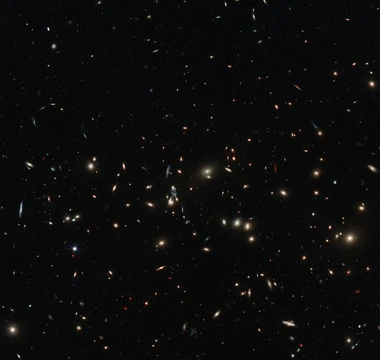
Zwicky's Triplet
Three interacting galaxies bound by streams of intergalactic matter.

Zwicky's Triplet is a group of three interacting galaxies about 425 million light-years away in the constellation Hercules. It was named for astronomer Fritz Zwicky, who—together with Milton L. Humason—identified the system's unusual structure and proved the galaxies are physically linked by streams of intergalactic material.
The triplet has two main parts: a tight, overlapping southern pair and a third galaxy about 2.5 arcminutes to the north. The southern pair's largest and brightest member is PGC 59061 (also known as UGC 10586B), an unbarred lenticular galaxy. Partly overlapping its southwestern side is PGC 59062 (UGC 10586A), a much smaller and fainter companion. The northern component is PGC 59065, another lenticular galaxy.
A long, narrow, luminous tidal bridge of stars and gas runs continuously between the northern galaxy (PGC 59065) and the core southern galaxy (PGC 59061). The overlapping southern pair is also surrounded by a broad, diffuse outer envelope of stars thrown off during their close encounter.
Halton Arp included the system in his 1966 Atlas of Peculiar Galaxies, classifying it under "Elliptical and elliptical-like galaxies connected to spirals." Early observations noted an "incomplete connection," but modern deep imaging and spectroscopy show the tidal plume is fully cohesive. All three galaxies have closely matching redshifts, confirming they form a true physical group rather than a chance alignment.
The galaxy NGC 6241 lies just southeast of Zwicky's Triplet. About half a degree north, the double star 52 Herculis (magnitude +4) can serve as a guide to locate both the triplet and NGC 6241.
Quick Facts
- Epoch
- J2000
- Constellation
- Hercules
- Ra
- 16 · 49 · 28.3
- Dec
- +45 · 27 · 40
- Brightest Member
- PGC 59061
- Member No
- 3
- Redshift
- 0.03140
- Distance
- 425 million ly
- Other Names
- Arp 103, UGC 10586, VV 712, KPG 481
- Names
- APG 103
Facts from the source article.
Lore & Background
The triplet is morphologically divided into a tight, overlapping southern pair and a third member situated roughly 2.5 arcminutes to the north. The largest and brightest component is the southern unbarred lenticular galaxy PGC 59061 (UGC 10586B). Partially superimposed on the southwestern flank of PGC 59061 is PGC 59062 (UGC 10586A), a significantly smaller and fainter companion galaxy. Located to the north of this primary pair is PGC 59065, a lenticular galaxy that forms the final component of the system.
The defining characteristic of Arp 103 is a long, luminous, and narrow tidal bridge of stars and gas that extends continuously between the northern galaxy (PGC 59065) and the core southern galaxy (PGC 59061). The southern overlapping pair is also enshrouded by a broad, diffuse outer envelope of stars ejected during their close passage.
Halton Arp cataloged the system in 1966 within his Atlas of Peculiar Galaxies under the category 'Elliptical and elliptical-like galaxies connected to spirals.' While early historical observations notes described an 'incomplete connection' due to the limitations of photographic plates at the time, modern deep spectroscopic and imaging datasets confirm the tidal plume is fully cohesive. Spectroscopic analysis shows that all three components share closely matching redshift profiles, confirming an active physical group rather than an optical line-of-sight alignment.
Reader's Guide
Zwicky's Triplet is significant as an interacting system where the physical binding of its three galaxies was confirmed by Fritz Zwicky and Milton L. Humason through streams of intergalactic matter. Its inclusion in Halton Arp's Atlas of Peculiar Galaxies as Arp 103 highlights its morphological peculiarity, categorized under 'Elliptical and elliptical-like galaxies connected to spirals.' The system's legacy lies in demonstrating how modern deep spectroscopic and imaging data can resolve earlier observational uncertainties—specifically, the historical note of an 'incomplete connection' was overturned by evidence of a fully cohesive tidal plume. The closely matching redshift profiles of all three components confirm they form an active physical group, not a chance alignment. This triplet serves as a clear example of galaxy interactions and tidal features, and its location near the double star 52 Herculis and galaxy NGC 6241 provides a practical guide for observers.
Did You Know?
- Zwicky's Triplet is located approximately 425 million light-years away in the constellation Hercules.
- The system was named after astronomer Fritz Zwicky, who along with Milton L. Humason first detailed its structural anomalies.
- The triplet's defining feature is a long, luminous, narrow tidal bridge of stars and gas between the northern and southern galaxies.
- Halton Arp cataloged the system in 1966 as Arp 103 in his Atlas of Peculiar Galaxies.
More in Galaxy Clusters and Groups, Part 2 1-24
Spotted an error? Know more?
Reader corrections go straight into our review queue. Suggest an edit · How this site is sourced