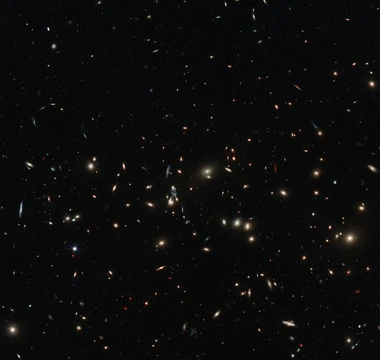
MACS J1149.5+2223
A massive galaxy cluster known for strong gravitational lensing.

MACS J1149.5+2223 is a huge gathering of galaxies, lying about 5 billion light-years away in the constellation Leo. Its gravity is so intense that it warps the fabric of space, creating a powerful magnifying glass effect known as gravitational lensing. This distortion bends and brightens the light of objects behind it, letting astronomers study galaxies and fleeting events that would otherwise be too faint to see.
One of the cluster's most remarkable finds was a star called Lensed Star 1 (LS1), nicknamed Icarus. When spotted in 2018, it was the farthest individual star ever seen, its light boosted by the cluster's lensing despite being more than 9 billion light-years away. The cluster also made possible the observation of Supernova Refsdal. First detected in 2014, this exploding star appeared as multiple images because the cluster's gravity split its light into separate paths. This gave scientists a rare chance to test their models of lensing and the distribution of dark matter. The Hubble Space Telescope captured an image of Refsdal, released on March 25, 2015.
Research on MACS J1149.5+2223 continues to shed light on dark matter, how the universe is expanding, and how galaxies formed in the early cosmos. It is a frequent target for deep-field surveys, including those carried out by the James Webb Space Telescope.
Quick Facts
- Credit
- NASA/ESA
- Epoch
- J2013.816
- Ra
- 11h 49m 35.7s
- Dec
- +22° 23 54
- Redshift
- 0.544
- Distance
- ~5 × 10 / 9 / light-years (1.5 × 10 / 9 / pc)
- Mass
- ~5 × 10 / 14 / M☉ (M200), ~7 × 10 / 14 / M☉ (M500)
- Richness
- High
- Temperature
- ~8–10 keV
Facts from the source article.
Lore & Background
One of the most significant discoveries made using MACS J1149.5+2223 was the detection of Lensed Star 1 (LS1), also known as Icarus. This was the most distant individual star ever observed at the time of its discovery in 2018. The gravitational lensing effect of the cluster magnified the star's light, making it visible despite being located over 9 billion light-years away.
Additionally, the galaxy cluster played a crucial role in the observation of Supernova Refsdal. This supernova, first detected in 2014, was notable because gravitational lensing created multiple images of the explosion, providing a unique opportunity to test models of gravitational lensing and dark matter distribution. The Hubble Space Telescope captured an image of Refsdal, which was publicly released on March 25, 2015.
The study of MACS J1149.5+2223 continues to offer valuable insights into the nature of dark matter, the expansion of the universe, and the formation of galaxies in the early cosmos. It is frequently studied as part of deep-field observations, including those conducted by the James Webb Space Telescope.
Reader's Guide
MACS J1149.5+2223 holds significance as a gravitational lensing laboratory that enabled landmark observations. The detection of Lensed Star 1 (Icarus) in 2018 marked the most distant individual star ever observed at that time, made possible by the cluster's magnification of light from a star over 9 billion light-years away. The cluster also facilitated the study of Supernova Refsdal, first detected in 2014, whose multiple lensed images allowed astronomers to test models of gravitational lensing and dark matter distribution. The Hubble Space Telescope's image of Refsdal, released on March 25, 2015, contributed to this analysis. Ongoing studies of the cluster provide insights into dark matter, the expansion of the universe, and early galaxy formation. It is frequently included in deep-field observations, such as those by the James Webb Space Telescope, underscoring its continued relevance in cosmology.
Did You Know?
- MACS J1149.5+2223 is located approximately 5 billion light-years from Earth in the constellation Leo.
- Supernova Refsdal was first detected in 2014 and produced multiple images due to gravitational lensing.
- The Hubble Space Telescope captured an image of Supernova Refsdal that was publicly released on March 25, 2015.
Frequently Asked Questions
What is MACS J1149.5+2223 and where is it in the sky?
It is a massive galaxy cluster sitting roughly 5 billion light-years from Earth, located in the constellation Leo. Its combined mass makes it one of the most powerful gravitational lenses known to astronomers.
What is 'Icarus' (LS1) and why is it a big deal?
Icarus, formally Lensed Star 1, is a single star whose light was amplified by the cluster's lensing, revealing it at a distance of over 9 billion light-years—the farthest individual star ever detected. It was identified in 2018 and gave researchers a rare look at a star at truly cosmic distances.
What is Supernova Refsdal and how did the cluster play a role?
In 2014 a supernova behind the cluster was first spotted, and lensing models predicted its light would re-emerge in separate magnified images months later. When it reappeared exactly as forecast, it became a striking real-world validation of gravitational-lensing predictions.
How does MACS J1149.5+2223 act as a natural telescope?
The cluster's immense gravity warps spacetime and bends the light of objects far behind it, stretching and brightening their images. This magnification lets astronomers detect and study galaxies and short-lived events that would otherwise be far too faint to observe directly.
When did Hubble release its well-known image of this cluster?
The Hubble Space Telescope published a widely shared photograph of MACS J1149.5+2223 on March 25, 2015. The picture clearly shows the distorted, arc-shaped galaxy images created by the cluster's lensing and became a staple in popular-astronomy features.
More in Galaxy Clusters and Groups, Part 2 1-24
Spotted an error? Know more?
Reader corrections go straight into our review queue. Suggest an edit · How this site is sourced