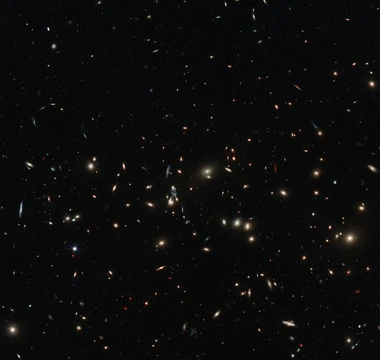
M81 Group
One of the nearest galaxy groups to the Local Group.

The M81 Group is a galaxy group located in the constellations Ursa Major and Camelopardalis. It includes the galaxies Messier 81 and Messier 82, along with several other galaxies of high apparent brightness. Its approximate center is at a distance of 3.6 Mpc, making it one of the nearest groups to the Local Group.
- Distance
- 3.6 Mpc
- Total mass
- (1.03 ± 0.17)×10^12 M☉
- Constellations
- Ursa Major and Camelopardalis
- Notable members
- Messier 81, Messier 82, NGC 3077
- Supercluster
- Virgo Supercluster (Local Supercluster)
Lore & Background
The M81 Group is a galaxy group whose approximate center lies at a distance of 3.6 Mpc, placing it among the nearest groups to the Local Group. It is located within the Virgo Supercluster, also known as the Local Supercluster, which also contains the Local Group and other nearby groups.
Three of its member galaxies—Messier 81, Messier 82, and NGC 3077—are strongly interacting with each other. Observations of the 21-centimeter hydrogen line reveal that gravitational interactions have stripped hydrogen gas from all three galaxies, forming filamentary gas structures within the group. Bridges of neutral hydrogen connect M81 with M82 and NGC 3077.
The interactions have also caused interstellar gas to fall into the centers of Messier 82 and NGC 3077, leading to strong starburst activity (the formation of many stars) within their centers. Computer simulations of tidal interactions have been used to show how the current structure of the group could have been created.
Reader's Guide
The M81 Group is significant as one of the nearest galaxy groups to the Local Group, offering a relatively close laboratory for studying galaxy interactions and their effects. The strong interactions among Messier 81, Messier 82, and NGC 3077 provide a clear example of how gravitational forces can strip gas, create filamentary structures, and trigger starburst activity. The detection of neutral hydrogen bridges connecting these galaxies, observed via the 21-centimeter line, illustrates the dynamic processes at work. Computer simulations of tidal interactions help explain the group's current structure. Its membership, cataloged by I. D. Karachentsev, includes several galaxies with high apparent brightness, making it accessible for detailed study. As part of the Virgo Supercluster, the M81 Group contributes to our understanding of large-scale cosmic structure and the evolution of galaxy groups.
Did You Know?
- The M81 Group is one of the nearest groups to the Local Group, with its center at 3.6 Mpc.
- Gravitational interactions have caused starburst activity in the centers of Messier 82 and NGC 3077.
- The group's total mass is estimated at (1.03 ± 0.17)×10^12 M☉.
Naming Conventions and the Fuzzy Boundaries of Groups
Within the broader taxonomy of galaxy groups, nomenclature follows a loosely structured, ad hoc system rather than a single unified catalog. Major nearby groups and clusters typically take their names from the constellation in which they reside, while many smaller groupings are identified by their brightest or most prominent member galaxy. This dual approach means that a group's identity is often anchored to a single luminous object rather than to a formal coordinate designation or systematic code. Complicating matters further, the very act of drawing a boundary around a group or cluster remains inherently imprecise. Many of these structures are still in the process of gravitational assembly, making their membership a moving target for astronomers. An additional quirk of classification is that structures in the vicinity of the Milky Way tend to receive the label of 'cluster' even when they are substantially smaller than their far more distant counterparts, creating an uneven playing field in how we categorize the cosmic neighborhood.
The Naked-Eye Question and Local Visibility
When considering whether a galaxy group can be perceived without optical aid, the Local Group stands out as the richest source of individually visible galaxies. Yet despite hosting the greatest number of naked-eye galaxies, its members do not appear as a visually coherent assembly in the night sky, with the sole exception of the two Magellanic Clouds, which do present a recognizable pairing. The IC342 and Maffei Group, which holds the distinction of being the nearest galaxy group to our own, would theoretically be resolvable by the unaided eye were it not for the dense stellar fields and interstellar dust clouds embedded within the spiral arms of the Milky Way that obscure it from view. Strikingly, no galaxy cluster of any kind has ever been confirmed as visible to the naked eye, underscoring how even the most massive gravitationally bound collections of galaxies remain beyond direct human visual detection.
Chasing the Most Distant Clusters and Protoclusters
The quest to identify the most remote galaxy clusters has produced a succession of records, each one holding the title only until a more distant structure is announced. In 1992, observations near the quasar field of Cl 0939+4713 revealed what appeared to be a background cluster, with the quasar itself measured at a redshift of 2.055. By 1995 and again in 2001, the cluster surrounding 3C 294 was reported at a redshift of 1.786. The 1999 discovery of RDCS J0849+4452 at z = 1.261 and the 2000 announcement of a cluster in the field of quasar QSO 1213-0017 at z = 1.31 continued to push the frontier. In 2003, RDCS 1252-29 at z = 1.237 claimed the title of most distant rich cluster, a record that endured until 2005. Pushing even further into the realm of proto-structures, a 2002 discovery in the field of MS 1512+36, centered on the gravitationally lensed galaxy MS 1512-cB58, identified an extraordinarily large and rich protocluster at a redshift of 2.724, representing the most distant protosupercluster known at that time.
Misidentifications, False Clusters, and the Need for Rigorous Verification
Not every announced cluster or group proves to be a genuine gravitationally bound structure. In 1975, the object 3C 123 and its associated galaxy cluster were assigned a redshift of 0.637, a measurement later corrected to 0.218, revealing a substantial error in the original determination. Similarly, in 1958, clusters Cl 0024+1654 and Cl 1447+2619 were estimated to sit at redshifts of 0.29 and 0.35 respectively, but these values were never confirmed through spectroscopic measurement, leaving their true distances uncertain. Beyond individual measurement errors, an entire category of false clusters exists, in which what appears to be a coherent group is actually a chance alignment of unrelated galaxies along the same line of sight. Distinguishing true bound systems from these superpositions requires careful investigation of member positions, distances, peculiar velocities, and total binding mass, a process that has led to the retraction of several formerly accepted clusters and superclusters from the astronomical record.
Frequently Asked Questions
What is the M81 Group?
The M81 Group is a small collection of galaxies spread across the constellations Ursa Major and Camelopardalis, anchored by the famous pair Messier 81 and Messier 82. It sits roughly 3.6 megaparsecs from us, making it one of the closest galaxy groups outside our own Local Group.
How far away is the M81 Group?
Its approximate center lies at a distance of about 3.6 megaparsecs (roughly 11.7 million light-years), placing it among the nearest galaxy groups to the Local Group.
Which famous galaxies belong to the M81 Group?
The group's most well-known members are Messier 81 (Bode's Galaxy) and Messier 82 (the Starburst Galaxy), along with the smaller NGC 3077. Several other galaxies of high apparent brightness are also catalogued as part of the group.
How massive is the M81 Group?
The total mass of the group is estimated at roughly (1.03 ± 0.17) × 10¹² solar masses. This makes it a relatively modest grouping compared to larger structures like the Virgo Cluster.
Why is the M81 Group important to astronomers?
Because it is one of the closest galaxy groups to us, it serves as a convenient laboratory for studying galaxy interactions, starburst activity, and the dynamics of small-scale cosmic structures. It also sits within the Virgo Supercluster (Local Supercluster), linking it to the broader cosmic web.
More in Galaxy Clusters and Groups, Part 2 1-24
Spotted an error? Know more?
Reader corrections go straight into our review queue. Suggest an edit · How this site is sourced