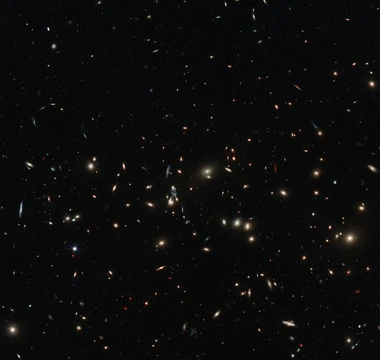
MACS J0025.4-1222
Colliding clusters reveal dark matter through separation of gas and mass.

MACS J0025.4-1222 is a galaxy cluster that formed when two separate clusters collided. It belongs to the MAssive Cluster Survey (MACS). Like the Bullet Cluster discovered earlier, this system exhibits a distinct offset between the center of its intergalactic gas—which makes up most of the ordinary, baryonic matter—and the centers of mass of the colliding clusters. This separation offers independent, direct evidence for dark matter and supports the idea that dark matter particles interact with one another only very weakly.
The visible-light images from the Hubble Space Telescope, combined with X-ray data from the Chandra observatory, allowed astronomers to map the distribution of total mass and ordinary matter separately. The hot intergalactic gas, which glows in X-rays, is shown in pink, while the regions where most of the mass resides—dominated by dark matter—appear in blue. The two clusters that merged to form MACS J0025 each have a mass nearly a quadrillion times that of the Sun. During the collision, the hot gas from each cluster slammed into the other and slowed down, while the dark matter, interacting only through gravity, passed through unimpeded. The resulting separation between the pink gas and the blue mass concentrations provides a direct visual signature of dark matter's existence and its weakly interacting nature.
- Survey
- MAssive Cluster Survey (MACS)
- Mass of each merging cluster
- almost a quadrillion times the mass of the Sun
- Merger speed
- millions of miles per hour
- Observation dates hubble
- November 5, 2006, and June 6, 2007
- Lead researchers
- Marusa Bradac (University of California, Santa Barbara) and Steve Allen (Kavli Institute for Particle Astrophysics and Cosmology at Stanford University and SLAC)
- Instruments used
- Hubble Space Telescope ACS and WFPC2 detectors, Chandra ACIS detector
Lore & Background
MACS J0025.4-1222 was created when two galaxy clusters, each almost a quadrillion times the mass of the Sun, merged at speeds of millions of miles per hour. As they collided, the hot gas in each cluster interacted with the hot gas in the other and slowed down, while the dark matter, which interacts only weakly, did not. This resulted in a separation between the normal matter (shown in pink in the composite image) and the dark matter (shown in blue).
The composite image was made from separate exposures by the Hubble Space Telescope's ACS and WFPC2 detectors and the Chandra ACIS detector. Hubble's visible-light images showed gravitational lensing, which allowed astronomers to infer the distribution of total mass (both dark matter and normal matter), colored blue. Chandra data accurately mapped the distribution of normal matter, mostly hot gas glowing in X-rays, shown in pink. From these observations, it was determined that most of the mass in the two blue regions was dark matter.
The international team of astronomers was led by Marusa Bradac of the University of California, Santa Barbara, and Steve Allen of the Kavli Institute for Particle Astrophysics and Cosmology at Stanford University and the Stanford Linear Accelerator Center (SLAC).
Reader's Guide
MACS J0025.4-1222 is significant because it provides independent, direct evidence for dark matter, similar to the earlier discovered Bullet Cluster. The clear separation between the intergalactic gas (normal matter) and the mass centroids of the colliding clusters supports the view that dark matter particles interact with each other only very weakly, almost entirely through gravity. By using gravitational lensing from Hubble to map total mass and X-ray data from Chandra to map hot gas, astronomers could directly observe that most of the mass in the blue regions was dark matter, which did not slow down during the collision like the normal gas did. This separation is a key observational signature that dark matter exists and behaves differently from ordinary matter, reinforcing the standard cosmological model where dark matter is collisionless. The study led by Bradac and Allen thus strengthens the case for dark matter as a fundamental component of the universe.
Did You Know?
- MACS J0025.4-1222 is part of the MAssive Cluster Survey (MACS).
- The two merging clusters each have a mass of almost a quadrillion times the mass of the Sun.
- The Hubble images used for the study were taken on November 5, 2006, and June 6, 2007.
- The separation between normal matter (pink) and dark matter (blue) provides direct evidence that dark matter particles interact with each other only very weakly.
Frequently Asked Questions
What is MACS J0025.4-1222?
MACS J0025.4-1222 is a merging galaxy cluster system catalogued as part of the MAssive Cluster Survey. It formed when two enormous clusters slammed into one another at speeds of millions of miles per hour.
How does MACS J0025.4-1222 serve as evidence for dark matter?
In this system the hot intergalactic gas is clearly displaced from the gravitational centers of the two colliding clusters, mirroring the signature first seen in the Bullet Cluster. That spatial separation tells us the dominant mass component passes through the gas almost unimpeded, which is exactly what we expect of weakly interacting dark matter particles.
Who led the research on MACS J0025.4-1222?
The study was spearheaded by Marusa Bradac at UC Santa Barbara and Steve Allen at Stanford's Kavli Institute (and SLAC). Their team combined multi-wavelength data to map the cluster's collision geometry.
How massive is each merging component of MACS J0025.4-1222?
Each of the two colliding clusters carries roughly a quadrillion solar masses, making the combined system one of the most massive structures known in the universe.
Which telescopes and instruments were used to observe MACS J0025.4-1222?
Visible-light imaging came from Hubble's ACS and WFPC2 detectors (taken on November 5, 2006 and June 6, 2007), while X-ray observations of the hot gas were obtained with Chandra's ACIS detector.
More in Galaxy Clusters and Groups, Part 2 1-24
Spotted an error? Know more?
Reader corrections go straight into our review queue. Suggest an edit · How this site is sourced