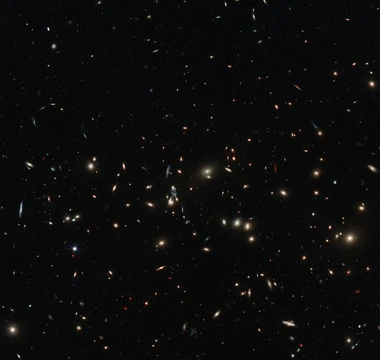
MS 0735.6+7421
A galaxy cluster hosting one of the most powerful AGN eruptions known.

MS 0735.6+7421 is a galaxy cluster in the constellation Camelopardalis, roughly 2.6 billion light-years from Earth. It is known for hosting one of the largest black holes ever found at the center of a galaxy, and for producing one of the most powerful active galactic nucleus outbursts on record.
Data from the Chandra X-ray Observatory suggests an eruption has been occurring at the cluster’s core for the past 100 million years, releasing as much energy over that period as hundreds of millions of gamma-ray bursts. The eruption left two cavities on either side of a large central galaxy. If the outburst—with a total energy exceeding 10⁵⁵ joules—was caused by a black hole consuming matter, it would have had to swallow nearly 600 million solar masses. However, work by Brian McNamara and colleagues (2008) raises the possibility that the outburst was not driven by accretion but by the black hole’s rotation. They also note that the central black hole in MS 0735.6+7421 could be among the largest in the visible universe. This idea is supported by the central cD galaxy having the largest known break radius. Based on a light deficit of more than 20 billion solar luminosities and an assumed light-to-mass ratio of 3, the central black hole mass would exceed 10 billion solar masses, assuming the break radius resulted from past black hole mergers. Given the enormous energy outburst, it is very likely the cluster hosts a supermassive black hole at its core. The cluster has a redshift of 64,800 ± 900 km/s and an apparent size of 25 arcminutes. More recent calculations using the central galaxy’s spheroidal luminosity and break radius estimate black hole masses of 15.8 +26.8−9.9 billion M☉ and 51.3 +96.6−33.5 billion M☉, with a range from 17.8 billion to 147.9 billion M☉.
The brightest cluster galaxy in MS 0735.6+7421 is the elliptical galaxy 4C +74.13, also known as LEDA 2760958, classified as a radio galaxy. It has a diameter of about 400 kpc and shows a steep-spectrum radio source. The core of 4C +74.13 has a spectral index of α₁₄₀₀³²⁵ = –1.54, while its outer radio lobes have α₁₄₀₀³²⁵ < –3.1. Studies indicate the core activity recently restarted in the form of two inner lobes. The galaxy also shows ongoing star formation. Its stellar core is estimated to be 3.8 kiloparsecs across, suggesting 4C +74.13 may contain an ultramassive black hole at its center.
Quick Facts
- Epoch
- J2000
- Ra
- 07 · 41 · 50.2
- Dec
- +74 · 14 · 51
- Redshift
- 64,800 ± 900 km/s
- Distance
- 2.6 billion light-years
- Names
- ZwCl 0735.7+7421
Facts from the source article.
Lore & Background
Using data from the Chandra X-ray Observatory, scientists deduced that an eruption has been occurring for the last 100 million years at the heart of the galaxy cluster, releasing as much energy over this time as hundreds of millions of gamma ray bursts. The remnants of the eruption are seen as two cavities on either side of a large central galaxy. If this outburst, with a total energy budget of more than 10^55 J, was caused by a black hole accretion event, it must have consumed nearly 600 million solar masses.
Work done by Brian McNamara et al. (2008) pointed out the striking possibility that the outburst was not the result of an accretion event, but was instead powered by the rotation of the black hole. Moreover, the scientists mentioned the possibility that the central black hole in MS 0735.6+7421 could be one of the biggest black holes inhabiting the visible universe. This speculation is supported by the fact that the central cD galaxy inside MS 0735.6+7421 possesses the largest break radius known, as of today. With a calculated light deficit of more than 20 billion solar luminosities and an assumed light-to-mass ratio of 3, this yields a central black hole mass much above 10 billion solar masses, as far as the break radius was caused by the merger of several black holes in the past.
Hot X-ray emitting gas pervades MS 0735.6+7421. Two vast cavities—each 600,000 ly in diameter—appear on opposite sides of a large galaxy at the center of the cluster. These cavities are filled with a two-sided, elongated, magnetized bubble of extremely high-energy electrons that emit radio waves.
Reader's Guide
MS 0735.6+7421 is significant as the site of one of the most powerful active galactic nucleus eruptions ever discovered, with a total energy budget exceeding 10^55 J. The eruption, ongoing for 100 million years, has released energy equivalent to hundreds of millions of gamma ray bursts. The cluster's central black hole is among the largest known, with mass estimates ranging from 15.8 to 51.3 billion solar masses (and a possible range up to 147.9 billion solar masses), based on the break radius of the central cD galaxy and its light deficit. The work of Brian McNamara et al. (2008) raised the possibility that the outburst was powered by black hole rotation rather than accretion, highlighting an alternative mechanism for such extreme energy releases. The cluster's legacy includes informing models of black hole growth and feedback in galaxy clusters, as well as the role of ultramassive black holes in shaping their environments. The eruption's cavities, each 600,000 light-years across, provide direct evidence of the black hole's influence on the intracluster medium.
Did You Know?
- The eruption in MS 0735.6+7421 has been occurring for the last 100 million years.
- The two cavities on either side of the central galaxy are each 600,000 light-years in diameter.
Frequently Asked Questions
What is MS 0735.6+7421?
MS 0735.6+7421 is a distant galaxy cluster situated in the constellation Camelopardalis, roughly 2.6 billion light-years away from Earth. It has gained particular attention because its central galaxy harbors one of the most massive black holes ever detected and has produced an extraordinarily energetic active galactic nucleus outburst.
How massive is the supermassive black hole at the center of MS 0735.6+7421?
Estimates place the central black hole's mass somewhere between roughly 18 billion and 148 billion solar masses, making it a contender among the largest black holes catalogued to date. The wide range reflects the difficulty of pinning down the exact figure from the available observational data.
What happened in the core of MS 0735.6+7421?
Chandra X-ray observations indicate that a violent eruption has been unfolding at the cluster's heart for on the order of 100 million years, releasing an energy exceeding 10^55 joules. The blast carved out two enormous cavities flanking the central galaxy and outshone hundreds of millions of gamma-ray bursts over that span.
Where exactly can I find MS 0735.6+7421 in the sky?
The cluster lies in Camelopardalis, the small northern constellation of the giraffe, and spans about 25 arcminutes of apparent sky. Its line-of-sight recession velocity is approximately 64,800 km/s (with an uncertainty of about 900 km/s), corresponding to a distance of roughly 2.6 billion light-years.
Why do astronomers consider MS 0735.6+7421 so important?
It provides a rare, natural laboratory for studying how supermassive black holes can inject staggering amounts of energy into their host cluster over cosmic timescales. The twin cavities and the sheer scale of the outburst make it one of the most extreme AGN events on record, offering key clues about feedback between black holes and galaxy clusters.
More in Galaxy Clusters and Groups, Part 2 1-24
Spotted an error? Know more?
Reader corrections go straight into our review queue. Suggest an edit · How this site is sourced