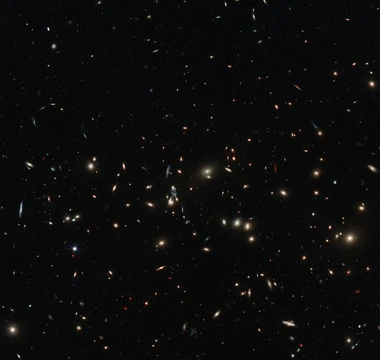
IDCS J1426.5+3508
Most massive young galaxy cluster detected at early age.

IDCS J1426.5+3508 (IDCS 1426) is an extremely massive young galaxy cluster, notable as the most massive galaxy cluster detected at such an early age. Located 10 billion light travel distance years from Earth, it has a mass of almost 500 trillion Suns and is observed when the universe was less than a third of its current age.
- Mass
- almost 500 trillion Suns
- Distance
- 10 billion light travel distance years from Earth
- Dark matter fraction
- about 90%
- Discovery year
- 2012
- Discovery telescope
- Spitzer Space Telescope
- Age of universe at observation
- 3.8 billion years
Lore & Background
IDCS 1426 was first discovered by the Spitzer Space Telescope in 2012, then observed using the Hubble Space Telescope and the Keck Observatory to determine its distance. About 90% of its mass is in the form of dark matter, detected only through its gravitational pull on normal matter. There is a region of bright X-ray emission near the middle of the cluster, but not exactly at the center, suggesting a collision or interaction with another massive system of galaxies within about the last 500 million years, causing the core to become offset.
The core, while still extremely hot, contains cooler gas than its surroundings, making IDCS 1426 the most distant galaxy cluster where such a 'cool core' of gas has been observed. These cool cores are important for understanding how quickly hot gas cools off in clusters, influencing the rate of star birth. This cooling rate can be slowed by outbursts from a supermassive black hole in the center of the cluster. Apart from the cool core, the hot gas in the cluster is remarkably symmetrical and smooth, another piece of evidence that IDCS 1426 formed very rapidly and quickly in the early Universe.
Reader's Guide
IDCS 1426 has important implications for understanding how mega-structures formed and evolved early in the Universe. Its existence at an age when the universe was only 3.8 billion years old—less than a third of its current age—demonstrates that enormous structures can form rapidly. The offset cool core indicates that mergers with smaller clusters likely play a role in a large cluster's growth. The smooth and symmetrical hot gas further supports rapid formation. Despite its high mass and rapid evolution, the cluster's existence does not pose a threat to the standard model of cosmology. The observation of a cool core at such a great distance provides a unique laboratory for studying how hot gas cools and influences star formation, as well as the role of supermassive black holes in regulating that cooling.
Did You Know?
- About 90% of the cluster's mass is in the form of dark matter.
- The cluster's cool core is offset from the center, likely due to a collision with another massive system within the last 500 million years.
- IDCS 1426 is the most distant galaxy cluster where a cool core of gas has been observed.
Frequently Asked Questions
What is IDCS J1426.5+3508?
It is an extraordinarily massive galaxy cluster caught in its youth, holding a total mass of nearly 500 trillion solar masses. It stands out as the heaviest cluster ever identified at such a primitive stage of cosmic history.
How far away is IDCS J1426.5+3508 from Earth?
Its light has traveled roughly 10 billion years to reach us, meaning we observe it as it existed when the universe was only about 3.8 billion years old—less than a third of its present age.
Who discovered IDCS J1426.5+3508 and when?
The cluster was identified in 2012 using observations from NASA's Spitzer Space Telescope. Its detection pushed the boundaries of how massive a structure could be found so early in the universe's timeline.
What is IDCS J1426.5+3508 made of?
Roughly 90 percent of its total mass is dark matter, with the remaining fraction accounted for by stars and hot intracluster gas. This dark-matter dominance is typical of clusters but is especially striking given how young the system is.
Why do astronomers consider IDCS J1426.5+3508 important?
It challenges standard structure-formation models because a cluster of nearly 500 trillion solar masses should not have assembled so quickly after the Big Bang. Its existence suggests that the seeds of massive clusters may have formed earlier or more efficiently than simulations predict.
More in Galaxy Clusters and Groups, Part 2 1-24
Spotted an error? Know more?
Reader corrections go straight into our review queue. Suggest an edit · How this site is sourced