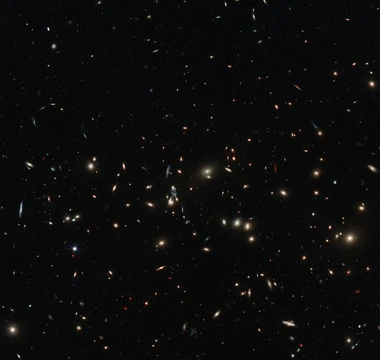
Leo Cluster
A young, spiral-rich cluster with giant black hole.

The Leo Cluster (Abell 1367) lies roughly 330 million light-years away in the constellation Leo and contains at least 70 major galaxies. Its brightest member is NGC 3842. Together with the Coma Cluster, it forms the two main clusters of the Coma Supercluster, which itself is part of the CfA2 Great Wall—a structure hundreds of millions of light-years long and among the largest known in the universe.
Scientists observed the Leo Cluster to catalog extended ionized gas (EIG) clouds, and this work also revealed many star-forming galaxies within the cluster. These star-forming galaxies closely resemble those in the neighboring Coma Cluster, but the EIGs in Leo are longer, suggesting that the Leo Cluster and its stars are probably younger than most comparable clusters and evolve at a different pace.
While most dense galaxy clusters are dominated by elliptical galaxies, the Leo Cluster mostly contains spiral galaxies—another sign it is much younger than clusters like Coma. At the center of NGC 3842 lies one of the universe's largest known black holes, with a mass 9.7 billion times that of the Sun.
Star formation is difficult within the Leo Cluster because infalling galaxies tend to strip gas away from stars attempting to form, creating a "hot zone" where stars cannot hold onto their gas long enough to form properly.
The cluster contains three subpopulations: elliptical galaxies roughly as old as the universe; red-sequence lenticular (lens-shaped) galaxies whose ages depend directly on their mass; and galaxies where star formation is still ongoing, which are morphologically distributed.
Quick Facts
- Epoch
- J2000
- Ra
- 11 · 44 · 36.5
- Dec
- 19 · 45 · 32
- Constellation
- Leo
- Brightest Member
- NGC 3842
- Member No
- ~100
- Richness
- 2
- Bmtype
- II-III
- Redshift
- 0.022 (6 595 km/s)
- Distance
- 113 Mpc for 0.705
- Flux
- (81.40 ± 6.0%)-12 erg s / −1 / cm / −2 / (0.1–2.4 keV)
- Other Names
- Abell 1367
Facts from the source article.
Lore & Background
The Leo Cluster is unusual among dense galaxy clusters because it mostly contains spiral galaxies, whereas most comparable clusters are composed mostly of elliptical galaxies. This suggests the Leo Cluster is much younger than other clusters, such as the Coma Cluster. A team of scientists observed the cluster to create a catalog of extended ionized gas (EIG) clouds, discovering many star-forming galaxies similar to those in Coma, but with longer EIGs, indicating the cluster and its stars are likely younger and evolve at a different pace. The cluster is home to one of the universe's largest known black holes, located at the center of NGC 3842, with a mass of 9.7 billion times that of the Sun. Star formation within the cluster is difficult because infalling galaxies strip gas away from forming stars, creating a 'hot zone' where stars cannot maintain gas long enough to form properly. The cluster contains three subpopulations: elliptical galaxies as old as the universe, red-sequence lenticular galaxies with ages tied to their mass, and galaxies where star formation is still occurring.
Reader's Guide
The Leo Cluster's significance lies in its contrast to typical dense galaxy clusters. Its predominance of spiral galaxies and longer extended ionized gas clouds suggest it is younger and evolving at a different pace than clusters like Coma. The presence of a 9.7-billion-solar-mass black hole in NGC 3842, one of the largest known, adds to its scientific interest. The cluster's role as one of the two major clusters in the Coma Supercluster, which is part of the CfA2 Great Wall, places it within one of the largest known cosmic structures. The discovery of star-forming galaxies similar to those in Coma, along with the difficulty of star formation due to gas stripping, provides insight into galaxy evolution in dense environments. The three identified subpopulations—old ellipticals, mass-dependent lenticulars, and actively star-forming galaxies—further illustrate the cluster's complex evolutionary state.
Did You Know?
- The Leo Cluster is about 330 million light-years away in the constellation Leo.
- It contains at least 70 major galaxies, with NGC 3842 as the brightest member.
- The black hole at the center of NGC 3842 is 9.7 billion times more massive than the Sun.
- Unlike most dense clusters, the Leo Cluster mostly contains spiral galaxies.
Naming Conventions and Classification Challenges
Galaxy clusters and groups occupy a fascinating gray area in astronomical taxonomy. Unlike individual stars or nebulae, the boundaries of a cluster are inherently fuzzy, particularly because many are still in the process of gravitationally assembling themselves. This makes drawing a definitive line around what belongs to a cluster and what does not a genuinely difficult task. The naming conventions add another layer of informality. Major nearby groups and clusters typically take their names from the constellation in which they reside, while smaller groups often borrow the name of their most prominent member galaxy. This approach, while practical, is essentially an ad hoc system rather than a rigorous cataloguing scheme. Furthermore, clusters in the vicinity of the Milky Way tend to be classified as full clusters even when they are considerably smaller than their more distant counterparts, suggesting that proximity to our own galaxy influences how we categorize these structures. The result is a landscape of groupings that resists neat classification.
Naked-Eye Visibility and the Local Group
When it comes to seeing galaxy groups and clusters with the unaided eye, the picture is surprisingly limited. The Local Group, which contains the largest number of galaxies visible without optical aid, is the standout example. Yet even here, the member galaxies do not appear visually clustered together in the night sky, with the sole exception of the two Magellanic Clouds, which do present as a paired grouping. The IC342/Maffei Group, the nearest galaxy group to our own, would theoretically be visible to the naked eye were it not for the obscuring effect of stars and dust clouds within the Milky Way's spiral arms. Beyond these exceptions, the situation becomes stark: no galaxy cluster is visible to the unaided human eye. This means that the grand structures we study through telescopes and space observatories remain entirely invisible to our natural sight, a humbling reminder of how much of the cosmic architecture lies beyond the reach of unassisted observation.
The Race to the Farthest Clusters
The history of identifying the most distant galaxy clusters reads like a decades-long arms race in observational astronomy. In 1958, clusters Cl 0024+1654 and Cl 1447+2619 were estimated at redshifts of roughly 0.29 and 0.35, though these values were never spectroscopically confirmed. By 1975, 3C 123 and its associated cluster were initially placed at z=0.637, a figure later corrected downward to z=0.218. The 1990s brought rapid progress: in 1992, a background cluster was detected near a quasar at z=2.055; in 1995 and 2001, the cluster around 3C 294 was announced at z=1.786; and in 1999, RDCS J0849+4452 was found at z=1.261. The record then shifted to a cluster in the field of quasar QSO 1213-0017 at z=1.31 in 2000, before RDCS 1252-29 claimed the title at z=1.237 in 2003, holding it until 2005. Even more extreme, a protosupercluster was discovered in 2002 at z=2.724, gravitationally lensed by the galaxy cluster MS 1512+36.
False Clusters and the Dark Matter Connection
Not every structure that appears to be a galaxy cluster truly is one. Through careful analysis of member galaxy positions, distances, peculiar velocities, and total binding mass, astronomers have occasionally discovered that what was once catalogued as a cluster is actually nothing more than a chance alignment of unrelated galaxies along the same line of sight. These false clusters, sometimes called superclusters that never truly bound together, serve as a reminder that the universe's apparent order can be deceptive. On the other hand, genuine clusters that do hold together gravitationally provide some of the strongest evidence for the existence of dark matter. The gravitational behavior of these bound systems cannot be explained by the visible mass of their stars and gas alone, pointing to a vast reservoir of unseen matter holding the structure together. This duality—false groupings that dissolve under scrutiny versus real clusters that reveal the hidden architecture of the cosmos—makes the study of galaxy groups a rich field of both discovery and correction.
Frequently Asked Questions
Who is Leo Cluster?
Leo Cluster, cataloged as Abell 1367, is a young, spiral-rich galaxy cluster located roughly 330 million light-years away in the constellation Leo. It contains at least 70 major galaxies and is anchored by the giant elliptical NGC 3842.
What are Leo Cluster's powers/role?
The cluster is distinguished by its extended ionized gas clouds and an unusually active population of star-forming galaxies for a group of its age. Its central black hole in NGC 3842 is estimated at about 9.7 billion solar masses, making it one of the heaviest known in the universe.
Why is Leo Cluster important?
It provides a natural laboratory for studying how a young, spiral-rich cluster evolves and how extended ionized gas interacts with its member galaxies. Its position within the Coma Supercluster also makes it essential for mapping the large-scale cosmic web.
What is Leo Cluster's brightest member?
NGC 3842 is the dominant galaxy in the Leo Cluster, a massive elliptical that sits near the cluster's gravitational center. It hosts a supermassive black hole estimated at roughly 9.7 billion times the mass of our Sun.
More in Galaxy Clusters and Groups, Part 2 1-24
Spotted an error? Know more?
Reader corrections go straight into our review queue. Suggest an edit · How this site is sourced