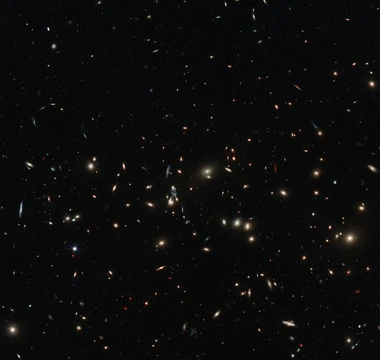
M60 Group
Closest-known isolated compact group of galaxies.

The M60 Group is a compact group of galaxies within the Virgo cluster, dominated by the giant elliptical galaxy Messier 60 (M60). It is the closest-known isolated compact group of galaxies, notable for containing several satellite galaxies, including the ultracompact dwarf galaxy M60-UCD1 discovered in 2013.
Quick Facts
- Epoch
- J2000
- Constellation Name
- Virgo
- Ra
- 12 · 43 · 40.008
- Dec
- +11 · 33 · 09.40
- Z
- 0.003726
- Dist Ly
- 17.38 Mpc
- Appmag V
- 8.8seds
- Group Cluster
- Virgo Cluster
- Names
- M60, NGC 4649, PGC 42831, UGC 7898.
Facts from the source article.
Lore & Background
M60 is the third-brightest giant elliptical galaxy of the Virgo cluster and is the dominant member of a subcluster of four galaxies known as the M60 group. This group is the closest-known isolated compact group of galaxies. It has several satellite galaxies, one of which is the ultracompact dwarf galaxy M60-UCD1, discovered in 2013. The motion of M60 through the intercluster medium results in ram-pressure stripping of gas from the galaxy's outer halo beyond a radius of 12 kpc.
NGC 4647 appears approximately 2.5′ from Messier 60, and their optical disks overlap. Although this overlap suggests interaction, photographic images show no evidence for gravitational interactions, implying the galaxies are at different distances and only weakly interacting if at all. However, Hubble Space Telescope studies indicate a tidal interaction may have just begun.
Reader's Guide
The M60 Group is significant as the closest-known isolated compact group of galaxies, providing a laboratory for studying galaxy interactions and evolution in a dense but relatively isolated environment. Its dominant member, M60, is a giant elliptical galaxy with a supermassive black hole of 4.5±1.0 billion solar masses, one of the largest ever found, which is currently inactive but shows evidence of past jet activity via X-ray cavities. The group's proximity allows detailed study of ram-pressure stripping, as M60's motion through the intercluster medium strips gas from its outer halo. The discovery of the ultracompact dwarf galaxy M60-UCD1 in 2013 adds to the group's importance for understanding dwarf galaxy formation. The ambiguous interaction with NGC 4647, where optical overlap suggests proximity but no clear gravitational disturbance, highlights the complexity of assessing galaxy interactions at different distances. Edwin Hubble included M60 in his landmark 1929 paper on the recession speed–distance relationship, though his distance estimate was far lower than the modern value.
Discovery & Early Cataloguing
In April 1779, German astronomer Johann Gottfried Koehler made an unexpected find while tracking a comet through the constellation Virgo. Looking in the same region of sky, he identified two faint elliptical smudges—what we now call Messier 60 (NGC 4649) and its neighbor Messier 59. Just three days after Koehler's observation, Charles Messier incorporated both objects into his famous catalogue of deep-sky targets, cementing their place in the astronomical record. At roughly 57 million light-years from Earth, M60 sits comfortably within the Virgo constellation's equatorial band. Its pairing with NGC 4647 later earned the designation Arp 116 in the Atlas of Peculiar Galaxies, a testament to how the two objects appear visually intertwined despite questions about whether they are truly gravitationally bound. The fact that M60 was spotted during a comet observation rather than a dedicated survey underscores how much of the early Messier catalogue was built on chance alignments and the keen eyes of observers scanning familiar patches of sky.
Structure, Mass, and the Central Black Hole
M60 is classified as an E1.5 elliptical galaxy, though some researchers prefer the lenticular S0 designation. Its nearly round profile—corresponding to roughly 20 percent flattening—gives it a deceptively simple appearance, yet its isophotes reveal a distinctly boxy geometry rather than the smooth ellipses one might expect. In the visual band, the mass-to-light ratio holds steady at approximately 9.5, a value that hints at a substantial dark-matter component. Within a volume three times the effective radius (about 10 kiloparsecs), the galaxy's total mass reaches roughly one trillion solar masses, with nearly half of that being non-luminous dark matter. X-ray observations independently confirm a mass of (1.0±0.1)×10¹² solar masses within five effective radii. Dominating the core is a supermassive black hole weighing 4.5±1.0 billion solar masses—one of the most massive ever detected. Though currently quiescent, the hole's past activity carved a visible cavity in the X-ray emitting gas, and faint radio lobes mark the jets that once poured energy at a rate of (6–7)×10⁴¹ ergs per second.
The M60 Group and Galactic Neighborhood
Within the sprawling Virgo cluster, M60 ranks as the third-brightest giant elliptical galaxy. More notably, it anchors the M60 group—a compact subcluster of four galaxies that holds the distinction of being the closest known isolated compact group in the universe. Several satellite galaxies orbit the dominant M60, including the ultracompact dwarf M60-UCD1, identified in 2013. The galaxy's passage through the hot intercluster medium is actively stripping gas from its outer halo beyond a radius of 12 kiloparsecs, a process known as ram-pressure stripping. M60's most famous companion, NGC 4647, appears just 2.5 arcminutes away on the sky, with their optical disks visibly overlapping. This alignment initially suggested a gravitational dance, yet photographic studies have failed to reveal the tidal distortions one would expect from a true physical pair. The Hubble Space Telescope, however, has detected subtle signs that a tidal interaction may have only recently begun, leaving astronomers to wonder whether the Arp 116 pair is a genuine bound system or merely a line-of-sight coincidence that will slowly drift apart over cosmic time.
Hubble's Pioneering Distance Measurement
M60 occupies a special place in the history of cosmology. In Edwin Hubble's landmark 1929 paper establishing the relationship between a galaxy's recession velocity and its distance, M60 was the fastest-moving object in his sample. Hubble measured a recession speed of 1,090 kilometers per second—a figure only 1.8 percent below the modern value of roughly 1,110 km/s derived from a redshift of 0.003726. However, he estimated M60's distance at merely two million parsecs, alongside similar underestimates for Messier 85, 49, and 87. Today, the accepted distance is approximately 16 million parsecs. This dramatic underestimation of distance forced Hubble to propose a Hubble constant of 500 km/s/Mpc, a value nearly seven times larger than the current estimate of around 70 km/s/Mpc. In other words, M60's peculiar combination of high velocity and what seemed like a modest distance made it the anchor point for one of the most consequential—and ultimately revised—calculations in the young field of extragalactic astronomy.
Frequently Asked Questions
What is the M60 Group?
It is a tightly bound compact group of four major galaxies sitting inside the larger Virgo cluster, with the giant elliptical Messier 60 (NGC 4649) serving as the gravitational anchor. Because it is the nearest known isolated compact group, it gives astronomers a close-up window into how small, dense galaxy assemblies behave.
How far away is the M60 Group and where do you look for it?
The group lies roughly 57 million light-years from Earth in the direction of the constellation Virgo. Its overall recession velocity is about 1,110 km/s, corresponding to a redshift near 0.003726.
What is M60-UCD1 and why did its discovery matter?
M60-UCD1 is an ultracompact dwarf galaxy found orbiting M60, announced in 2013. Its extremely small size and high stellar density make it a valuable test case for theories about how dwarf galaxies form, evolve, and eventually get stripped down by their larger host.
Why do astronomers care that the M60 Group is the closest isolated compact group?
Proximity means we can resolve individual members and their satellite populations with far better detail than in more distant compact groups. That level of access lets researchers study tidal interactions, star-formation histories, and the fate of dwarf galaxies in a way that is simply impossible at greater distances.
How many galaxies actually make up the M60 Group?
Four major galaxies form the core of the group, all gravitationally linked around the dominant M60. In addition, smaller companions such as the ultracompact dwarf M60-UCD1 orbit within the system, bringing the total member count a bit higher once satellites are included.
More in Galaxy Clusters and Groups, Part 2 1-24
Spotted an error? Know more?
Reader corrections go straight into our review queue. Suggest an edit · How this site is sourced