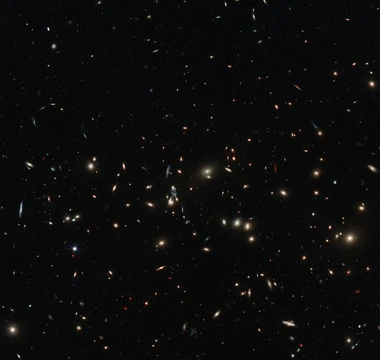
JADES-ID1
Earliest protocluster with hot intracluster medium found.

JADES-ID1 is a galaxy protocluster roughly 12.7 billion light-years from the Milky Way, in the constellation Fornax. Its redshift shows it formed about 1 billion years after the Big Bang. The Chandra X-ray Observatory detected a massive cloud of hot gas within it, and the James Webb Space Telescope identified at least 66 potential galaxies there. Located in the Chandra Deep Field South, it has an unusually high overdensity of z ≈ 5.7, marking it as a nascent protocluster. It emits X-rays and is the earliest known protocluster with a hot intracluster medium—a stage of cluster formation never seen before when the universe was only 3 billion years old. Its gravitational mass is around 20 trillion solar masses, far too large for a single galaxy, so it must contain many galaxies bound together in a single gravitational well. It must have existed long enough to heat the intracluster gas and begin emitting X-rays, indicating substantial gravitational collapse. JADES-ID1 appears to be a mature, bound group, though models predict such systems should be abundant only much later after the Big Bang. Its name comes from the JWST Advanced Deep Extragalactic Survey (JADES).
Quick Facts
- Epoch
- J2000
- Constellation
- Fornax
- Ra
- 03 · 32 · 31.75
- Dec
- -27 · 46 · 51.5
- Member No
- ~66
- Redshift
- ~5.68
- Distance
- 12.7 billion light years (light travel distance)
Facts from the source article.
Lore & Background
JADES-ID1 lies within the Chandra Deep Field South, a deep-sky survey studied by the Chandra X-ray Observatory. The space satellite Chandra X-ray Observatory shows that it contains a massive cloud of hot gas, and the James Webb Space Telescope found it contains a minimum of 66 potential galaxies. Its redshift of z ≈ 5.7 indicates an unusually high overdensity, marking it as a nascent protocluster.
The protocluster emits X-rays and has a gravitational mass of approximately 20 trillion solar masses, much too large to be a single galaxy, implying it contains many galaxies sharing a single gravitational potential. It must have existed long enough to heat the intracluster gas and start emitting X-rays, showing substantial gravitational collapse. JADES-ID1 appears to be a bound group that is mature, though models predict such systems should only be abundant much later after the Big Bang.
Reader's Guide
JADES-ID1 is significant as the earliest protocluster found that has a hot intracluster medium, a stage of cluster formation never seen before while the universe was only 3 billion years old. Its discovery, using the Chandra X-ray Observatory and the James Webb Space Telescope, provides direct evidence of substantial gravitational collapse occurring much earlier than models predict. The protocluster's high overdensity at redshift z ≈ 5.7 and its gravitational mass of 20 trillion solar masses confirm it is a bound, mature group of many galaxies, not a single galaxy. This challenges existing models, which suggest such systems should only be abundant much later after the Big Bang. JADES-ID1 thus offers a unique glimpse into the early formation of galaxy clusters, showing that hot intracluster gas and X-ray emission can arise within the first billion years of cosmic history.
Identity as a Protocluster
JADES-ID1 is classified as a protocluster, also termed a precursor cluster, representing an early evolutionary stage before a gravitationally bound galaxy cluster fully takes shape. In this formative phase, the structure consists of massive concentrations of plasma gas where galaxies are still in the process of forming, having not yet undergone the gravitational collapse that defines a mature cluster. Protoclusters like JADES-ID1 form extended structures containing multiple star-forming galaxies and may represent the dominant population of higher-density features at high redshifts. They sit below the threshold of what is classified as a true galaxy cluster, which contains 100 to 1,000 galaxies with total masses of 10^14 to 10^15 solar masses, but above simple galaxy groups. The identification of such objects relies on detecting an over-density of dark matter, provided baryonic tracers are available for observation.
Multi-Wavelength Discovery
The identification of JADES-ID1 as a structure being assembled in the very early universe required combining observational data from three major facilities: the James Webb Space Telescope, the Chandra X-ray Observatory, and the Atacama Large Millimeter Array. No single instrument could confirm its nature alone. This multi-wavelength approach mirrors how galaxy clusters are studied more broadly, since their three main components—galaxies, heated intracluster gas, and dark matter—emit across different parts of the spectrum. Galaxies are visible in optical light, the intracluster medium produces X-ray emissions at temperatures between 30 and 100 million degrees Celsius, and dark matter, which constitutes the majority of a cluster's mass, cannot be detected optically. The fact that JADES-ID1 could be characterized through this combined dataset underscores the complexity of identifying structures still in their formative, pre-collapse stage.
Significance in Cosmic Evolution
JADES-ID1 occupies a critical position in our understanding of how the large-scale structure of the cosmos assembled. As a protocluster being formed very early in the evolution of the universe, it provides a window into a period when the universe was still building its foundational structures. Protoclusters are theorized to have played an important role in the reionization of the cosmos, the process by which the early universe transitioned from a neutral state to one filled with ionized gas. These precursor structures, including JADES-ID1 and its counterpart SPT2349-56, represent a stage before the full gravitational binding that characterizes mature clusters with their characteristic velocity spreads of 800 to 1000 km/s. Their existence so early in cosmic history refines models of structure formation, showing that the hierarchical assembly of matter into increasingly massive bound systems was already well underway in the universe's youth.
The Evolutionary Path to a Mature Cluster
The evolutionary trajectory from a protocluster like JADES-ID1 to a fully formed galaxy cluster involves massive energy release through shock waves, gas heating, and galaxy interactions. As gas collides with existing material during this assembly process, shock waves are generated that heat the gas to tens of millions of degrees, producing the X-ray emissions characteristic of mature clusters. Galaxy evolution within the forming structure is governed by interactions such as mergers and gas stripping, processes that reshape individual galaxies as they become part of the larger bound system. The end product—a cluster containing hundreds to thousands of galaxies with total masses between 10^14 and 10^15 solar masses and diameters spanning 1 to 5 megaparsecs—represents the largest known gravitationally bound structures in the universe. JADES-ID1, observed in its precursor phase, offers a rare glimpse at the beginning of this lengthy transformation.
Frequently Asked Questions
What is JADES-ID1?
JADES-ID1 is a nascent galaxy protocluster sitting roughly 12.7 billion light-years away in the constellation Fornax. It represents one of the earliest known stages of cluster assembly, having taken shape only about a billion years after the Big Bang at a redshift of approximately 5.7.
How big is JADES-ID1?
The protocluster carries a gravitational mass of around 20 trillion solar masses and contains at least 66 candidate galaxies identified by the James Webb Space Telescope. Its unusually high overdensity at z ≈ 5.7 sets it apart from typical field environments at that epoch.
What makes JADES-ID1 unique among early protoclusters?
It is the earliest protocluster ever found to host a hot intracluster medium, a dense cloud of X-ray-emitting gas detected by the Chandra X-ray Observatory. This means the stage of cluster evolution where galaxies begin pooling hot gas between them had already begun just one billion years after the Big Bang.
Where exactly can I find JADES-ID1 in the sky?
It lies within the Chandra Deep Field South region in the constellation Fornax, at a distance of about 12.7 billion light-years from Earth. Its redshift of roughly 5.7 places it in the very early universe.
How do we know JADES-ID1 is a protocluster and not just a random galaxy group?
The combination of a high overdensity of at least 66 galaxies, a massive hot gas halo visible in X-rays, and a total gravitational mass of 20 trillion solar masses all point to a gravitationally bound assembly rather than a chance alignment. Together these signatures match what astronomers expect from a young cluster still in its formative phase.
More in Galaxy Clusters and Groups, Part 2 1-24
Spotted an error? Know more?
Reader corrections go straight into our review queue. Suggest an edit · How this site is sourced