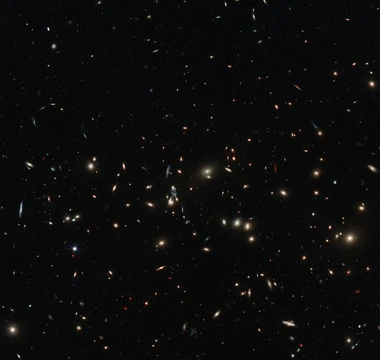
Musket Ball Cluster
A slow, old merger showing dark and baryonic matter separation.

The Musket Ball Cluster, also cataloged as DLSCL J0916.2+2951, is a galaxy cluster formed by a recent merger of two smaller clusters. Its name references the Bullet Cluster, but this collision is both slower and older. Discovered in 2011 by the Deep Lens Survey, the cluster is about 700 million years old—roughly 500 million years older than the Bullet Cluster—and is further along in the merger process.
As of 2012, it is one of only seven known galaxy clusters where dark matter and baryonic matter have separated following a collision. On average, the galaxies and their dark matter components are offset by 19,000 light-years (5,800 parsecs). This separation suggests that dark matter might interact with itself through a "dark force"—a force that affects only dark matter. The cluster itself spans about 8 million light-years (2.5 megaparsecs) across.
Quick Facts
- Epoch
- J2000.0
- Constellation
- Cancer
- Ra
- 09 · 16 · 10.9
- Dec
- +29 · 48 · 44
- Redshift
- 0.53
- Names
- Musket Ball Cluster, DLSCL J0916.2+2951, SHELS J0916.2+2949
Facts from the source article.
Lore & Background
The Musket Ball Cluster is a recent merger of two galaxy clusters, discovered in 2011 by the Deep Lens Survey. It is named after the Bullet Cluster because it is a slower collision and older, being some 500 million years older at 700 million years old. This cluster is further along the process of merger than the Bullet Cluster.
As of 2012, it is one of seven galaxy clusters that exhibit a separation of dark matter and baryonic matter following cluster collision and merger. The separation between the galaxies and their dark matter components is on average 19,000 light-years (5,800 pc). The galaxy cluster itself is some 8 million light-years (2.5 Mpc) across.
This separation may indicate that dark matter may interact with itself, through a dark force (a force that only interacts with dark matter) or a set of dark forces. The cluster is one of the few galaxy clusters to show such a separation.
Reader's Guide
The Musket Ball Cluster is significant as one of the few galaxy clusters, as of 2012, to show a separation between its dark matter and baryonic matter components. This separation, averaging 19,000 light-years, provides evidence that dark matter may interact with itself through a dark force or set of dark forces. Its legacy lies in being a slower, older analog to the Bullet Cluster, offering a later stage in the merger process for study. The cluster was discovered in 2011 by the Deep Lens Survey and is part of a small set of seven known dissociative cluster mergers at that time. Its age of 700 million years, some 500 million years older than the Bullet Cluster, allows astronomers to examine the evolution of such separations over time. The cluster's size of 8 million light-years across and its status as a recent merger contribute to understanding dark matter behavior in cosmic collisions.
Did You Know?
- It is some 500 million years older than the Bullet Cluster, at 700 million years old.
- The separation between galaxies and dark matter averages 19,000 light-years.
- As of 2012, it is one of seven galaxy clusters showing dark matter and baryonic matter separation.
The Elusive Boundaries of Cluster Membership
Drawing a firm line around a galaxy cluster remains one of the more stubborn problems in observational astronomy. A great many clusters are still in the process of gravitational assembly, meaning their member galaxies have not yet settled into a fully bound, coherent structure. This ongoing formation makes it inherently difficult to declare where the cluster ends and the surrounding intergalactic void begins. Compounding the difficulty is a notable classification bias rooted in proximity: clusters located relatively close to the Milky Way frequently receive the formal "cluster" label even when they are substantially smaller than their more distant counterparts. This means the threshold separating a "group" from a "cluster" is not applied uniformly across the observable universe. Researchers cataloging these structures therefore work within a taxonomic landscape where distance from Earth subtly influences how a collection of galaxies is categorized, creating an uneven and somewhat arbitrary framework for what we call a cluster.
An Ad Hoc Naming Tradition
The naming of well-known galaxy groups and clusters follows no single rigorous international standard. Instead, the system that has emerged is largely ad hoc, shaped by historical convenience rather than a unified scientific taxonomy. Major nearby groups and clusters tend to take their names from the constellation in which they appear on the night sky, tying their identity to their celestial neighborhood. Other groups are identified by the name of their most prominent or leading galaxy, anchoring the cluster's label to its brightest member. This approach means that a structure's identity is determined by either its position relative to familiar star patterns or by a single standout galaxy, rather than by a systematic catalog number or a set of coordinates. Clusters that lack a memorable constellation association or a dominant member galaxy may end up known only by catalog entries or coordinate strings, underscoring just how uneven and informal this naming landscape truly is.
Seeing the Clusters with Bare Eyes
No galaxy cluster can be seen with the unaided human eye, a limitation that underscores just how vast and faint these structures are. Nevertheless, individual member galaxies within nearby groups can be visible under dark skies. The Local Group, which contains our own Milky Way, holds the largest number of naked-eye-visible galaxies of any group in the universe. Yet these galaxies do not appear visually clustered together in the night sky, with the notable exception of the two Magellanic Clouds, which do present as a small recognizable pair. The IC342/Maffei Group, the closest known galaxy group to us, would theoretically be visible to the naked eye were it not for the obscuring effect of our own galaxy's spiral arm dust and foreground stars. This means the nearest cluster of galaxies beyond our own is effectively hidden from direct visual observation by the very structure of the Milky Way, a poetic irony for astronomers who study these objects through telescopes.
Chasing the Most Distant Clusters
The record for the most distant rich galaxy cluster has been broken repeatedly as observational technology and survey depth have improved. In 1999, RDCS J0849+4452 was identified at a redshift of 1.261. By 2000, a cluster was announced in the field of quasar QSO 1213-0017 at z=1.31. In 2003, RDCS 1252-29 at z=1.237 was reported as the most distant rich cluster, a record that held until 2005. Even earlier, in 1995 and again in 2001, the cluster around 3C 294 was announced at z=1.786. In 2002, a remarkable and very large protocluster was discovered in the field of MS 1512+36 at z=2.724, making it the most distant protosupercluster found at that time. These successive discoveries, each pushing the frontier farther back in cosmic history, illustrate how the observable boundary of cluster astronomy keeps receding with each new instrument and deeper survey.
Frequently Asked Questions
What is the Musket Ball Cluster?
It is a galaxy cluster, cataloged as DLSCL J0916.2+2951, that formed when two smaller clusters collided and began merging. The Deep Lens Survey team identified it in 2011, and its name is a playful nod to the more famous Bullet Cluster.
How does the Musket Ball Cluster compare to the Bullet Cluster?
While the naming is a reference to the Bullet Cluster, the Musket Ball Cluster's merger is both slower and considerably older. At roughly 700 million years since the collision began, it is about 500 million years further along in the merger process than the Bullet Cluster.
Why is the Musket Ball Cluster important for dark matter research?
As of 2012 it was one of only seven known clusters in which dark matter and baryonic matter had visibly separated after a collision. The two components are offset by roughly 19,000 light-years (5,800 parsecs), offering astronomers a clear natural laboratory for studying how dark matter behaves during cluster mergers.
How large is the Musket Ball Cluster?
The cluster spans approximately 8 million light-years (2.5 megaparsecs) across. Within that structure, the displaced dark-matter and galaxy components sit about 5,800 parsecs apart from one another.
When and how was the Musket Ball Cluster discovered?
The Deep Lens Survey team identified the cluster in 2011, giving it the catalog designation DLSCL J0916.2+2951. Its relative rarity—only seven such separated clusters were known by 2012—made it a significant addition to the list of observable cluster-merger systems.
More in Galaxy Clusters and Groups, Part 2 1-24
Spotted an error? Know more?
Reader corrections go straight into our review queue. Suggest an edit · How this site is sourced