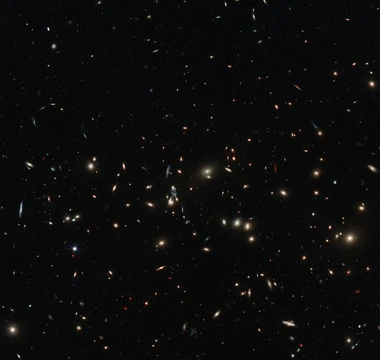
NGC 1550 Group
A luminous fossil galaxy group with a cooling core.

The NGC 1550 Group consists of at least eight galaxies, with the lenticular galaxy NGC 1550 at its center in Taurus. It stands out as one of the brightest galaxy groups in X-rays, known for its high temperature and velocity dispersion, and is categorized as a fossil group.
The central galaxy, NGC 1550, was first spotted by William Herschel in 1785. Heinrich d'Arrest later observed it on 29 December 1861, cataloging it as NGC 1551 before the two were recognized as the same object. In scientific literature, the group is sometimes called after its dominant member or the X-ray source RX J0419+0225. In 2020, Chandra data suggested that active galactic nuclei heat the group’s galaxies.
The hot intragroup gas has a temperature of 1.37 ± 0.01 keV. Chandra observations reveal a cooling core at the center and an entropy profile used to study non-gravitational processes in galaxy groups. The group shows signs of AGN feedback and gas sloshing, seen in combined Chandra and GMRT data; once considered relaxed, it now exhibits structures from minor mergers or infalling material. Suzaku mapped metal abundances out to about 0.5 r₁₈₀, showing steep radial gradients for magnesium, silicon, sulfur, and iron, while oxygen remains nearly flat. Abundance ratios and the supernova type II to type Ia ratio (roughly 2.9 in the inner regions) match those of other groups and poor clusters. XMM-Newton data support a galaxy-merger scenario where metals trace total mass well, but the stellar component is more centrally concentrated.
Quick Facts
- Constellation
- Taurus
- Ra
- 04 · 15 · 27.3
- Dec
- 02 · 41 · 02
- Distance
- 51.4 +/-
Facts from the source article.
Lore & Background
The central galaxy NGC 1550 was discovered by William Herschel in 1785. It was later observed by Heinrich d'Arrest on 29 December 1861 and catalogued as NGC 1551 before they were recognised as the same object. The group itself is sometimes referred to in literature by the name of its dominant member or the associated X-ray source RX J0419+0225.
The intragroup medium has a temperature of 1.37 ± 0.01 keV. Detailed Chandra observations reveal a cooling core in the central regions and an entropy profile that has been used to study nongravitational processes in galaxy groups. The group shows evidence of active galactic nucleus (AGN) feedback and gas sloshing, as revealed by combined Chandra and Giant Metrewave Radio Telescope (GMRT) data; it was previously considered relaxed, but exhibits structures indicating minor mergers or infalling material.
Suzaku observations have mapped the metal abundance distributions out to ~0.5 r180, showing steeper radial gradients for magnesium, silicon, sulfur, and iron, while oxygen is nearly flat. The abundance ratios and supernova type II to type Ia ratio (approximately 2.9 in the inner regions) are consistent with those of other groups and poor clusters. XMM-Newton data support a galaxy-merger scenario in which the metals trace the total mass well, while the stellar component is more centrally concentrated.
Reader's Guide
The NGC 1550 Group holds significance as one of the most luminous galaxy groups in X-ray light, making it a key target for studying the hot intragroup medium and the processes that heat it. Its classification as a fossil group—where a single dominant galaxy has merged with others—provides a laboratory for understanding galaxy evolution in dense environments. The 2020 Chandra observations suggesting that galaxies in the group are heated by active galactic nuclei highlight the role of AGN feedback in preventing cooling flows. The detailed entropy profile and metal abundance gradients measured by Chandra and Suzaku offer insights into nongravitational heating and chemical enrichment, with the supernova type II to type Ia ratio of about 2.9 in the inner regions matching other groups and poor clusters. The discovery of gas sloshing and minor merger signatures from combined Chandra and GMRT data revises the earlier view of the group as relaxed, emphasizing the dynamic nature of even seemingly quiescent systems. XMM-Newton data further support a merger scenario where metals trace total mass, while stars are more centrally concentrated. These characteristics make the NGC 1550 Group a valuable case for testing models of galaxy group formation and feedback.
Did You Know?
- The group is sometimes referred to by the X-ray source name RX J0419+0225.
- Heinrich d'Arrest observed the central galaxy on 29 December 1861 and catalogued it as NGC 1551 before it was recognized as the same object as NGC 1550.
- The intragroup medium temperature is 1.37 ± 0.01 keV.
- The supernova type II to type Ia ratio in the inner regions is approximately 2.9.
Gravitational Architecture and Cosmic Context
The NGC 1550 Group belongs to the vast family of gravitationally bound galaxy groups that populate the observable universe. Rather than drifting in isolation, most galaxies are organised into hierarchical structures—groups, clusters, and superclusters—that form the scaffolding of cosmic large-scale structure. The Milky Way itself sits within the Local Group, a modest assembly it shares dominance of with the Andromeda Galaxy, and that Local Group in turn is embedded in the Virgo Supercluster. At the broadest scales, such associations trace out sheets and filaments separated by immense voids of near-empty space. Individual member galaxies within a group like NGC 1550 are typically separated by distances measured in millions of parsecs, or megaparsecs, making the group a sprawling gravitational community rather than a tight cluster. Galaxy formation itself operates over timescales of roughly a billion years, and while the physics of stellar condensation from dense gas clouds is reasonably well understood, the broader process by which galaxies assemble into groups remains less fully explained. Occasional collisions between members are a natural consequence of their shared gravitational domain.
Stellar Content and the Dominance of Dark Matter
Each galaxy within the NGC 1550 Group is, at its core, a gravitationally bound physical system comprising stars, planetary systems, stellar remnants, substellar objects, interstellar gas, dust, and—most significantly—dark matter. The visible stellar population of a typical galaxy averages around one hundred million stars, though the range is staggering: dwarf galaxies may contain fewer than a thousand, while the largest known supergiants boast as many as one hundred trillion individual stars, all orbiting their host galaxy's center of mass. Critically, the vast majority of a galaxy's total mass is not in the form of luminous matter at all. Dark matter constitutes the dominant component, with only a few percent of the total mass appearing as the stars and nebulae we can actually observe. Supermassive black holes are a common feature residing at the centers of these systems. The group as a whole therefore represents a collection of these massive, mostly invisible gravitational structures, each spanning diameters from roughly 1,000 to 100,000 parsecs—approximately 3,000 to 300,000 light years—held together by forces that extend far beyond what any single telescope can directly image.
Cataloguing a Faint Object: The NGC Designation
The designation NGC 1550 places this group squarely within the New General Catalogue, one of several major reference systems that astronomers rely on to identify and cross-reference the millions of known galaxies. Unlike a handful of famous objects—the Andromeda Galaxy, the Magellanic Clouds, the Whirlpool Galaxy, the Sombrero Galaxy—most galaxies, including members of the NGC 1550 Group, are known primarily by their catalogue numbers rather than by memorable names. A single well-known galaxy might appear simultaneously in the Messier catalogue, the NGC, the Index Catalogue, the CGCG, the Morphological Catalogue of Galaxies, the Uppsala General Catalogue, and the Principal Galaxies catalogue (also called LEDA), each time carrying a different numerical identifier. For instance, Messier 109 is also NGC 3992, UGC 6937, and PGC 37617, among others. Millions of even fainter galaxies are tracked through modern sky surveys such as the Sloan Digital Sky Survey. The NGC 1550 Group's identity as a distinct gravitationally bound collection is thus anchored in this web of overlapping catalogues, each offering a different numerical lens on the same patch of sky.
From Spiral Nebulae to Island Universes: A Naming Legacy
When the galaxies of the NGC 1550 Group were first glimpsed through early telescopes, they were not recognized as the distant stellar systems they truly are. Eighteenth- and nineteenth-century astronomers typically classified such smudges of light as either unresolved star clusters within our own Milky Way or as extragalactic nebulae—vague, poorly understood objects whose true composition remained a mystery. It was only as larger telescopes began resolving a few nearby bright galaxies, such as Andromeda, into vast conglomerations of individual stars that their true nature started to emerge. The apparent faintness and sheer number of resolved stars implied distances far beyond the Milky Way, earning these objects the popular moniker of island universes. The terminology battle was protracted: Harlow Shapley championed the word galaxy and argued against the use of universes or nebula, yet the enormously influential Edwin Hubble continued to refer to them as nebulae. The nomenclature did not fully settle in favor of galaxy until after Hubble's death in 1953, meaning that for much of the twentieth century, the members of groups like NGC 1550 would have been catalogued and discussed under a name that no longer reflects their true identity.
Frequently Asked Questions
What is the NGC 1550 Group and where is it located?
It is a small galaxy group in the constellation Taurus, anchored by the lenticular galaxy NGC 1550. The system contains at least eight member galaxies and is classified as a fossil group because one dominant galaxy accounts for most of the total light and mass.
Why does the NGC 1550 Group stand out in X-ray observations?
The group ranks among the brightest known galaxy groups in X-rays, with its intragroup medium reaching a temperature of about 1.37 keV. It also hosts a cooling core, making it a key target for studying how hot gas radiates energy in dense galactic environments.
Who first observed the central galaxy NGC 1550?
William Herschel first spotted NGC 1550 back in 1785. In 1861, Heinrich d'Arrest independently recorded the same object and gave it the separate catalog number NGC 1551 before astronomers recognized the two entries as one galaxy.
What does the term 'fossil group' mean for NGC 1550 Group?
A fossil group is a compact system in which most of the mass has already merged into a single dominant galaxy, leaving only a few smaller companions. NGC 1550 Group fits this description, with NGC 1550 overwhelmingly dominating the group's luminosity and gravitational pull.
What is the supernova ratio in the inner core of the NGC 1550 Group?
Measurements in the group's inner region show a Type II to Type Ia supernova ratio of roughly 2.9. That means core-collapse explosions from massive stars occur about three times as often as thermonuclear detonations in that zone.
More in Galaxy Clusters and Groups, Part 2 1-24
Spotted an error? Know more?
Reader corrections go straight into our review queue. Suggest an edit · How this site is sourced